
Homemade mayonnaise without tears (Basics)
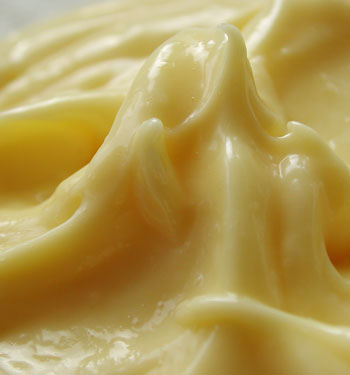
If there is one food that has defeated me over the years, it's mayonnaise. For the longest time I couldn't figure out how to make a good mayonnaise. I read the instructions in numerous cookbooks. I watched the Good Eats episode about it. I tried using a food processor, a stick blender, whipping by hand.
Every time, I'd end up with a mess - eggy globs floating in a sea of oil, sort of like a Chinese eggdrop soup. Eggdrop soup is delicious, but eggdrop oil is not.
Why would I even bother to make mayonnaise? All I can say is that once you've tried homemade mayonnaise made with real fresh eggs, the store bought stuff would just not be enough. Even my favorite commercial mayonnaise in the world, Kewpie Mayonnaise, pales in comparison.
But finally and completely by accident, I discovered how to make mayonnaise that is creamy, eggy, and smooth without fail.
So if you have had mayonnaise problems too, read on....
The ingredients
You will need:
- 2 large, fresh, organic or pasteurized eggs. The egg is not cooked so it must be certifiably fresh and/or pasteurized. This is not just to avoid any problems with salmonella and so on, but because fresh eggs emulsify much better. I use date-stamped eggs, or the fresh ones I can buy from a local farm.
- 1 to 1 1/2 cups of oil. The choice of oil varies based on what you intend the mayo to be used for. Normally I use a flavorless oil such as peanut or safflower, but for making a mayo for dipping vegetables in, or as a basis for aioli (garlic mayonnaise) I use either a mixture of safflower and extra virgin olive oil, or olive oil alone. If you use all olive oil, the predominant taste in your mayo will be olive oil. My usual preference is for the egg flavor to be more forthcoming.
- 1-2 Tbs. lemon juice or white wine vinegar. Again, the amount of acidic liquid you add will influence the flavor of your mayo.
- 1/2 to 1 tsp. salt, to taste.
- Optional: 1/4 Tbs mustard powder, OR 1 Tbs. mustard. Again...the type of mustard and the amount will also change the flavor. I actually prefer no mustard at all, or just a smidgen of mustard powder, but this is a matter of personal taste of course.
- Finally, all the ingredients (and equipment) should be at room temperature.
The equipment
- I prefer to make mayonnaise with an electric whisk. You can use a food processor or a stick blender, but I find that both of those methods make a mayo that is very stiff. Whisks seem to make a lighter mayo. A hand whisk would work too, but electric is easier. The hand-cranked type of beater will not work because it requires two hands. One hand for your beater of choice, one hand for the squeeze bottle, is what you will need.
- 2 small to medium sized bowls.
- A moistened kitchen towel, to place under the bowls to keep them from moving about. This is critical since you will be using both hands as mentioned above.
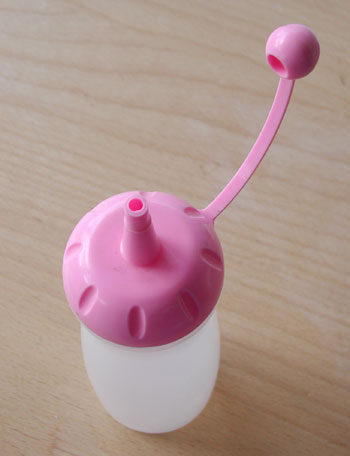
- A plastic squeeze bottle with a small nozzle. Mine is a $1 'dressing bottle' that I bought at the almost-everything-for-$1 store in Japantown in San Francisco.
- Optional equipment: an iPod. You'll be standing around drizzling oil s-l-o-w-l-y for some time so the iPod will keep away the boredom. (You may choose to substitute another MP3 player.) For maximum effect use noise-cancelling headphones to shut out most of the egg beater racket.
The procedure
Put your chosen oil into the plastic squeeze bottle. My pink capped bottle just happens to hold exactly 1.5 cups.
Separate the egg yolks from the whites; discard the whites or keep them for something else. Put the two egg yolks in the two bowls - one yolk per bowl. Why? You will see.
Add about 1/2 tsp of salt and the optional mustard to one of the bowls.
Start beating at low speed. In short order the egg yolk will look rather sticky. Add the oil, drop by drop, to the egg yolk mixture. And I do mean drop by drop. This is really critical to creating the emulsion that is the basis of mayonnaise.
Keep adding the oil, drop by drop.
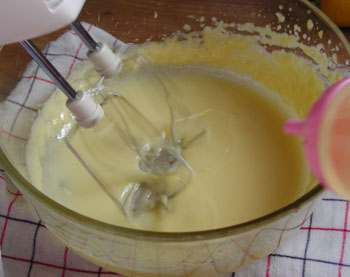
After a while you'll get tired and bored and start thinking, it's safe to add the oil faster now, and you'll squeeze that bottle a bit harder. It's human nature to do so, and besides, the books tell you that you can add the oil faster once the emulsion has started. Now, if you are lucky your mayo will still be smooth and cohesive. But in my case this is rare. Usually it separates into that icky eggdrop oil:
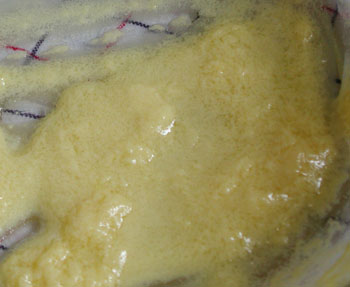
This is where the second yolk comes in. Transfer your whisk or beater to the other bowl, the one with the second yolk. Beat this one like the first one until it looks a bit sticky. Now add the egg-oil mixture from the first bowl to this, one spoonful at a time, making sure to beat each spoonful in. Here you see the eggdrop oil mix going into the new emulsion:
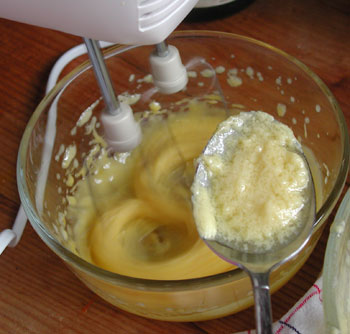
It's quite safe to add that partially emulsified but separating mixture in spoonfuls rather than drop-by-drop to the new egg yolk emulsion. Just be sure that each spoonful is incorporated. Keep adding until all the eggdrop oil is gone. At this point you can resume adding the rest of the oil in the squeeze bottle, in a thin stream - keep beating, and it will not separate.
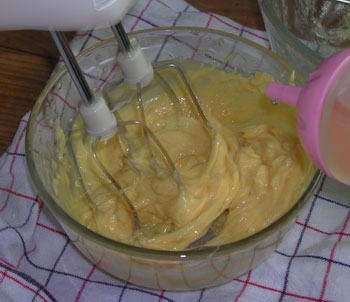
When all the oil is added, add the lemon juice. Start with 1 tablespoonfull, beat in, then taste. Add more if you want it a bit more lemony. The lemon juice will lighten the color of the mayo. Adjust the salt too, if needed.
You will end up with approximately 2 cups of beautiful mayonnaise.
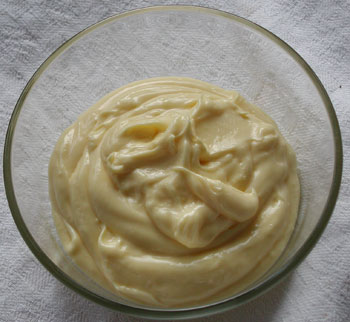
This is pure, preservative-free mayonnaise, so use it up within a couple of days. Store it well covered in the refrigerator.
Variations and uses
- Add 1 to 2 crushed garlic cloves to turn mayonnaise into an aioli-like mayonnaise. (Note: 'real' aioli is quite a bit rougher. I'll try to post a recipe someday).
- To make saffron aioli that is served with a bouillabase in Marseilles, soak a pinch of saffron threads in a tiny bit of warm water. Whisk this into the garlic aioli above.
- For Japanese style mayonnaise a la Kewpie, use a sweet tasting apple cider vinegar (note: I used to think it was rice vinegar but perusing some manufacturer's sites, it seems apple vinegar is more usual) for the vinegar component, a neutral flavored oil such as canola or safflower oil, and add a little sugar (about 1/2 teaspoon) when you add the salt.
- Add about 1/2 cup of finely chopped pickles to turn it into tartar sauce.
- Add a bit more lemon to the mayo than you normally might, and use as a sauce for seafood like shrimp and other shellfish. (At a certain restaurant in Strasbourg, France, they serve a humongous assiette de fruits de mer (seafood platter with a variety of steamed and chilled shellfish) with home made mayonnaise that is almost green because of the use of extra virgin olive oil.)
- To lighten up mayonnaise, mix with plain yogurt or totally emulsified (in the food processor) cottage cheese.
- Add chopped hardboiled eggs, or even just the egg yolks, to make it very eggy. Incease the amount of egg to make it egg salad.
- My stepfather loves to eat grilled himono (dried fish), especially dried octopus or squid, with mayonnaise sprinkled with a little red pepper powder.
- Mayonnaise is used as a sauce for okonomiyaki - Japanese savory pancake, and takoyaki
Submitted by maki on 2006-02-21 03:06.
If you enjoyed this article, please consider becoming my patron via Patreon. ^_^
 Welcome to Just Hungry, where we serve authentic Japanese recipes and more! I'm







Comments
santos.
21 February, 2006 - 08:19
Permalink
Basics: Mayonnaise without tears
thank you for the suggestion to lighten up mayo with yogurt or cottage cheese. next time i have the urge to make my own mayonnaise, i'll definitely try one of these tricks!
also, have you tried ajinomoto's version of kewpie mayonnaise? it's a little eggier, richer. delicious!
anon.
23 September, 2009 - 15:50
Permalink
Re: Basics: Mayonnaise without tears
I have prepaed mayonaise with 35.1% fatty phase content. The standards says 65%. I find this too high fat and the product becomes runny.
Need your imput on my dilema.
Thanks.
prince11
27 December, 2011 - 11:20
Permalink
Re: Basics: Mayonnaise without tears
Thanks for sharing the post.. parents are worlds best person in each lives of individual..they need or must succeed to sustain needs of the family. find jobs
anon.
28 February, 2012 - 03:14
Permalink
Re: Basics: Mayonnaise without tears
Can you tell me if Mayonnaise Sauce can be made with just Egg White? (no yellow yolk at all). Thanks
anon.
25 June, 2012 - 09:19
Permalink
Re: Basics: Mayonnaise without tears
egg whites will turn into a Meringue.
anon.
16 April, 2012 - 15:43
Permalink
Re: Basics: Mayonnaise without tears
When I make my own mayonnaise I prefer to beat it by hand.
B'gina
21 February, 2006 - 10:01
Permalink
Basics: Mayonnaise without tears
I never thought of the squeeze bottle. So far - knock wood - I've never had a mayonnaise fail, but it sure is hard keeping the oil down to a trickle using only a measuring cup. I think you've found the magic trick!
anon.
10 April, 2013 - 20:33
Permalink
Re: Basics: Mayonnaise without tears
If you don't have a squeeze bottle, I use a turkey baster! I just suck up the oil out of the measuring cup and use a food processor. I set the tip of the turkey baster along the edge of the feed tube so that it just drizzles down along the side, then, it goes in drop by drop. I think I'll try the squeeze bottle but a turkey baster works great, too!
yoko
21 February, 2006 - 15:20
Permalink
Basics: Mayonnaise without tears
sigh... Kewpie mayonnaise cannot compare to any mayonnaise on the market. Your mayonnaise looks heavenly. I've always been daunted by the idea of making my own mayonnaise, but maybe I'll try it someday.
foodcrazee
22 February, 2006 - 09:20
Permalink
Basics: Mayonnaise without tears
hhmmm....never had a problem like urs before. I just use plain stainless steel hand whisk and a lipped ladle for drizzling. Ur idea was superb and never had thought of it. Wow! is all i can say.
I whisk the mustard, acid ( lemon juice/ vinegar) and the egg yolk first. Then drizzle the oil and ensure emulsification. Dont stop beating or when it separates, stop the oil and beat till they emulsify. If it is too thick, add a lil acid. Mixed well and season.
I love homemade mayo as we can play with it. add a lil dry sauteed or baked curry powder and it turns into a wonderful dipped for a lot of food.
Yummy!
Great tips
maki
22 February, 2006 - 15:19
Permalink
Basics: Mayonnaise without tears
Santos, last year my mother brought me 2 bottles of mayonnaise from Japan that she said were better then kewpie. Both were delicious! I wish I'd written down the names...but I'm sure one of them was the Ajinomoto one. (Yes my crazy family carries around bottles of mayo in their luggage...not to mention dried fish, senbei that 'you just have to try', etc...)
foodcrazee I guess I am just too impatient when adding the oil or something...it curdles and separates on me every time. But the 2nd yolk after fixes it so I'm happy. (it's the way to fix any separated mayo...I've tried other methods like a spoonful of boiling water etc but only the extra yolk works for me.)
And as Santos and Yoko say...Kewpie is da bomb when it comes to commercial mayo. Unfortunately here in Switzerland it costs 9.50CHF (about $8) a bottle!
anon.
3 November, 2009 - 18:21
Permalink
Re: Basics: Mayonnaise without tears
I am just a little worried that this wonderful "Aji no Moto' brand is LOADED with MSG... nothing beats home made, nothing.
anon.
4 August, 2011 - 10:21
Permalink
Re: Basics: Mayonnaise without tears
Reading through comments, saw this.. who cars that it's uh. Two years later. :P
So you know the purported effects of MSG are largely a myth. AKA: MSG doesn't really have any other effect than a large enhancement of flavor on most people. Yes, there are a few people who have a reaction, but 90% of the time, no one ever will.
As for the whole 'but it gives you cancer!' bit, so does.... Food. Pretty much everything gives you cancer. Living gives you cancer. Realistically, if you're going to get cancer you're going to get cancer, and it's not going to be because you enhanced your Chinese food with a bit of MSG.
So, I suggest, say 'f- it' and enjoy your life. After all, you only get one shot.
anon.
24 August, 2011 - 02:06
Permalink
Re: Basics: Mayonnaise without tears
MSG gives me terrible migraines. It took me years to figure out what it was causing them.Four months ago I quit eating & using ANYTHING w/ MSG, it's derivatives, additives...basically only eat if made from scratch & natural(not natural like on food labels, really natural!)! No more migraines,lost about 8-10 lbs. & feel much better! There's lots of people out there that don't know they're having problems from MSG. It's hidden in everything!!! No wonder this country's obese! Seriously! Look up MSG derivatives. You'll be shocked!I personally know quite a few people personally that can't tolerate it!!! Why is everyone advertising "without MSG" on their labels...makes you wonder...
anon.
22 September, 2011 - 19:55
Permalink
Re: Basics: Mayonnaise without tears
[quote=anon.]
So you know the purported effects of MSG are largely a myth. AKA: MSG doesn't really have any other effect than a large enhancement of flavor on most people. Yes, there are a few people who have a reaction, but 90% of the time, no one ever will. (Quote)
Sorry but your immunity to the effects of MSG is a lucky break for you and the rest of us have no choice but to eliminate it from our diets. Next time you eat it, chart your dreams that night and you might find you can eliminate your nightmares if you eliminate MSG from your diet.
MsgSensitive
11 February, 2012 - 22:49
Permalink
Re: Basics: Mayonnaise without tears
I suffered through horrible panic attacks, migraines, hives and heart palpitations for YEARS, even had to go on anti-depressants before I figured out it was MSG causing all the issues. & let me tell you, it is a lot easier to avoid it now than it was in 2004, when it was still in EVERYTHING. And I am far from the only person I know who has some kind of problem with it - slightly more than your alleged 10% average because my group is not a large sample.
So yeah, as stated above, your immunity is a lucky break for you, but MSG-problems sure ain't no myth.
foodcrazee
23 February, 2006 - 05:06
Permalink
Basics: Mayonnaise without tears
as long as it works, who cares how we do it...chuckle
Its the final product that counts...
sovel
24 February, 2006 - 23:49
Permalink
Basics: Mayonnaise without tears
Even though your idea is great I think I maybe found the problem that lead to you getting some icky stuff instead of mayonnaise before.
I tried out this recipe (from my mother in law) and it worked right away the first time:
Take a _SMALL_ bowl that is just big/deep enough so you can use the electric whisk. Put in an egg yolk, some vinegar, salt/pepper and 2 teaspoons of mustard (real dijon mustard;
start to mix all that with the electric whisk in the small bowl. After about 10 seconds start to slowly pour in the oil (I use sunflower oil) until the texture of the mayonnaise is right.
Hope that helps something, regards.
anon.
9 October, 2011 - 00:45
Permalink
Re: Basics: Mayonnaise without tears
*looks around at mayonnaise covering EVERYTHING*
I do believe you're correct. Small, deep bowl did help get the emulsion started.
It was also light enough that when the newly-thick mixture started to put up some resistance, the whisker started to spin the whole bowl and mayonnaise, assisted by centrifugal force, took it's chances and made a break for freedom.
Some people probably dream of mayonnaise explosions, but trust me, it's not pretty.
maki
26 February, 2006 - 11:27
Permalink
Basics: Mayonnaise without tears
sovel, thanks for your great ideas! The small bowl suggestion is great. I somehow prefer mayo made without the Dijon mustard, which may account for some of my emulsion-failure problems. (on Good Eats Alton Brown did say that the yolk + dijon mustard helps to form the initial emulsion...)
Flower
30 July, 2006 - 16:44
Permalink
Basics: Mayonnaise without tears
Thanks for the great idea! My mayo is thin no matter how slowly I incorporate the oil. I end up putting it in the mic at 2% power for 2-3 min and beating it well to get a thick mayo. It only turned out nice and thick once on its own and I have no clue what I did different. Did I add an extra egg yolk? Did I add dijon to the yolk? I can't wait to try out your method of two eggs in two separate bowls. T
maki
1 August, 2006 - 23:36
Permalink
Basics: Mayonnaise without tears
Flower, it has to do with the emulsion I believe. Once you form that emulsion with the egg yolk and other thing plus the first few drops of oil, then the mayo will turn out nice and thick. I'm not sure what happens when you nuke it though...maybe you thicken the yolk a bit by cooking it slightly and helping along the emulsion? Not sure though...
Mei
17 July, 2007 - 15:31
Permalink
Kewpie
Given that the regular ol' American mayo probably lasts indefinitely... I've been wondering about the shelf... make that 'fridge' life of an opened tube of Kewpie. My 日本語 is kinda rusty but I surmise the note of the package says to consume it within a month of opening? (I've definitely kept Kewpie longer than that... erm...) Wot's your take, Maki?
maki
17 July, 2007 - 20:29
Permalink
kewpie
I don't have a Kewpie bottle on hand at the moment, but once it's opened I try to use it up within a month or so...though I must say it does seem to last longer (as do all commericial mayos...)
Actually, I have been trying to stay away from commercial mayos altogether...the theory being that if I'm going to have something that is mostly fat, I might as well make it myself and have the best I can have!
margi
18 October, 2007 - 03:35
Permalink
Emulsify - Mustard
I heard a chef say the other day on the telly that it is the lecithin in the musard that makes the emulsification happen and without it, or with very little of, it is much more of a drama to get everything to happen as it should. I have no trouble adding the oil quickly after the initial slow inclusion of the oil and the emulsification has taken place.
I make mayo in a food processor using, predictably enough, the emulsifying disc! ...and would not have the patience for mucking around with separate bowls and drip drip drip all through the making of it. Because of that, I never bothered with homemade mayo until I got this appliance and now have it all the time with lots of variations. Love it!
mike
16 January, 2008 - 20:00
Permalink
It’s the lecithin in the
It's the lecithin in the egg that binds the oil and water, not the mustard.
Sophie
7 August, 2010 - 06:21
Permalink
Re: It’s the lecithin in the
Mustard has lecithin, so it's both.
marnen
24 August, 2011 - 07:24
Permalink
Re: It’s the lecithin in the
Mustard is certainly an emulsifier, but from what I've been able to find, I don't think lecithin is the active ingredient as it is with egg yolk.
Carol
27 May, 2012 - 19:49
Permalink
Re: Emulsify - Mustard
The acid in the vinegar/lemon juice breaks down the protein in the yolk forming an emulsifier that allows an oil base to blend with a water base liquid. Mix the yolk and acid long enough for this process to complete before adding oil very slowly.
anon.
11 November, 2007 - 00:05
Permalink
eggs...separated?
Your initial recipe just calls for two eggs. Do you leave them whole or just use the yolks??
maki
11 November, 2007 - 11:39
Permalink
yolk
The yolks are used in the mayonnaise. (The 'separate eggs' part is in the instructions.)
Lori Johansen
23 January, 2016 - 21:10
Permalink
Mayo
Actually, I missed that part (separate eggs) as I have done whole egg mayo in the past. I thought it would, perhaps, lighten up the color, so left them whole. I'm married to a Viking, from Norway, and Mills Ekte (real) Mayo is the BOMB!!! Very mild and creamy, unlike most of the mayo I've been able to find in the USA..I've tried Heinz, Duke's, etc...just not the same. I used my blender for this recipe and used lemon to lighten the color even more...got nice and creamy thick, like the hubster loves it. I bought some of the squeeze bottles (normally only found in red or yellow for catsup and mustard) that had a WHITE bottle included...so use this for my mayo has hubby likes to squeeze his mayo in a thin stream on his open face sammies, like the typical Viking. Hoping he loves this recipe as it was a snap to make! I, too, slowly squeeze the oil in using an old mustard bottle...works great!
Jane
6 January, 2008 - 18:49
Permalink
Storage life
How long can i store this mayo in the fridge?
maki
6 January, 2008 - 19:07
Permalink
about a week
Provided you start with very fresh eggs, you can keep it for about a week or so, well covered, in the refrigerator. I've kept it for that long and it's been fine. Beyond that, I have no experience.
Guy
10 January, 2008 - 16:25
Permalink
What if...
sovel,
The idea with a small bowl... what if we use a large drinking glass or maybe even a vase? It would confine everything to the whisk (the whisk has to fit of course) and perhaps the oil issue would be solved? Just a suggestion.
Browsing around and found this site - so far, I like it!
Lori
11 January, 2008 - 06:53
Permalink
Happy I found this site!
I just got back from Japan where my niece and I struggled four times to make homemade mayonnaise. (She is 26 and a great cook.) Recipe was basically the same, but the mayonnaise came out differently every time -- my niece thought that we needed to hand whip the ingredients in one direction only and that was the source of our failure. Now I know that we poured the oil in too quickly (even though we felt like we were pouring slowly). Your plastic squeeze bottle idea for the oil is nothing short of genius! I'm thrilled to have found this site!
lena Shore
22 January, 2008 - 01:14
Permalink
Use an immersion blender?
I have made mayonnaise in about a minute with an immersion blender. Basically, you put in your egg and pour all your oil over it. Use a clear glass just big enough for the blender to fit. The egg(s) will be at the bottom. Stick the blender in and turn it on. Pull up slowly. You will see the mayo form as you pull slowly up. You can add your ingredients as you wish. Hey! I even just found a youtube video of someone doing it: http://www.youtube.com/watch?v=Gz0fLT_k3_U
I bet your recipe would work just great this way!
Betty Joshi
13 October, 2008 - 16:26
Permalink
Making mayo with an immersion blender
This is the very method I used BUT it didn't work.
My question is: why?
maki
13 October, 2008 - 16:41
Permalink
I think you need an
I think you need an immersion blender with a flat 'whipping' disk attachment for it to work. That being said...I have one of those, and this method doesn't work well for me either. I end up with the eggdrop-soup mess, or a mayo that is so thick that it's almost solid...it won't budge when i turn it upside down. Whereas the method with the whisks works perfectly and turns out a light, smooth mayo. But of course YMMV...
Elena
9 January, 2012 - 13:03
Permalink
Re: I think you need an
I always use the one minute immersion blender method with almost 100% success, using whole eggs, peanut (or sometimes olive) oil, lemon and salt, in this order, in the tall glass that came with the blender. My blender has just a blade (flat, but not a disk), so I don't think that's the problem.
On the other hand, while I've never had the eggdrop-soup mess, I do get a somewhat firm mayo (less than italian commercial ones, but I suspect more than you like) – since I've learned the immersion blender method from my mother that's the texture I've been used to, which probably helps. :)
Drew
5 February, 2008 - 18:07
Permalink
Arrrgh! Where were you last week?
I wish I'd read this last week. I just tried to do mayo for the first time and it broke. (Never heard that term before ... now I know.) I ended up tossing the whole batch and starting over. And it broke again. [Sigh.]
I used a stick blender in a tall, narrow container, but it didn't work as magically as it seems to for other people. I think I'll try pomace instead of extra virgin next time.
lorien
14 February, 2008 - 22:13
Permalink
how much oil in the first step?
You say to add the oil drop by drop in for the first yolk, then add the rest to the mixture after, so is it half in one step and half in the other step?
Sorry to be so needy, but I have made a lot of emulsified but runny mayo and I'd be really excited to find one that isn't.
maki
15 February, 2008 - 18:30
Permalink
You add it drop by drop
You add it drop by drop until you have a good emulsion. The emulsion really is the key here. If it starts to separate, then you add the other yolk, to form the emulsion properly. Once you have a smooth emulsion going, you can add the rest of the oil. So you'd be adding more oil later on, but I can't say how much is in the emulsion stage and how much later on...it depends on when you get your emulsion. (Also, with the total amounts specified in the recipe, you won't get a runny mayo provided you have that emulsion. It will be very creamy like in the picture.)
Navillus99
18 February, 2008 - 04:24
Permalink
This is tastey
I didn't think I could make it but this came out great.
http://navillus99.blogspot.com
Bronwyn
4 April, 2008 - 01:47
Permalink
Mayo hints
a) your eggs want to be warm or room temp, not just out of the fridge. This is really important. The friction from beating them for a few minutes in the food processor warms them up sufficiently.
b) adding a little aqueous liquid, such as the lemon juice or vinegar, or a little water, to the egg yolks before adding the oil helps A LOT.
c) you CAN use the whole egg, it emulsifies a whole lot more easily (you have added a lot of water in the egg white) but it is less rich.
There is a website I found once which documented an experiment in mayo making. It turns out that there is enough lecithin in one egg yolk to emulsify gallons of oil, so long as you have gallons of aqueous liquid for it to go into. But it will be an oil/water(or whatever) emulsion and will not taste like mayonnaise. It is the yummy egg yolk which gives it that scrumptiousness.
Kyle Samejima
7 April, 2008 - 04:10
Permalink
Kewpie Mayo
Japanese husband is addicted to expensive Japanese mayo, so I made my own tonight - using rice vinegar. Wanted it a little thicker, so will try making sure the emulsion is thicker at the beginning before I add more oil. He seemed to think adding a little sugar would also act as a thickener.
Now if I could only make some ichigo daifuku like I used to get at Nishina in the springtime!
cmd
28 May, 2011 - 04:31
Permalink
Re: Kewpie Mayo
A thicker mayonnaise can also be made by using less oil. Generally, the thickness is determined by the amount/number of egg yolk to the amount of oil.
Another trick to use if the emulsion isn't very strong etc. is to add a few drops of liquid lecithin (available in most health food stores and it is very shelf stable). The amount of lecithin in the egg yolk is the determining factor in the 'strength' of the emulsion and the thickness - the thickness is also affected by the amount of oil to the number of yolks.
Jeannette
7 April, 2008 - 22:00
Permalink
After making the mayonnaise,
After making the mayonnaise, stir some whey into the it and let it sit out overnight. The whey ferments the mixture, which means it will keep much longer. I do this with all of my homemade mayo, so that I don't have to worry about consuming it within a limited time frame.
Phoebe.
15 May, 2008 - 19:43
Permalink
Hi Jeannete, I don’t have
Hi Jeannete,
I don't have any clue for whey.
what kind of whey that I can use? is it in the form of dry powder or liquid? and where usually I can buy it?
I'm planning to make this kewpie mayo tomorrow. my bf really like it a lot. wish me luck in the first attempt (^_^)v
Loli
14 September, 2009 - 20:07
Permalink
Re: After making the mayonnaise - Culture your mayo!
Dear Mayo makers,
(Jeannette) your comment that suggests we add homemade whey then leave mayo out of the refrigerator (could that be a huge typo?!) really got my attention.
I then remembered that in our house we own an amazing cook/text book, which recommends treating many foods with kitchen fermentation, for the numerous health benefits fermentation brings (increases mineral availability and vital enzymes for example). I pulled out the book (our kitchen bible, honestly) (will reference book at bottom of my post) and found Jeannette is absolutely correct.
Here's what I learned while I read:
The publication 'New Scientist' published a study in which they did this very thing to mayonnaise. They discovered that adding a positive bacteria called lactobacillus (supplied by your homemade whey) stimulates positive fermentation, and that then yes, leaving mayo at room temp for 7 hours (I know this sounds dangerous) actually treats or cultures (inoculates during incubation time out on the counter) the mayo so that it becomes more stable, will be more nutritious, and will last longer in refrig. I found this a bit shocking, however we trust this cookbook beyond any other we've ever owned.
Those concerned with food safety (I sure was) may be comforted to read this quote: 'The lactic acid produced by the bacteria during incubation prevent the growth of other bacteria at low tempuratures. Fermentation delays the oxidation of unsaturated oils which form the basis of the dressing, because the added bacteria consume all the oxygen.' (I know from experience this same thing occurs when we make homemade saurkraut, one of my personal faves.)
Article then states "Fermentation also produces a pleasant, mildly sour taste many consumers prefer." Yum!
I plan to make some cultured Mayo the next chance I get! Thank you Jeannette and everyone for sharing this fine forum.
The cultured Mayonnaise Recipe, and a citation from New Scientist, will be found on page 137 of the fabulous book:
'Nourishing Traditions' (2nd Edition) by Sally Fallon and Mary Enig Ph.D.
Kawaii-ne
6 May, 2008 - 13:14
Permalink
Emulsions
If i remember correctly, emulsions are actually quite hard to get perfect (im a pharmacy student) You only have about 50% chance of getting it right and i think it all comes down to ur technique. So i guess if ur mayo doesnt turn out right the first time, dont worry about it too much and blame it on logistics? XD
Hillery
13 June, 2008 - 05:47
Permalink
Perfect mayo
I don't want to brag, but mine came out perfect my first time. On the other hand, that was about a half hour ago, and I'm certain I'm not infallible. I'm a little annoyed, though, that I have this delicious two cups of homemade mayonnaise, and maybe a cups worth of recipes for it if I try hard enough in the next couple days. Next time I will cut the recipe in half, but cutting it in quarters or eighths would be even better. Maybe I could find tiny eggs...
maki
13 June, 2008 - 10:03
Permalink
I think that we all have our
I think that we all have our own cooking blindspots or something...for instance I know a lot of people who just can't make bread, or choux pastry, and so on, and I have never had problems with those. Mayonnaise on the other hand is something I just couldn't get right (until this method that is)
You can actually freeze mayo quite successfully if you have more than you can use. Just flatten it out in a ziplock bag, and thaw in the fridge when using.
frustrated
23 June, 2008 - 23:51
Permalink
my mayo was just an oily mess..
what went wrong? I tried it with canola oil and it was a liquidly mess!!!
Valerie
29 September, 2013 - 02:50
Permalink
Re: my mayo was just an oily mess..
Possibly the canola oil is the problem. It is very bad for you. I have never had problems making Mayo. I have a cuisinart food processor which has a push tube on top. If you put your egg yolks, lemon, salt, etc. in the bowl (I suggest adding the yolks while the processor is spinning), then add about 1/4 cup of oil in the push tube (or less), which will start dripping thru the little tiny hole in the bottom while the blade is spinning. Add a bit more oil and after two or three additions, just fill the tube and let 'er rip. I have never had a "fail" with this method, whether using just egg yolks, whole eggs or 1 whole egg and 1 extra yolk. Also, I too read the article about how much oil one egg yolk cab absorb. It was amazing, Possibly our most favorite brands don't have much to do with eggs at all.
Nancy
7 July, 2008 - 21:22
Permalink
compliments to the chef!
i love this site. it is so specific yet simple. as i love japanese food and have been trying to cook it without recipes for years, i appreciate this down-to-earth approach! thanks!
Shannon
13 July, 2008 - 22:43
Permalink
Yum
This recipe worked great for me, thanks!
I used a large bowl, a hand wire whisk and just added both eggs first thing. I started out slow with the oil but soon started adding it in a few tablespoons at a time (I was pouring with a measuring cup. It was a perfect texture but with the last bit of oil I felt it got thicker than I wanted. Not a big deal and the lemon juice after thinned it a bit.
My first time making it homemade and I'll be doing it again for sure.
anon.
30 August, 2008 - 23:48
Permalink
A Starfrit food manual food
A Starfrit food manual food processor with dressing attachments makes perfect mayo. You can see and buy it online at:
http://www.starfrit.com/Products/kitchen/Gadgets/ChoppersChippers/93900....
Nakor
9 September, 2008 - 11:20
Permalink
lethicin in egg & mustard
There is actually lethicin in both the egg yolk and also in mustard , by adding less mustard you will have less emulsifing power which is probably why adding the extra yolk in works for you..
MitarashiDango
11 September, 2008 - 13:20
Permalink
My goodness..
After reading the part about adding the oil drop by drop, I am amazed by your patience in making this.
How long did it take you to make a batch of mayo?
MitarashiDango
11 September, 2008 - 13:38
Permalink
Maki-san..
I posted a comment just now but I don't think it got through..
Anyways, after reading the "drop by drop" part, I was wondering how much time did it took you to make a batch of this mayonnaise??
(゚Д゚)
anon.
19 September, 2008 - 23:02
Permalink
Homemade mayonnaise without tears (Basics)
well tried to make this mayo, i followed to directions to a tee! and it came out as butter! dont ask me how but it did. hahahahha..... i dont know.....i did something wrong.
CHUCK
21 September, 2008 - 15:18
Permalink
We have been making our own
We have been making our own mayonnaise for a couple of years with success. I asked my wife to make it with extra virgin olive oil because it is a healthier fat.
That tasted unbearably strong. We tried half canola and olive oil and still no good. Anyone had luck using only olive oil to make mayo?
maki
23 September, 2008 - 10:21
Permalink
If you do use 100% extra
If you do use 100% extra virgin olive oil for the oil in mayonnaise, it is going to taste very strongly of the oil. In Provence, France, they make a version of mayo (mentioned in the article) with olive oil and garlic called aioli - delicious! If you are after the health benefits of olive oil rather than the taste of it though, look for 'light' or 'extra light' olive oil - it's still olive oil, but is much more neutral in taste.
daisy
23 September, 2008 - 07:58
Permalink
Question..?
Can anybody tell me, why it is important to make mayonnaise in sequences..?why there is difference in the final product if we add everything together and mix up just in one step? can anybody give me the scientific reason behind it..?plzzz..
maki
23 September, 2008 - 10:23
Permalink
You need to do it in
You need to do it in sequence because you must get the emulsion formed first. Otherwise you end up with scrambled eggy bits in oil!
CHUCK
25 September, 2008 - 02:56
Permalink
I will give the light or
I will give the light or extra light a try and see how it works. I am not sure if I can get it in Central America though.I'll let you know if it works, thanks.
Chuck
ella
21 November, 2008 - 12:16
Permalink
what would happen if you
what would happen if you make mayonnaise without raw egg yoke ??
Gaby
22 November, 2008 - 00:54
Permalink
Quite surprised
First time I comment on one of your entries though I've know your blog for a couple of months, but I just had to leave a comment here, even if it isn't really relevant.
I'm actually astonished to hear that mayonnaise is so difficult to make. One of my dearest childhood memories consists of little me looking at my mother preparing home-made mayonnaise in what rarely exceeded 5 minutes everytime we would have beetroot salad (consisting of only boiled beetroot, really) and juicy fish nuggets. Lack of time has gotten the best out of this tradition and we now use purchased mayonnaise for my chilhood dish, but my mother still says that mayonnaise is one of the easiest toppings to make. How come there is such a difference? Is my mother some kind of mayonnaise god? As far as history recalls, she never got one single serving of mayonnaise wrong, and my first cooking satisfaction came from when I was left in charge of making said mayonnaise and succeeded easily.
In what kind of world have I been living until now, where mayonnaise is easy to make?
anon.
23 November, 2008 - 16:43
Permalink
Yes, I agree you need to
Yes, I agree you need to start with the lemon juice in with the egg yolk. Your recipe is the best, no mustard and lemon jce no vinegar, i like just a tad bit of paprika.
tahnks for th info all.
Kiri
21 January, 2009 - 15:16
Permalink
Re: Homemade mayonnaise without tears (Basics)
Brilliant recipe! I just made this, using rice vinegar, and I did use about half a teaspoon of english mustard, and had absolutely no problems with it! In fact the egg yolk and oil didn't split at all, and I was quite careless about how I added it; I was putting in about a tablespoonful at a time, as I don't have a squeeze-bottle and I am impatient, and it didn't separate once. Eventually I just whisked the other egg yolk and added it in. Oh, and I used an electric hand whisk.
Absolutely delicious, too! So, many thanks for this recipe! I absolutely cannot fault it!
anon.
4 February, 2009 - 15:09
Permalink
Trying it out now
Thank you very much for posting this article! I am now going to try this recipe and I know that it would taste fab! And I would not forget those earphones to keep from boredom.
anon.
12 February, 2009 - 16:08
Permalink
how to eliminate the taste of the raw egg??
I made mayo today......but i did not like the dominating taste of the raw egg..can any one help me with getting rid or atleast minimizing the taste of the raw egg........
Thanks
maki
12 February, 2009 - 19:32
Permalink
Re: how to eliminate the taste of the raw egg??
If you don't like the taste of egg, then you seriously might be better off with store bought mayonnaise.
anon.
13 February, 2009 - 05:16
Permalink
Re: how to eliminate the taste of the raw egg??
thanks..
Tanya
2 March, 2009 - 14:01
Permalink
Re: how to eliminate the taste of the raw egg??
Try using whole eggs instead of just the yolk.
Tanya
2 March, 2009 - 13:58
Permalink
My Experience...
Hi! I just discovered this site as I was trying to figure out how to fix my broken mayonnaise...and I did it! I blended a whole egg in my blender and then slowly added the ruined mayonnaise. It came out perfectly. I have been making mayonnaise for years. The first two times I tried it, it failed even though I was extremely careful about pouring the oil SLOWLY; it probably took 15 minutes! After that, it always turned out fine until today. I use the blender side of my Bosch mixer. (How can anyone cook without a Bosch?! :-))It is very powerful and creates a lot of heat after a few minutes of running, so I have wondered if those first 2 times I actually "cooked" my mayo? It got thick initially and then broke apart. I have learned to pour in a thin stream but not too thin. Today I got cocky and did it too fast. I use whole eggs (2), lemon juice (2 Tbsp), apple cider vinegar (2 Tbsp), salt, pepper, and canola (2 cups) for a lighter taste that suits my children.
anon.
26 March, 2009 - 05:17
Permalink
Re: Homemade mayonnaise without tears (Basics)
Lemon/vinegar or any acidic solution stabilizes the emulsification between oil and water, in addition to lecithin from the egg yolk. I guess it makes much more sense to add it at the beginning rather than much later.
Hmm .. I wonder ... if I increase the vinegar content 2x-10x to make the mayo more acidic, will it prolong its refrigerated life? Time to experiment :)
anon.
30 March, 2009 - 21:33
Permalink
Re: Homemade mayonnaise without tears (Basics)
hmmm, all i got was a cup full of yellow oil. no clumps since i was mixing constantly.
i dont think i put the oil in too fast as it took me well over an hour to add it drop by drop.
it never hit the consistency of mayo.
just a thin yellow liquid. im afraid to taste it.
maki
31 March, 2009 - 00:43
Permalink
Re: Homemade mayonnaise without tears (Basics)
That means that the emulsion didn't form for you. Try the rescue method...
Alex
2 April, 2009 - 19:04
Permalink
Re: Homemade mayonnaise without tears (Basics)
thank you, thank you, thank you - this was so easy after many failed other tries at making good mayo ^___^ - my mayo got quite orange cause i only had sherry vinegar, but nevertheless it was tasty and creamy *nom, nom*
anon.
6 April, 2009 - 20:24
Permalink
Re: Homemade mayonnaise without tears (Basics)
i sse what you maen
marty
1 May, 2009 - 02:48
Permalink
Re: Homemade mayonnaise without tears (Basics)
to the best of my knowledge consuming raw fresh eggs or organic eggs is still risky. raw eggs are a very well known source of salmonella. bearing that in mind, i am a still a wannabe homemade mayonnaise consumer. would like very much to know of a recipe for homemade mayo where there is no risk of such contamination. by the way, store bought mayo ie hellmans never contain raw eggs, for the most part they are dehydrated or in some other form then raw to prevent food borne illness. please respond. thanks
maki
3 May, 2009 - 21:43
Permalink
Re: Homemade mayonnaise without tears (Basics)
Egg safety really differs from country to country and region to region. Since this site has an international audience, I urge everyone to find out the situation in their own local region for themselves. Depending on where you are, good choices may include date-stamped eggs, locally produced organic eggs where you trust the source, and pasteurized eggs.
LindaP
13 June, 2009 - 23:45
Permalink
Re: Homemade mayonnaise without tears (Basics)
I am 68 and for years have used raw eggs in everything. In fact I have a raw egg in my protein drink EVERY morning. In all of those years I have never been sick because of raw eggs. (The egg is a perfect protein)
I would prefer eggs from range free chickens only because they are healthier ... they are not always available.
I am stunned at how frightened the public has become over things we did as common practice years ago.
The world has become "sue" at the drop of a hat buyers and the people who sell have to put out all of these "cover your ass" disclaimers to protect themselves.
It is indeed unfortunate.
Nick Lavigne
3 June, 2009 - 21:56
Permalink
Re: Homemade mayonnaise without tears (Basics)
How much oil is added to the first egg mixture before before adding that mix with the other egg? Or I guess I could phrase it differently. How much oil should be left when you "resume adding the rest of the oil in the squeeze bottle, in a thin stream" to the now combined mixtures? Thanks!
Tim
17 June, 2009 - 21:49
Permalink
Re: Homemade mayonnaise without tears (Basics)
Thanks for the recipe. Homemade cooking sounds a bit "realer" than Hellmann's. If only I had the patience...
anon.
20 June, 2009 - 06:37
Permalink
Re: Homemade mayonnaise without tears (Basics)
I read this and got so obsessed that I bought a Bamix just to do it - turns out I use it for most everything, from quiches to omelettes. I find that if I use more aqueous ingredients, the mayonnaise will not be stiff at all.
So my proportions for a more Kewpie-like mayonnaise goes like this - add the ingredients exactly in that order so the aqueous liquids stay just below the oil. Apparently that's supposed to help with the emulsification.
2 organic egg yolks
1 tbsp sugar
1/2 tsp salt
1 tbsp Japanese rice vinegar
1 tbsp lemon juice
1 cup oil - no more - I did try with 1.5 cups previously and that turned out quite stiff
I emulsify it from bottom up with the whisk/blade B and it takes less than 30s. Cleanup is a breeze - I rinse everything off with hot water, then wash with detergent.
I finish off the whole lot making pasta salad. Considering I used to go through 1kg Kewpie a month I think it's much better. I love Kewpie so much I used to squeeze it on pasta when I had it with pesto ... this is even better! I can stare at how beautiful it is all day!
Bob
23 July, 2009 - 18:54
Permalink
Re: Homemade mayonnaise without tears (Basics)
Using a hand blender is by far the easiest method for me. You can even skip separating the egg yolks and simply add 1 whole egg instead. Crack the egg into a tall container - I use a cleaned 2 to 3 cup yogurt container - add the juice of half a lemon - about 2 tablespoons - salt and pepper to taste - I usually add paprika as well. Blend briefly with hand blender, then slowly start to add 1 cup of olive oil while blending. Once it starts to thicken or emulsify you can dump the rest of the oil in. Mix for a minute or 2 more, adding any more spice if you want to and finito!
FoX
30 July, 2009 - 23:27
Permalink
Re: Homemade mayonnaise without tears (Basics)
yumm.... i m addicted to kewpie mayo, might as well try to make some on my own now dat i found this,
btw, mixing some wasabi in makes it a very nice dip as well
anon.
17 August, 2009 - 08:42
Permalink
Re: Homemade mayonnaise without tears (Basics)
hey ..
i have tried to make mayo about 4 times and i guess 5th times a charm. I used an electric hand mixer and used only one egg yolk which i had cooked...
Cooking:
2 egg yolks
2 tbsp water
1 tbsp vinegar
mix together and then place on an unheater pan, put on the stove at the lowest level and KEEP ON mixing it without stopping until the egg mix becomed thick but not custard like, then let sit for 4 mins on the pan.
Then use this as you would use the raw egg yolk.
My mayo with the cooked egg turned out amazingily thick and fluffy!!! and just the way i like it...
Thanks for the tips and if you dont have a squeeze bottle wid a nozzle, i suggest having a teaspoon and do it really slowly...... thank you...
Jacq
22 August, 2009 - 09:39
Permalink
Re: Homemade mayonnaise without tears (Basics)
0_0 All the googling I did, and one of my bookmarks don't pop up.... This is exactly what I was looking for a while back, for an aioli (or several) for my husband's surprise birthday! So simple, and I had all the ingredients. >_<
Oh well, will have to try to make some now just to see if the hubby likes it in his tuna. ^_^ Yay for Just Hungry!
Lori
12 September, 2009 - 18:26
Permalink
It's gross!
I followed this recipe, however, had to use olive oil in place of the oil...big mistake (for me)...all I can say is it was gross! My husband's from Norway, and we have the most wonderful mayonnaise here. I'm trying to duplicate it, or come up with a nice, white, really bland, flavorful mayo What we get here in Norway is almost like a cream..just fabulous. He's not found a mayo he really likes in the U.S. and we live there half the year. Perhaps it was the mustard or too much lemon for our taste? I wouldn't even allow him to try it. I used an electric mixer, and the consistency was no problem...worked like a charm. Just didn't care for the taste. Will try again with oil and see how that turns out. Suggestions??
maki
12 September, 2009 - 19:56
Permalink
Re: It's gross!
It probably is the olive oil...people seem to love or hate mayonnaise made with olive oil. (For what it's worth most Japanese people can't stand mayo with olive oil, though I've gotten quite fond of it.) Try a flavorless, light oil next time. Also try looking up mayonnaise recipes in Norwegian!
Lori Johansen
23 January, 2016 - 21:19
Permalink
Norway Mayo
I'm married to a Nordmann as well and though he will use Heinz or Duke's brands, he loves his Norsk mayo (so do I!). I followed the directions pretty closely, but used the WHOLE egg, mustard powder and 1 T of lemon juice. I just prefer that to vinegar, plus it lightens the color of the mayo. Norwegian mayo is a bit yellow-ish, but this turned out great. I do not like using olive oil, because of the taste...so try using Sunflower or another type.
webs7er
20 September, 2009 - 20:05
Permalink
What would happen...
What would happen if one added the whites in the mixture? Will it still work out? Why/why not? Thanks in advance :)
Sadiqa
30 September, 2009 - 22:48
Permalink
Re: Homemade mayonnaise without tears (Basics)
I got very ambitious last night and attempted to make the mayonnaise but it separated and no matter what I did, it would not emulsify again. I tried it twice and now have a jar full of separated ingredients. I tried it again tonight and it worked!!! I think I needed to add more salt, but I got the hang of it. My question is can the jar of separated oil/egg/lemon/mustard be used in cooking or anything else. I'd hate to throw it away. It's in the fridge.
All comments greatly appreciated
Alz
27 October, 2009 - 07:12
Permalink
Re: Homemade mayonnaise without tears (Basics)
I just made this, I added one clove of garlic. Easy to make, great taste!! Thank you for such an easy to do and easy to read recipe :)
Kate
13 December, 2009 - 05:20
Permalink
Re: Homemade mayonnaise without tears (Basics)
I was nervous to try making my own mayo after reading cook books that made is sound so difficult to get right. But your recipe made it sound so easy and I just gave it a go! My mayo turned out perfect first time - I didn't even get the 'egg drop' phase!
Thanks for this straight forward way to make homemade mayo!
joe
25 January, 2010 - 18:31
Permalink
Re: Homemade mayonnaise without tears (Basics)
looks egg-zactly like what A.B. said in good eatsm but thanks
anon.
11 March, 2010 - 08:17
Permalink
Re: Homemade mayonnaise without tears (Basics)
wonderful it worked ! Thanks
Sharon
23 April, 2010 - 19:54
Permalink
Re: Homemade mayonnaise without tears (Basics)
Thanks! I tried using a 'ketchup' bottle that I got from Walmarts, and it helped alot. I've learned that one yolk holds no more than 3/4 cup of oil, to have all ingredients room temperature, to start yolk first then when the emulsion starts I add the vinegar, and start dropping the oil a little at a time, I now can make homemade mayo by hand without a blender. I like the mayo best when I add splenda and curry powder!
Nicole T.
30 April, 2010 - 01:17
Permalink
Great Recipe!
I gave this a shot because I needed mayo for some homemade Cheesesteak sandwiches and we were all out. My boyfriend absolutely needed mayo for some reason and wouldn't eat his sandwich without it, so instead of going out and buying some, I decided to try making some.
Your recipe worked great on the first try and was really easy. It ended up really thick and creamy. I ended up with about a cup of mayo since I halved the recipe.
I used a hand blender and lemon juice and I added a little paprika too with the salt. Unfortunately, I put a bit too much salt in, but that was my fault, lol.
Since I made it too salty, I probably won't end up using it again within a week, but since all I'm out of is an egg and some oil, I feel a bit better. Plus, I know that it'll be perfect when I make it again. Thanks! :oD
everybodyeatswe...
17 May, 2010 - 15:50
Permalink
Re: Homemade mayonnaise without tears (Basics)
Hi Maki
Your blog is fantastic, there are so many home-made stuff that I wanna try!
I just wanna let u know that, u should try beating the egg mixture over a bain marie, that should help in forming a well-emulsified sauce. That's what I read in my belgian cookbook. (Belgians are experts in mayonaise, they eat it with belgian fries ;p ) And do u know that, if u add 1/4 cup ketchup, 1 1/2 tbsp cognac or brandy, 1 tsp worchester sauce and a dash of tabasco to 2 cups of your home-made mayo, u can make American cocktail sauce (Belgian version) ?
Try it :)
Miss B
anon.
15 June, 2010 - 17:55
Permalink
Re: Homemade mayonnaise without tears (Basics)
my hubby is the master mayo maker in the house... today he is at work, and i want potato salad... so... i stumbled upon your page, and fell head over heels in love!!! we just happened to have a squirt bottle (white, for holding MAYO!!)it worked perfect, and i can't wait to tell hubby! Also, i don't own an electric mixer, so i mixed this whole thing by hand! I love your idea to save a yolk, and use it later to make sure it is all the right thickness! It worked like a charm for me! thanks again! happy mayo making!
anne
15 June, 2010 - 20:10
Permalink
Re: Homemade mayonnaise without tears (Basics)
made it just now and it turned out great!i'm so grateful cos its actually my first time.Thank you so much!
Polly
28 June, 2010 - 15:19
Permalink
Re: Homemade mayonnaise without tears (Basics)
I have been trying to avoid GMO's like the plague and finding a commercial mayo without GMO ingredients (soy, canola oil, ect) is impossible. The organic mayo at the local healthfood store costs a fortune and is, um...gross.
Well, I made this recipe yesterday and I am over the moon! It was SO worth the time and effort. I used extra virgin olive oil, which I thought would make it a little runny...not!
I used some of it to make tartar sauce for last nights cod dinner and it was absulutely sublime. Better than any I have ever eaten.
Thanks for allowing me to enjoy tasty mayo again!
elmar
8 July, 2010 - 09:27
Permalink
Re: Homemade mayonnaise without tears (Basics)
Sorry, where is the problem? I make mayo on demand in about 5-10 minutes and the easy way:
Put a whole egg, yellow and white, (right out of the fridge) in the food processor. Start on 1 and let it run for about a minute to warm it up. Add a tbl spoon of mustard. Continue the mixing on 1. Slowly drizzle in the oil until you see it emulsify then slowly add as much oil as you want to have mayo. Ready!
For taste you now can add what your heart desires: water to make it "lite", sun-dried tomatoes, capers, onion, garlic, vinegar, salt, pepper, what ever.
One obstacle I had in all the years: It seems to be important that the bowl is DRY. So dont clean or wash it before you start. Use a dust dry bowl.
Good luck, guys
Paula
16 July, 2010 - 17:05
Permalink
Re: Homemade mayonnaise without tears (Basics)
Your instructions were great, the pictures helped, and the recipe WORKS. I never made homemade mayo before. Just as you said, it broke horribly in my first bowl, but when I transferred the "gloppy" stuff to the second bowl, it emulsified beautifully! I made an awesome pimento cheese with this by adding grated sharp cheddar cheese, drained pimentos, and some garlic salt. The BEST pimento cheese we ever had. Thank you so much for the instructions!
Antilope
3 August, 2010 - 00:32
Permalink
Re: Homemade mayonnaise without tears (Basics)
Here's what I always make, but I like Best Foods mayonnaise, so that's the flavor I aim for.
Homemade Best Foods/Hellmans Mayonnaise using stick blender
1 whole egg, medium or large size
1 Tablespoon lemon juice (bottled ok)
1 teaspoon distilled white vinegar
1 teaspoon dry mustard
1/4 teaspoon table salt
pinch white pepper
1 cup vegetable (canola) oil, room temperature
Break egg into bottom of 1-quart
canning jar or other tall narrow jar
that allows you to immerse the mixing blades of a stick blender all the way to the bottom. The jar should be only slightly wider than the end of the stick blender.
Add lemon juice, vinegar, mustard,
table salt and white pepper.
Add 1 cup of vegetable oil.
Place mixing blades of stick blender (turned off) all the
way to the bottom of the jar, pressing
down over the egg.
Turn stick blender on high speed, hold in
place at bottom of jar for about
5-seconds until you see mayonnaise form
under stick blender's mixing blades.
Slowly pull stick blender upward until the mixing blades
reaches top of jar, taking about
5 more seconds. The stick blender will turn
the oil into mayonnaise as it is pulled slowly to the
top of the jar.
After chilling in the fridge, this mayonnaise gets
slightly thicker and tastes very much like Best Foods/
Hellman's Mayonnaise.
Makes about 1 cup of mayonnaise.
diane
21 August, 2010 - 04:47
Permalink
Re: Homemade mayonnaise without tears (Basics)
How do I know if the egges form whole foods are "fresh"
Michael
21 August, 2010 - 18:28
Permalink
Re: Homemade mayonnaise without tears (Basics)
I tried this recipe using canola oil and all I got was a runny mess that separated as soon as the mixer stopped. There was no body to it at all, and the taste was that of lemony oil. I noticed that olive oil has a much higher fat content than canola. Does that play a part in holding the mayo together?
maki
21 August, 2010 - 20:19
Permalink
Re: Homemade mayonnaise without tears (Basics)
Canola oil and olive oil have the same amount of fat - they're both oil. The problem you had is that you didn't get the emulsion going. You probably added the oil to the egg yolks too fast. It's a common problem with making mayonnaise.
Kelly @ The Pin...
25 August, 2010 - 17:06
Permalink
Awesome tutorial! Thanks
Awesome tutorial! Thanks for sharing.
Day
26 September, 2010 - 19:26
Permalink
Re: Homemade mayonnaise without tears (Basics)
If you want your mayo not to break, first of all, you start with two yolks, not just one. Also, you can start with one of the yolks hard boiled and finely mashed. Add 1 or 2 tsp of lemon juice (vinegar is a no-no in mayo, it completely changes the taste) and 1 tbsp of mustard - the cheapest yellow mustard, the Dijon also changes the taste.
I make mine for over 25 years with a hand mixer in a bowl - and for another 15 before that with a simple wooden spoon - and it never broke. My sister's does though.
If you want to fix it, don't use boiling water. Use boiling lemon juice. Or a hard-boiled yolk.
Also, one very important thing. If you are during "that time of the month", the mayo will break. 100%. Might think it's "old wives story" but it's true.
Homecook
4 October, 2010 - 15:21
Permalink
Re: Homemade mayonnaise without tears (Basics)
Hi,
I use raw apple cider vinegar and whey to make pickles in the summer and wonder if the addition of either or both would help increase the shelf life of this mayo.
Ukyou
28 January, 2011 - 07:13
Permalink
Re: Homemade mayonnaise without tears (Basics)
According to the book Nourishing Traditions you can add up to 1 tablespoon of whey. When you do so don't put it in the fridge for a couple of hours. Then it will last a couple of months.
Damaris @Kitche...
9 November, 2010 - 21:10
Permalink
Re: Homemade mayonnaise without tears (Basics)
Thank you. Bascially you've changed my life with this post.
s yamanaka
16 November, 2010 - 11:34
Permalink
Re: Homemade mayonnaise without tears (Basics)
Thank you so much for this wonderful recipe!
Can this mayonnaise be frozen? I don't think we could eat 2 cups within a couple of days, unless we were ODing on okonomiyaki...
Vivian
18 December, 2010 - 21:37
Permalink
Re: Homemade mayonnaise without tears (Basics)
I made the mayo with a immersion blender and a whole egg and whole mustard seeds. It was my first try and it came out perfect. I'll never buy mayo again. Thanks
Katie
10 February, 2011 - 22:04
Permalink
Re: Homemade mayonnaise without tears (Basics)
Tried this after we run out of store-bought mayo; it worked beautifully, though I didn't listen to what you said about the olive oil and my mayonnaise had a yellow-ish tint and a distinct olive oil taste (I like mayo on hard-boiled eggs, which is kinda weird I know, but I didn't appreciate the olive oil flavor on them). Still, that aside, it came out better tasting than the typical stuff we buy, so I'm going to try it again with more neutral oil ^^ Thanks for the instructions!
Thalenoi
30 March, 2011 - 23:42
Permalink
Re: Homemade mayonnaise without tears (Basics)
Accidentally came to this website by checking for ingredients in Kewpie mayo red versus yellow bag. I just bought the red bag because supposedly no sugar is added, whilst the yellow bag contains 6%. Heer in Thailand most mayos contain 12 to 20% of sugar!!!!
Usually I make my mayo by hand, since age 15 after observing my mother. She used a soup plate, a fork to whisk, egg yoke, a teaspoon mustard, mixed both and started adding oil slowly from a bottle. When obtaining the desired quantity she would add some drops of lemon juice, salt and pepper.
I have been cloning her technique for 50 years and a thousand times, trying out hundreds of variations.
I got that icky eggdrop 3x in my life and started over with a fresh egg yoke.
Thus I really don't understand why so many people can't make a mayo by hand. It takes 5 minutes.
Many years ago I attended a cooking class, being the only male in a group of 30 women. To my surprise NONE succeeded in making mayo. I showed them how I made perfect mayo all the time in different conditions: egg out of fridge or not, adding oil drop by drop or faster. Seems they still could not manage. Strange.
But yes, I do have industrial mayo in my fridge, usually brand Devos Lemmens I bring from Belgium, but living here in Thailand, the local mayo with sugar is horrible.
OK, I'll taste the red Kewpie on a ham sandwich now.
Thalenoi
Amber
10 April, 2011 - 01:55
Permalink
Re: Homemade mayonnaise without tears (Basics)
Hi,
I have found it SUPER easy to use a whole egg in a stick mixer bowl attachment. I blitz the egg for 5 seconds, add a half tbspn of olive oil, blitz again for 15 seconds, a tbspn of oil, 20 seconds blitz again. Add the oil this way until 3/4 of a cup of oil is used. Add the last 1/4 cup oil a little quicker. Add the salt & acid- vinegar, lemon or lime. Lime is nice for seafood with lime zest added. Garlic can be added with the egg at the begining. Finished- 2 minutes max!!! Bought myself a new Sunbeam SM640 & it's amazing!
Ann J.
10 April, 2011 - 20:32
Permalink
Re: Homemade mayonnaise without tears (Basics)
Thank you for saving my mayo! I would have wasted a lot of expensive farm-fresh eggs, oil, and organic lemons without your advice!
PattyD
30 May, 2011 - 18:48
Permalink
Re: Homemade mayonnaise without tears (Basics)
I've decided to try making mayonnaise, and I usually check a few recipes and ALWAYS read some of the comments... Anyways, I used this recipe-except for the lemon juice. I used 1 tsp lemon juice and 1 tsp vinegar- I couldn't make up my mind which, so I used both. However, I didn't follow the instructions. I separated my eggs, added the vinegar/lemon juice and salt right away, and mixed them up. These eggs were nice and cold, just out of the fridge. I added my oil in nice sized batches... no dribbling at all. Altogether it took me about 4-5 minutes, and it is just BEAUTIFUL!!! I had no issues at all with separation, or breaking or whatever its called! I will definitely be making my own mayo more often.
Mary Yamada
2 June, 2011 - 22:21
Permalink
Re: Homemade mayonnaise without tears (Basics)
Always wanted to do this; my grandmother (born 1888) used to make her own.
Robert
11 June, 2011 - 13:41
Permalink
Re: Homemade mayonnaise without tears (Basics)
Thank you, came out fantastic. And nice tip about the iPod :) I thought my arms are going to fall off, but the end result is so worth it.
kanadra
14 June, 2011 - 01:43
Permalink
Re: Homemade mayonnaise without tears (Basics)
I've been wanting to make my own mayo lately, and after searching around the internet, I thought this recipe seemed to be the safest/most 'fail' proof. At first things were okay, but the egg and oil started separating. So I used your trick with the second egg yoke, and it instantly changed into the right texture. I was so excited, because it was mayonaise.... but then, adding more oil, it separated again. When It started getting really thin and I couldn't stand it anymore, I tried using a third egg yolk, hoping the same thing would happen again... But no luck. So now I've got broken mayonaise sitting in my kitchen that I don't know what to do with. I'd really like to make it work. Any Ideas?
anon.
25 June, 2011 - 09:25
Permalink
Re: Homemade mayonnaise without tears (Basics)
hey this happened to me as well. i wanted to share what happened to me so someone can benefit from this.
basically i was lucky enough to find one of those dressing bottles, which i used to add the oil literally drop by drop . .
i followed the directions to a t and wanted to let you guys know that after you've added the second yolk and then the subsequent oil, once it looks good don't keep going and think you can put more oil..
i thought the 1 - 1.5 cups was your choice, as in it doesn't matter how much you use . . it actually does matter.!!
after the 2nd yolk, i kept adding more oil for awhile, this time in a slow drizzle. . . it was so creamy and perfect it was going smoothly and i was happy. then almost instantly it started separating and this was nearing the end of the 1.5 cups of oil, so there you go .
after the 2nd yolk and between the 1 - 1.5 cup mark of oil, once the mayonnaise looks nice and creamy just stop, because if you keep going it will separate and it this is because there is too much oil . . . it will happen no matter what, no matter how slow you go..
so again, once its good keep it don't keep going :) good luck it does take awhile but its very good . .
you want to use humanely raised eggs, organic when possible, and only the best non - gmo organic vegetable oil. i used a combo of canola and soybean, both organic and non gmo . . .
i used the mustard (not the powder) and both lemon juice and vinegar, tasted GREAT!!!
thank you!
rebecca
20 June, 2011 - 19:41
Permalink
Re: Homemade mayonnaise without tears (Basics)
Use an oil spout to pour the oil. You can go really slow with one-down to a trickle. I keep my oil in an old wine bottle fitted with an oil spout. If you aren't sure what they are, google it.
Linda Horton
3 July, 2011 - 20:26
Permalink
Re: Homemade mayonnaise without tears (Basics)
Has anyone ever used Kefir milk instead of whey to prolong the shelf life of the mayonnaise? It is loaded with lots of good bacteria too.
Bacon-Quest
11 July, 2011 - 21:19
Permalink
Re: Homemade mayonnaise without tears (Basics)
Just wanted to say this post absolutely saved me and my friend from losing an entire batch of bacon-mayonnaise (yes, we used bacon fat instead of any of those prissy oils). Thanks again so much!
Sailaja
9 September, 2011 - 19:35
Permalink
Re: Homemade mayonnaise without tears (Basics)
Thank you so very much for sharing such a fool proof recipe.
tamari shivek
30 September, 2011 - 01:36
Permalink
Re: Homemade mayonnaise without tears (Basics)
loved the post! i also make homemade mayonnaise, but my method is a bit deferent - i would love to try yours!
anon.
15 October, 2011 - 21:58
Permalink
Re: Homemade mayonnaise without tears (Basics)
I have been using the same mayo recipe for about 3 years now and have never had it fail. I use a fairly deep, round stainless steel bowl with an extended lip on one side (this enables the bowl to be wedged between body and kitchen counter thus leaving both hands free - you could always just get a friend to help)and a simple balloon whisk. I prefer this as you get a better feel for the texture of the mixture. I also think a round bottomed bowl is vital to ensure that your whisk doesn't miss anything. For those interested, the recipe is below. It is naturally similar to the other wit one notable exception.
Put as many egg yolks as you wish in bowl (I usually use two). To this, add 1 'big' teaspoon of mustard (my preference is for either wholegrain or Dijon) per egg yolk. The addition of mustard rather than just mustard powder greatly helps in the emulsification process (this may just be due to the acid but I think there is another effect). I always add some garlic (crushed into a paste). Usually about a chunk the size of the little finger nail for two egg yolks (vary this as you wish). The secret ingredient is anchovies (the kind preserved in oil). This doesn't make the mayo taste fishy if used in the appropriate quantity and adds a wonderful depth of flavor. I go for three fillets for two eggs and mash them into as fine a paste as possible. When all of the above are in the bowl, give them a whisk to distribute everything evenly.
I usually go with canola oil and use olive oil as more of a seasoning. I can't give the exact amount here but I imagine it is round about a cup and a half. If you taste the mayo before there is enough oil in it, it will have a distinctive raw egg aftertaste. You have enough oil when this is barely detectable. I add the oil by means of a jug, pouring slowly at first (by no means drop by drop however), whisking all the time. As the mixture thickens, you can start adding the oil more vigorously. You can generally see if you have added oil to quickly. If this happens (depending on how far along the mixture is), stop adding oil and give it a good whisk to get everything incorporated. As with everything, practice makes perfect (when determining how fast to pour). Usually it takes me no more than three minutes whisking to incorporate all the oil.
When you have enough oil, you can move onto seasoning. The first step here is to add olive oil. Start with a little bit and keep trying it until you are happy with the flavor. The next step is to add some form of dairy product. The best choices here are plain yogurt or sour cream (usually about two tablespoons). Milk or fresh cream will also do. There is also an opportunity here to adjust the texture. If the mixture is too thick, add milk until it is correct. If the mixture is erring on the thin side, go easy on the dairy. Next add citrus juice (lemon/lime for preference (Yuzu could be nice but the stuff is impossible to get hold of here in SA)) to taste. Bare in mind that this will also thin the mixture. Lastly add salt and pepper. It should need little if any salt however due to the anchovies. A few drops of truffle oil also work very well. As always with the seasoning, taste the mixture regularly and always try to under rather than overshoot.
Hopefully some of you will find use for this. It really is a winner.
Thanks so much for the great site and especially the plain Japanese rice recipe. Foolproof and robust.
P.s. apparently your spam filter thinks this is spam.
mokus
23 October, 2011 - 00:47
Permalink
Re: Homemade mayonnaise without tears (Basics)
For those of you, who are afraid of using raw egg yolks or concerned about the fridge-life of it, i'd suggest to make mayo of boiled egg yolks. Make hard-boiled eggs, and use their yolks, crumbled, just the same way you would use raw. It takes a bit less oil, so it might be lighter, and keeps longer than the raw yolk-style. taste is just about the same. And i think it even works better, though i haven't messed up any mayo yet (or am i just lucky?)
Cay
25 October, 2011 - 21:39
Permalink
Re: Homemade mayonnaise without tears (Basics)
Thanks for all the advice. I was trying to make a coconut sauce, like mayo, using an egg and coconut oil. Had to heat the coconut oil warm enough to melt it and add a few drops of flavoring, but it worked! I also use a Bosch blender to make mine. I'd had a specialty hamburger at a local restaurant that used coconut dressing and grilled, fresh pineapple. Oh, so good! So we're trying it for supper tonight.
m
31 October, 2011 - 20:41
Permalink
Re: Homemade mayonnaise without tears (Basics)
Thanks. i followed your directions, only my first yoke bowl never seperated so I just kept adding oil, came out great. Also a water bottle with a small hole punched in the cap will sub for a squeeze bottle.
anon.
24 November, 2011 - 07:33
Permalink
Re: Homemade mayonnaise without tears (Basics)
Nothing but a bowl of egg. whipped my ass off. Nothing. Just a bowl of runny egge. Even added a tad of cornstarch (ick). NOTHING. Just a thin bowl of oil and egg. Suggestions?
Tia
29 December, 2012 - 20:41
Permalink
Re: Homemade mayonnaise without tears (Basics)
Sorry. You gave me such a laugh. However, i had a similar experience. This was after over 35 mins of standing there whipping this stuff! So, I whipped a yolk in a seperate dish and then added the oil/egg goop to it one teaspoon at a time. I had the handmixer on high/whip and 30 mins later i finally had mayo. Next problem, it did seperate after a little while. Once this happened I used the magic bullet and that fixed the problem. When I was on my first try, all I kept thinking was "without tears?!? I am BORED to tears!" LOL! Next time I am going to try the magic bullet from the start and do it like some other people have, with the canning jar and whip stick. Good luck if you give it another try. Tia
Kim
27 November, 2011 - 19:15
Permalink
Re: Homemade mayonnaise without tears (Basics)
I followed instructions to a tee & failed. I used mustard powder, a Kitchen Aide mixer, and it took me over 30 minutes. Mystified, I read the comments and made the following changes: small bowl, electric hand beater, ensured bone dry bowl, used Dijon mustard, didn't go through the hassle of two bowls. As soon as I started mixing & drizzling the oil, the mayo formed. Finished in 5 minutes!
anon.
29 November, 2011 - 15:46
Permalink
Re: Homemade mayonnaise without tears (Basics)
So excited to try this. My family loves mayo. And it has gotten to be so expensive! Besides this will be so much better for them. We have our own laying hens so why wouldn't I make our own mayo?!?!
Thanks!
feathers
20 February, 2012 - 22:37
Permalink
Re: Homemade mayonnaise without tears (Basics)
thanks it worked! XD yep all was going well in my food processor with the whisk and the drip drip drip out of a 5ml syringe then I got braver with a trickle all fine then suddenly :'( meh eggy oil mess. Looked just like your fail pic. So did what you said and now have mayo!! I added a little too much lemon so a bit tart but nevermind. It's 21:30 now I started about 19:00 :O I think it's going to have to be Hellmans unless it's a REALLY SPECIAL occasion ;p x
Jay
20 March, 2012 - 21:17
Permalink
Mayo Even Easier
I used this page to find the ratios for mayo as I had misplaced my recipe card. I too am puzzled as to why people are having such a problem getting mayo to make. I think it may be that they are adding the oil too quickly. Here is what I do:
Measure out about 1 3/4 cup Safflower Oil into a measuring cup with a spout.
Put the following in the Kitchen aid:
2 yolks in the Kitchen Aid mixer with whisk attachment
Add Salt to taste
Add Dollop of Dijon (or regular mustard)
Add about 1 Tbsp of lemon juice
Mix thoroughly on highest setting until well blended.
Then, WITHOUT turning off the mixer start dribbling oil into the bowl. DO NOT turn off the mixer to scrape the sides, just keep dribbling, the oil eventually makes its way down into the mixture. As soon as its emulsified (starts to hold its shape as the whisk moves around) you can add the oil a bit faster.
After 3/4 of the oil is added, I add the final tbsp of lemon juice and then after its combined, add the rest of the oil until its the consistency I want.
Dead easy. Of course I use fresh duck eggs from my free range ducks which makes for a great golden mayo. I think the main trouble some might have is being able to tell when the mixture has emulsified or not.
veronica pierce
27 March, 2012 - 01:48
Permalink
It didn't come out right :(
My mayo didn't come out right. The emulsion wnet well and it was going fine as i was adding it to the second youlk but then the whole thing got liquidy and wouldn't pick back up again. :(
Rosemary
27 May, 2012 - 03:26
Permalink
I could hug you right now.
My mayo efforts so far have been hit and miss. I just made mayo and this time, it was a miss. I was ready to throw in the towel altogether and swear off making my own mayo. But I followed your instructions of beating another egg yolk and then spooning the liquid mess into that, and my mayo came out beautifully! I ran to my boyfriend and said excitedly, 'I fixed it!!' I am bookmarking this page for the next time I have a mayo 'fail'. Thank you so much for your suggestions!
jenny
25 June, 2012 - 07:07
Permalink
Re: Homemade mayonnaise without tears (Basics)
Ive been trying to figure out what i'm doing wrong. I keep making mayo and it's not tasting like Helmans. I've been so bummed. The only thing i'm doing different then your recipe is to use the egg whites with the egg yolk. Maybe next time i'll leave out the egg whites and try that. And i've been using sunflower oil, maybe i will buy some safflower oil and try that. Thanks for your help.
culinarystudent
25 June, 2012 - 09:31
Permalink
Re: Homemade mayonnaise without tears (Basics)
me i add the yolk and lemon first then beat it slowly add the olive oil and the SALT LAST or else your egg will break.and tip if u guys are making mayonnaise use a glass bowl not the metal bowl coz if u over beat it the bowl and the whisk they will conduct heat and ull end up having a black mayonnaise from your metal bowl. some kid from my school over did it he enjoyed whisking so he failed our exam
Floramy
26 June, 2012 - 13:12
Permalink
Re: Homemade mayonnaise without tears (Basics)
From the first go, it was a success! I'm hardly an experienced cook but i did the mayonnaise based on this recipe without any problems.
I have a question re oils that can be used. Since i'd like to avoid some controversial oils like sunflower oil, i did this mayonnaise with olive oil. But it is quite heavy tasting and my little one doesn't want to eat it. Is there any other oil that someone can reccomend?
Thank you!
Dave
18 September, 2012 - 22:02
Permalink
Re: Homemade mayonnaise without tears (Basics)
so... try some horseradish and smoked paprika in this mix! Goes very well with beef and some types of fish.
Creative Simple Life
12 December, 2012 - 06:23
Permalink
You saved me!
Thanks for this great solution to the frustrating endeavor of whipping up your own mayo! This article saved me in my most recent attempt at lacto-fermented mayonnaise.
cristina
26 March, 2013 - 04:25
Permalink
Re: Homemade mayonnaise - mustard alternative
I've always made mayo using a spoonful of boiled potato instead of mustard. It works every time. If mixing by hand, keep a constant speed and always move in the same direction. If egg drippings appear, first try to fix by adding a little lemon juice in the middle of the bowl and gently mixing starting from there. If that does not work, start in a different bowl with 1 tbsp of existing mixture, a small amount of boiled potato and oil. Once you form a thick paste you can start adding the damaged mayo.
This is my mom's recipe. :)
I like your recipes. I'm not making mayo anymore, I'm a vegan. I've enjoyed your furikake no. 11.
Thank you!
KarenG
10 April, 2013 - 05:14
Permalink
Re: Homemade mayonnaise without tears (Basics)
I have eggs coming out my ears--so I decided to try my own mayonnaise. I tried another recipe and this one.
What am I doing wrong?
All I taste is oil (I used grapeseed and then olive), and salt
We cut the salt and it was still too salty.
Floyd Gary Thacker
21 April, 2013 - 19:28
Permalink
Re: Homemade mayonnaise without tears (Basics)
This is an amazingly detailed recipe and the comments were terrific, too. I have been looking to make a healthy mayonnaise. This will be my reference point. Thanks for this blog post.
Pooja Arora
25 April, 2013 - 13:28
Permalink
Re: Homemade mayonnaise without tears (Basics)
Really greatful to you for posting such a beautiful post, i love japanese food and i will try your recipes and let you know once i prepared.
Po Chang
10 July, 2013 - 15:09
Permalink
Re: Homemade mayonnaise without tears (Basics)
Sincere thanks for your recipe, it is really working and I made for the very first time the creamy and sticky mayo! We ate it with boiled artichokes and accompanied by red wine. Grand technique indeed! You saved time for many.
anon.
7 August, 2013 - 02:54
Permalink
Re: Homemade mayonnaise without tears (Basics)
When I made mayo for the first time (in the winter) it turned out perfect. Today, my second time (summer) it turned out soo liquid. I didn't change anything other than I didn't add salt and used balsamic vinegar instead of lemon juice. I am thinking could the salt change the texture? Or the balsamic vinegar? I ended up trying to "redo it" using two more egg yolks but it didn't change anything. I did one drop at atime and all that too. I eventually got desperate and added arrowroot powder to try and thicken it but for some reason didn't work much. I then gave up and made a dressing out of it. Ahhh so disappointed tho.
[quote=maki]
If there is one food that has defeated me over the years, it's mayonnaise. For the longest time I couldn't figure out how to make a good mayonnaise. I read the instructions in numerous cookbooks. I watched the Good Eats episode about it. I tried using a food processor, a stick blender, whipping by hand.
Every time, I'd end up with a mess - eggy globs floating in a sea of oil, sort of like a Chinese eggdrop soup. Eggdrop soup is delicious, but eggdrop oil is not.
Why would I even bother to make mayonnaise? All I can say is that once you've tried homemade mayonnaise made with real fresh eggs, the store bought stuff would just not be enough. Even my favorite commercial mayonnaise in the world, Kewpie Mayonnaise, pales in comparison.
But finally and completely by accident, I discovered how to make mayonnaise that is creamy, eggy, and smooth without fail.
So if you have had mayonnaise problems too, read on....
Technorati Tags: mayo, mayonnaiseThe ingredients
You will need:
The equipment
The procedure
Put your chosen oil into the plastic squeeze bottle. My pink capped bottle just happens to hold exactly 1.5 cups.
Separate the egg yolks from the whites; discard the whites or keep them for something else. Put the two egg yolks in the two bowls - one yolk per bowl. Why? You will see.
Add about 1/2 tsp of salt and the optional mustard to one of the bowls.
Start beating at low speed. In short order the egg yolk will look rather sticky. Add the oil, drop by drop, to the egg yolk mixture. And I do mean drop by drop. This is really critical to creating the emulsion that is the basis of mayonnaise.
Keep adding the oil, drop by drop.
After a while you'll get tired and bored and start thinking, it's safe to add the oil faster now, and you'll squeeze that bottle a bit harder. It's human nature to do so, and besides, the books tell you that you can add the oil faster once the emulsion has started. Now, if you are lucky your mayo will still be smooth and cohesive. But in my case this is rare. Usually it separates into that icky eggdrop oil:
This is where the second yolk comes in. Transfer your whisk or beater to the other bowl, the one with the second yolk. Beat this one like the first one until it looks a bit sticky. Now add the egg-oil mixture from the first bowl to this, one spoonful at a time, making sure to beat each spoonful in. Here you see the eggdrop oil mix going into the new emulsion:
It's quite safe to add that partially emulsified but separating mixture in spoonfuls rather than drop-by-drop to the new egg yolk emulsion. Just be sure that each spoonful is incorporated. Keep adding until all the eggdrop oil is gone. At this point you can resume adding the rest of the oil in the squeeze bottle, in a thin stream - keep beating, and it will not separate.
When all the oil is added, add the lemon juice. Start with 1 tablespoonfull, beat in, then taste. Add more if you want it a bit more lemony. The lemon juice will lighten the color of the mayo. Adjust the salt too, if needed.
You will end up with approximately 2 cups of beautiful mayonnaise.
This is pure, preservative-free mayonnaise, so use it up within a couple of days. Store it well covered in the refrigerator.
Variations and uses
[/quote]
Tom
8 August, 2013 - 09:50
Permalink
Re: Homemade mayonnaise without tears (Basics)
Hi,
I am hoping that your earlier difficulties and eventual success will dispose you to helping me solve this little problem.
I am having trouble getting good results, but I have to admit up front that it isn't with your recipe/method.
Because I really want to emulate Hellmann's Mayonnaise, I have been trying this recipe:
https://www.topsecretrecipes.com/Hellmanns-Best-Foods-Mayonnaise-Recipe....
My Problem - The mayo is always too runny; never thickens up, even after refrigeration. It has the consistency of something like gravy rather than mayo. I first used olive oil and then suspected that the olive oil was the cause. Switched to canola oil, with no improvement. Reduced the oil from 1 cup to about 7/8 cup, with no improvement.
Clue - In Step 3 of the recipe, after using only half of the oil, the recipe says "your mayonnaise should be very thick". It never is, even at that stage, before diluting it with the remainder of the oil.
Guesses about the cause:
1. I use light rice vinegar. It is supposedly about 50% as acidic as white vinegar. Maybe too weak?
2. I may be guilty of faster and faster squeezing of my oil bottle while whisking. Still, I do get an emulsion, just not a thick one. I am definitely adding it faster than drop by drop.
3. I suspect that the recipe that I provided simply has too much oil to egg yolk (compared with your recipe).
Any tips would be appreciated, even if not applicable to my recipe. I just want to know what technique or ingredient is the most important factor determining mayo thickness.
Thanks.
maki
8 August, 2013 - 11:13
Permalink
Re: Homemade mayonnaise without tears (Basics)
My guess is that you are adding the oil too fast. You really need to get the emulsion going first by adding the oil literally drop by drop to the egg. The emulsion is really the key to the texture of mayonnaise. Everything else is basically just flavoring.
BW
23 March, 2014 - 05:41
Permalink
Re: Homemade mayonnaise without tears (Basics)
A "Pyrex" 2cup measuring cup gives great control. A drop, a dribble, or stream are easy with it. I use 1 cup canola or safflower, or corn oil plus 1/2 cup EVOO for best taste blend. Whipping the yolks for 15 to 30 seconds before adding oil makes emulsification easier
Holdemxpert
1 June, 2014 - 22:24
Permalink
Re: Homemade mayonnaise without tears (Basics)
I use a food processor and never fails. The trick is to put the oil into the pusher, which has a hole in the bottom. It drips at a perfect rate. I make a pineapple coconut mayo for Maui Burgers that's off the hook.