feature
Miso Basics: A Japanese miso primer, looking at different types of miso

[From the archives. This miso primer was published here last September (2008). I’ve added some notes about miso-based blends, especially sumiso or miso with vinegar.]
This is a post that has been a long time coming. I kept on holding it off until I had a good variety of miso on hand to show photos of. I can’t say I have a comprehensive selection to show you, but I hope you will find this article useful anyway.
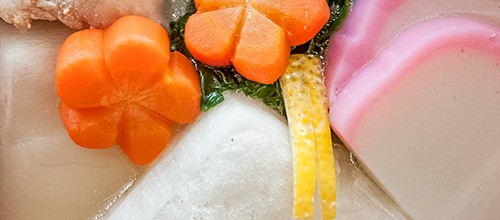
Miso (味噌、みそ), as you probably know already, is a naturally fermented paste made by combining cooked soy beans, salt, and often some other ingredient such as white or brown rice, barley, and so on. The texture can range from smooth to chunky, and the color from a light yellow-brown to reddish brown to dark chocolate brown, and the flavor ranges from mildly salty and sweet to strong and very salty. It is packed with umami and protein, not to mention all sorts of nutrients.
Miso-like fermented bean products and pastes exist all over Asia, but here I will mainly limit myself to the most commonly used Japanese misos. continue reading...
Julie and Julia: An overly long and very late review

Last night I finally got to see Julie and Julia. Here is my very long and otaku-ish take on it. continue reading...
Book review and giveaway: Izakaya, the Japanese Pub Cookbook
When a Japanese person dreams of quitting his or her rat-race job and opening a restaurant, the type of restaurant they usually envision is either a kissaten or kafe (a café-restaurant) or an izakaya. An Izakaya (居酒屋)is a small traditional pub that serves food, rather like a Spanish tapas bar. Many are quite tiny, with just the counter and maybe a few tables. The best ones are run with a lot of passion and love, and have fiercely loyal customers.
Izakaya, the Japanese Pub Cookbook conveys the atmosphere and love of food and good sake that are hallmarks of good izakaya perfectly. Written by Mark Robinson, an Australian journalist who fell in love with izakaya establishments in Tokyo, with gorgeous photography in both color and black and white by Masashi Kuma, it is part cookbook and part ode to the cult of the izakaya. You don’t just get recipes here, even though it’s called a cookbook. There are profiles of izakaya masters, useful advice on izakaya etiquette, notes on sake types, anecdotes and a lot more. I think it can reside as happily on a bedside table as in the kitchen - a quality I look for when I buy cookbooks. continue reading...
Real beef
Some real meat this time. continue reading...
Poverty, rice, and Air Yakiniku
A bit about Air Yakiniku, an odd slice of Japan. continue reading...
The sweet, cultured taste of Calpis

As your sometime guide to Japanese culinary culture, I would be remiss if I let another summer pass by without talking about Calpis.
Calpis is a sweetened fermented milk beverage. The label says:
“CALPIS” is a cultured milk drink, a refreshing gift from nature.
People tend to either love or hate Calpis. continue reading...
Traditional Japanese strategies for combatting natsubate, or the dog days of summer

A cat of our acquaintance’s natsubate strategy: All-day naps in the shade.
August is particularly bad in the Tokyo area where I’m from, as it is in most parts of Japan except for the northern parts of Hokkaido. It gets really hot, and the high humidity makes everything and everyone moist, sticky and generally nasty. There’s a bit of relief in the form of a brief evening thunderstorm (夕立 ゆうだち yuudachi) most days, but the respite is temporary. Getting a decent night’s sleep without air conditioning is pretty much impossible.
The term to describe the stage of lethargy and fatigue brought on by this hot, humid weather is 夏バテ (なつばて natsubabe; literally ‘summer fatigue’). Japanese people have devised various ways of combatting it. Some are food related, and some aren’t, but here are some of my favorites. continue reading...
Postcards from Southwestern France: Gazpacho or cold soup, Cassoulet, Albi, Moissac, Conques
We left Provence this week for a little trip to the Midi-Pyrénées in the southwestern part of France. We’ve been trying to save money by cooking at home most of the time since we started our nomadic existence in France (see previously; not that that’s much of a hardship, since the produce and other foodstuffs in Provence are spectacular). But this week we’ve been staying in an apartment in a 17th century townhouse right around the corner from the Toulouse-Lautrec Museum in the heart of Albi, the capital of the Tarn Department. Since there are tons of great little restaurants here, we’ve been indulging ourselves a bit. continue reading...
Borough Market, London: A Very Literary Food Paradise
When I found out that I’d be in London this week for a couple of days, my thoughts immediately turned to what food-related things I could fit into my schedule. Tea and scones, check. Curry, check. A visit to Japan Centre, check. But at the top of my list was a proper roam around Borough Market.
Long time readers of Just Hungry may know that I absolutely love markets, and go to them whenever and wherever I can. One big reason I’ve decided to move to the south of France is because of the wonderful markets here. So, how does London’s oldest market compare to some of my favorites? While Borough Market is not the biggest market, nor does it have the widest selection, or even the best selection, of foodstuffs, it’s a very special place. In my opinion, it’s simply the most intellectually pleasing market there is. continue reading...
Book review: The Enlightened Kitchen, shōjin ryōri (shoujin ryouri) for the home

A review of The Enlightened Kitchen: Fresh Vegetable Dishes from the Temples of Japan by Mari Fujii, a beautifully presented, easy introduction to the world of shojin ryori (or shoujin ryouri 精進料理), the highly refined vegan cuisine developed by Buddhist monks in Japan. One copy of this great book is up for grabs! continue reading...