
Back to Japanese Basics: The essential staples of a Japanese pantry
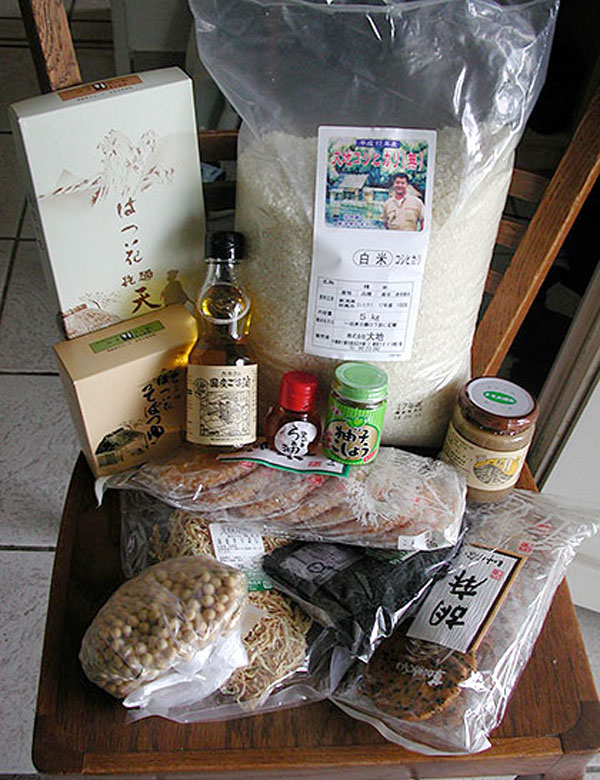
My mother, who lives in Yokohama, occasionally sends me a box of Japanese food goodies. Since she is in her own way as much of a foodie as I am, she diligently scours the land for great sources of locally produced, artisanal and/or organically produced foods. Many of these foods are known under the umbrella term sanchi chokusou(産地直送), direct from where it was produced. If you think French people are hung up on terroir, you should read some Japanese food magazine ads for sanchi chokusou products. Here's a photo of a recent box that arrived by seamail. (If you go to the flickr page, there are notes that describe what each item is.)
I'm always writing about Japanese food from the perspective of a person living outside of Japan, where it's naturally more difficult to get a hold of various ingredients. Japanese food prices outside of Japan are more often than not priced in the range of luxury gourmet items. I feel that most books written about Japanese cooking for a non-Japanese audience don't address the issue of the difficulty or expense of getting the right ingredients outside of Japan or an area with a big Japanese population. While I can rely on my mother to supplement my pantry, I've had to pare down what I do purchase and keep there while still being able to reproduce those "flavors of home".
The must-have ingredients
These are things I always have in stock. If your interest in Japanese cooking is limited, or you're on a tight budget, concentrate on this list first.
- Medium grain rice, white or brown. This is most often sold nowadays as "sushi rice". Japanese cuisine is based on rice. See this basic Japanese rice primer in the archives. See also: Looking at different types of rice.
- Japanese soy sauce. Soy sauces produced by various soy-sauce-using countries do differ. For Japanese food, use Japanese soy sauce, rather than Chinese, etc. A good, widely available and not too expensive brand is Yamasa. Kikkoman is okay, and generally not expensive since the company produces it worldwide rather than shipping it from Japan. You can spend a lot for good soy sauce, an there is a difference in flavor, but it's not totally necessary to do so for most everyday needs.
- White miso (shiromiso). There are different kinds of miso, but the white (actually a pale yellow-brown) kind is the most versatile.
- Bonito flakes (katsuo bushi). Not only is this used to make dashi stock, but it's also used as a condiment in so many foods such as tofu, blanced spinach, and so on. A purist can get a solid dried bonito and shave their own, but the pre-shaved bags are more convenient.
- Konbu seaweed. Essential for making good dashi stock, as is bonito flakes.
- Sake. In a pinch a sweet sherry can be substituted, but many Japanese foods include sake as an ingredient. You don't have to get an expensive brand - as long as it's drinkable it is fine for cooking.
- Mirin - sweet fortified liquor made from rice, used exclusively in cooking.
- Rice vinegar. Rice vinegar is mild and sweeter than white wine vinegar. You will also see something called sushi vinegar - this is just rice vinegar with added flavorings, mainly salt. Making sushi vinegar mix is so easy that I don't see a need for stocking sushi vinegar.
- Dried shiitake mushrooms. More intense in flavor than fresh, they are used a lot as a flavoring as well as an ingredient.
- Sesame seeds. These are often used toasted and ground up, or whole as a condiment.
- Dark sesame oil. This is used for flavoring many dishes, especially chuuka (Japanese Chinese-style) dishes.
- Green tea leaves. Sencha is the standard green tea (shincha is new sencha), and there is kukicha (made from the stems), genmaicha (with toasted rice), hatomugicha (with toasted barley), and so on. Matcha, or powdered green tea, is not made that much in the home (you get it at tea ceremonies, prepared by a skilled person), but it's often used nowadays for cold drinks and ice cream.
- Non-Japanese dry or bottled ingredients that are used a lot in Japanese cooking: salt, sugar, Worcestershire sauce, mayonnaise, potato starch flour or cornstarch flour, white wheat flour.
And a few essential fresh ingredients:
- Fresh ginger. Powdered ginger cannot be substituted.
- Spring onions or green onions and leeks. Leeks are used more than onions, though onions are used in a lot of Japanese Western-style dishes or yohshoku.
- White daikon radish. In Europe, mouli can be substituted. Used cooked as well as raw; in stews, soups, as garnish, etc. Grated daikon radish cuts down on the oiliness of things like tempura and grilled oily fish. In a pinch you can use red radishes instead, especially for salads, grating and so on.
Good to have ingredients
These are ingredients that are staples of a Japanese kitchen, but aren't as essential as the ones above.
- Tofu and tofu products such as aburaage (fried thin tofu), atsuage (tofu blocks that have been deep fried), kohya dofu (frozen and dried tofu, somewhat spongy), okara and yuba (very thin sheets of dried tofu). You might wonder why tofu isn't in the Essential category. While tofu is ubiquitous in Japanese cooking, you can still get Japanese flavored dishes without it.
- Wakame seaweed. This is available either preserved in salt, or dried. The dried kind is easier to handle. Used in miso soup, salads, and as sashimi garnish. See hijiki, wakame, konbu/kombu.
- Nori seaweed. The black dried sheets used to wrap sushi rolls, also used shredded as a topping and so on. It's even cooked to a paste to eat with rice.
- Seven-ingredient red pepper powder (called shichimi togarashi or sometimes nanami togarashi. Togarashi is sometimes spelled tohgarashi). This is a coarsely ground red pepper condiment that's used on udon noodles, cold tofu, and so on. It has ground up yuzu peel, sesame seeds, and other good things in it.
- Ground curry powder. Curry flavor is very popular in Japan. See curry powder formula.
- Wasabi paste or powder.
- Mustard paste or powder. This is plain mustard (equivalent to English mustard powder, e.g. Colman's), not the kind with vinegar.
- Japanese pepper (sanshou). Available usually in powdered form, though in Japan fresh sanshou is used too.
- Dried anchovies (niboshi). This is used as an alternative to, or in addition to, the classic konbu seaweed and bonito flake combination for making dashi stock in some regions.
- Ponzu. Basically a citrus juice - yuzu or sudachi plus lemon is usual. (There is also a product called Ajipon, a mixture of ponzu, soy sauce and flavorings.)
- Yuzu in various forms. Yuzu is a citrus fruit with a tangy juice and fragrant peel. You can find dried yuzu peel powder, or yuzu juice. It is possible to use lemon juice instead, though it will be different. (There are many other kinds of citrus used in Japanese cooking, such as sudachi, daidai, etc. but yuzu is the only one so far that has gaines some sort of distribution outside of Japan.)
- Various dried foods: hijiki, a dark seaweed; kanpyou, dried gourd strips often used in sushi rolls; kiriboshi daikon, dried shredded daikon radish. See hijiki, wakame, konbu/kombu.
- Various dried beans: azuki, black beans (kuromame), and white beans (ingenmame) are the most commonly used.
- Various dried noodles: soba, so-men (thin white wheat noodles), udon, etc.
- Umeboshi, or pickled plums. Nowadays touted as a macrobiotic food product, umeboshi is part of my childhood. Used in rice balls, in bento boxes, and as flavoring for various things.
- Red miso (akamiso). This is a bit stronger in taste, and usually more salty, than white miso.
- Short grain sticky (glutinous) rice (mochigome), used for some sweet and savory dishes (such as Japanese red beans and rice, or sekihan.
- Various fish-paste products such as chikuwa - used in soups and oden (a sort of stew).
- Shiso leaves. Shiso (perilla) is the most common herb used in Japanese cooking, about as useful as fresh basil is in Italian cooking. The green kind is used fresh, and the red kind is used for pickling.
- Sesame chili oil (ra-yu). Dark toasted sesame oil infused with red chili. This can turn rancid fast so store after opening in the refrigerator.
- Rice bran for pickling (nuka). People of an older generation in Japan pine for the flavor of nuka zuke - vegetables pickled in wet fermented rice bran. I seem to have been born younger than the nuka zuke cutoff point or something, since I don't really miss this type of pickles, though I have thought about making my own nuka doko (rice-bran pickling bed). It's sort of like minding a sourdough base.
- Instant dashi stock granules, as backup.
Not essential at all
There are lots of these of course, but here are a few that are often mentioned as 'essential' Japanese ingredients, but I have little use for.
- Tamari soy sauce. This is a pet peeve of mine, but I find it rather annoying when tamari is touted as a more 'real' soy sauce than regular soy sauce in some circles. Tamari literally means the dregs; it's the dark, somewhat viscous soy sauce at the bottom of the barrell. Tamari is traditionally only used as a dipping sauce.(Conversely, in Kyoto, which has arguably the most refined cuisine in all of Japan, they regard the regular dark soy sauce that is used in the rest of the country as an inferior product that contaminates the color and flavor of foods too much, and prefer a light colored soy sauce.)
- Furikake. I will write about furikake in depth soon, but in a nutshell it's a dried, flaked topping for rice (if you remember that Japanese food mostly centers around plain, white rice, a lot of things make sense) and comes in various flavors. A certain "gourmet" newsletter lists it as some kind of wonder food, which is sort of funny since I always grew up with the notion that furikake was sort of low-class. My maternal grandfather, a rather strict gentleman, didn't allow it on his table. But I do love it. Keep in mind that most commercial furikake is loaded with MSG. I like to make my own as time allows - see furikake recipes on Just Bento.
- Ajinomoto, aka MSG. A lot of Japanese households still have a bottle of this, but I find the flavor a bit too harsh.
For more about Japanese flavors, see the SaShiSuSeSo article from the archives. And if you are serious about Japanese cooking, don't miss the Japanese essence in a bottle.
See also
- About Japanese ingredients and substitutions
- Essential Japanese cooking equipment
- A dozen Japanese herbs and vegetables to grow
- Looking at rice
- Japanese miso primer
Submitted by maki on 2006-08-09 17:15.

 Welcome to Just Hungry, where we serve authentic Japanese recipes and more! I'm






Comments
Cinnamon
6 September, 2006 - 19:19
Permalink
Back to Japanese Basics: The essentials of a Japanese pantry
Thank you so much. I love Japanese food and have wanted to learn how to make more of it at home, but I've struggled because I'm drawn visually to Nobu's cookbooks and other fancy, pretty books.
Now I can learn the basics before I begin experimenting with more expensive ingredients.
Lydia
12 September, 2006 - 15:23
Permalink
Back to Japanese Basics: The essentials of a Japanese pantry
Wow -- lots of good ideas to add to my own Perfect Pantry! Thanks.
ana
7 April, 2007 - 01:43
Permalink
Thank you for this
Thank you for this wonderfull list :)
White daikon radish. In Europe, mouli can be substituted.
But this sentence makes me wonder.
What is mouli?
maki
7 April, 2007 - 06:01
Permalink
mouli
Mouli is a large white radish that's commonly sold in some countries in Europe. It's also called bierrettich (beer radish).
Micah
9 April, 2007 - 03:21
Permalink
your own website
Maki,
I've been looking through this Just Hungry page at Japanese recipes for a couple hours now and have come to the conclusion that you could easily have your own website on Japanese cooking! In fact that would not be a bad idea, people can get intimidated by the internet but buying/setting up a website isnt that difficult and rather inexpensive (you could do it easily enough for about 10-20$, and can sell advertising spots that will end up making you money so it pays for itself.)
maki
9 April, 2007 - 08:16
Permalink
actually...
...Just Hungry is my own website. Thanks for the suggestion though. :)
Mei
21 April, 2007 - 14:23
Permalink
Brands
Maki,
Question about brands of Japanese pantry items here... Are there brands that you'd recommend for soy sauce, mirin and cooking sake? I'm in Taiwan where I can get my paws on some Japanese imports so would like your recommendations. Moreover, I just got a bottle to Taiwanese made mirin-like liquid seasoning (みりん風調味料). Tastes fine to me but I was wondering if this would be an inferior product to hon-mirin (本味醂) - minus the provenance factor :P. BTW, sake is just rice wine, is it? So I guess I could just use Taiwanese rice wine as a substitute... Would like to know your 2 swiss francs on the subject matter.
maki
21 April, 2007 - 21:05
Permalink
soy sauce, mirin, sake
If you want to splurge a little you can try the ones that says "Maru Daizu" - Yamasa makes one, as does Kikkoman, and other makers.
For dipping only you can try more expensive ones but for every day cooking those would be fine.
Mirin seasoning vs. Hon Mirin: Mirin seasoning just has much less alcohol, while Hon Mirin has about 17% alcohol (varies according to the brand - check the label). So you can use the Mirin seasoning for dishes you won't be heating, if you prefer. Flavor wise I think Hon Mirin has more flavor but Mirin seasoning is fine really.
Sake and Taiwan rice wine - they are different but I think you can substitute (try tasting both to see if there's a huge difference...) for example some mainland Chinese rice wines are very strong and/or sweet and different from most Japanese sakes. Just like say a California Chardonnay is very very different from say, a German Riesling.
Mei
22 April, 2007 - 18:36
Permalink
Sake for sake's sake
Thanks Maki,
Now wots your take on the cooking sakes (料理酒) that I see in the green plastic bottles in the supermarkets? Make the cut?
maki
22 April, 2007 - 21:53
Permalink
cooking sake
Cooking sake of the cheap variety has additives like salt, sugar, and MSG, so I tend to avoid them. Though there are expensive 'natural' cooking sakes...but they aren't cheap.
Mei
23 April, 2007 - 06:32
Permalink
Sake - Top Shelf?
Thanks Maki,
Well, now... just what sake would you recommend? You can start by telling me which one you use :>
maki
23 April, 2007 - 07:48
Permalink
hmm sake
Well I am no sake expert by any stretch of the imagination. I'm not a regular sake drinker either. I just have whatever jizake (locally usually-microbrewed sake from various regions) that my mom happens to bring along... they are usually very nice, light, and drinkable ice cold. For whatever it's worth, I do not like atsukan (hot sake) too much - I prefer it cold always. So...I don't think I can recommend any mass-produced sake...not that they're totally bad or anything, but my sake needs are met by the jizake. For cooking purposes I just use a regular Gekkeikan or something (which is middle-of-the-road) though sometimes I'll use up some getting-older jizake that's around (sake does not age well).
Tracy
20 August, 2007 - 05:02
Permalink
Furikake
Got a little giggle about furikake. I had read about it in researching onigiri and finally found some to try. We did discover that we liked it for that quick meal of rice and tuna or surimi that we whip up some nights when we really don't want to cook. I was telling a friend of ours about it; however, when he mentioned that he would be hosting some Japanese business acquaintances, I warned him that if he discovered he liked it, he might not be too quick to brag on it to his business friends lest they think he was a bit lowbrow. LOL.
Andrea
2 February, 2008 - 18:38
Permalink
Mirin
I always have used Kikkoman brand mirin, but my local Safeway recently stopped carrying it and I had to buy the Sun Luck brand. I definitely noticed the Sun Luck didn't have as much flavor, so as soon as possible, I went to my local Japanese store and bought a large bottle of the Kikkoman.
But THEN I read the ingredients on each brand! Kikkoman is LOADED with corn syrup and other added sugars! The Sun Luck says it is just fortified rice alcohol......no added sugar. No wonder the Kikkoman seems to taste so much better. My husband is diabetic, so this is very important in our family. Just thought other people might want to know this, also. Thanks, Maki!
maki
2 February, 2008 - 20:48
Permalink
Andrea, if your husband is a
Andrea, if your husband is a diabetic he may want to stay away from mirin altogether. That is the advice that I see on Japanese websites...even mirin without additives does have sugar (though not from sugar cane or corn syrup). If his doctor says he has to avoid ketchup for example, then probably mirin is not ok either. I would use plain sake instead of mirin in that case. Of course I am NOT A DOCTOR or medical professional! (the standard disclaimer :))
Andrea
11 February, 2008 - 05:42
Permalink
Thank you Maki! I never
Thank you Maki! I never thought about just using sake - duh! I've already cut out the added sugar in the Japanese "essence"......my mother-in-law's recipes all seem to call for shoyu, mirin, and "a little sugars". Another reason I like your website, you have a lot of good vegetable recipes that are good for diabetics. Thank you again!
Ginger
23 February, 2008 - 16:46
Permalink
Tamari
I can't eat wheat (so no shoyu) but some tamaris are fine. You don't seem overly fond of the stuff, but is it ok to use tamari if normal soy sauce is off the cards? Or is it best not to bother making the recipe?
By the way, I discovered your site through "recommendations" on Google Reader recently and haven't looked back since! Thanks!
maki
23 February, 2008 - 21:22
Permalink
Using tamari is fine,
Using tamari is fine, especially if you have a food intolerance. (there's no absolute NO in cooking :)) I guess I have a prejudice against tamari in cooking because in general, 'haute cuisine' in Japan is Kyoto style cooking, and in that style they definitely frown upon dark soy sauce. (But there's nothing inherently wrong with it.)
Melody
24 February, 2008 - 20:10
Permalink
Eureka, the Perfect Japanese Pantry List
We're soon moving back to the U.S. after four years living the good life in Kamakura. After a recent trip back to Texas (our new home), I know it will be a challenge to get many of the now-familiar basics that I can usually get at my local Seiyu or from Manaka, our vegetable delivery truck or from the green-grocer down the hill. So, I'm stocking up on what I can mail or ship and praying for the best. Thanks for providing this "pantry list" as well as mail-order vendors for everything from equipment to seeds. I'm sure that once we get settled, I'll be making quite a few orders!
Jeff
26 February, 2008 - 06:14
Permalink
mayo
Good list! If I have one nitpick it's that the mayo in Japan seems to taste different than the mayo back home; it seems a bit sweeter. Is it just me? I don't usually like my お好み焼き with mayo, but if you do and wonder why it tastes different then maybe that's something to keep in mind.
maki
26 February, 2008 - 11:41
Permalink
Japanese mayo is indeed
Japanese mayo is indeed different...see here for mayo variations. (In a nutshell, there's sweetness from the rice vinegar and the sugar, which in turn I think brings out the egg-flavor more.)
anon.
17 April, 2008 - 04:36
Permalink
Just MaqQuested the closest
Just MaqQuested the closest Japanese market to me and bought everything on your must-have list. Now I just need to figure out how to use it all since I can't afford to go to buy anything from the good-to-have list for a couple of weeks ...
Jan
3 July, 2008 - 20:10
Permalink
konbu
First of all thank you Maki for this excellent web site ( I have been "living" here for a couple of days now since googling soba )
I am stocking my kitchen with your recommendations but am a little confused about which seaweed or konbu to buy for making dashi stock. At the market all I saw were the nori roasted seaweed in sheets - couldn't find konbu. Can I use the nori to make dashi - isn't it all seaweed after all?
Thanks again, Janice
Abu
10 February, 2009 - 10:58
Permalink
Start Up Guide
Hi maki!!
I just recently moved to nagoya and of course all of these ingredients are accessible to me. But the problem I have now is that my fridge and cabinets are pretty much empty. I'm looking to cook beyond yohshoku foods (cooked way too much of it back home). Would this must have list remain the same or is there something else that I need to consider?
Thanks and keep up the great work!!
maki
10 February, 2009 - 19:19
Permalink
Re: Start Up Guide
Actually the list above only lists one yohshoku ingredient (curry powder). The rest are things you use mainly for washoku, or traditional Japanese cooking.
For yohshoku you'd add tonkatsu or 'bulldog' sauce, mayonnaise, and ketchup, plus milk (to make bechamel) and pasta, and you're basically good to go.
With the ingredients on this list, plus fresh produce and fish, meat etc you can make any kind of Japanese recipe you want.
anon.
2 March, 2009 - 07:11
Permalink
Re: Back to Japanese Basics: The essential staples of a ...
Hi
Could I please ask which brand of mirin you use? Takara?
Janie
22 April, 2009 - 18:56
Permalink
Re: Back to Japanese Basics: The essential staples of a ...
Thanks so much! I always forget something that winds up being a key ingredient, this is GREAT!
anon.
11 August, 2009 - 04:19
Permalink
Daikon, anybody?
Does anybody know if daikon freezes well? There are loads of wonderful daikon recipes that I'd love to try, but I live alone, so buying a vegetable the size of my arm (are they that size everywhere?!) would probably serve me better as a self-defense weapon than a meal.
I'd love to be able to slice that thing up, then pull chunks out of the freezer as I need them. Or should I just give up and use red radish?
Thank you! ^^
maki
12 August, 2009 - 09:26
Permalink
Re: Daikon, anybody?
Daikon does not really freeze well - the fibers break down and it gets all mushy. You can freeze grated daikon, to use as garnish, but imho it's not really worth it (it's so easy to grate). However, a daikon lasts for a very long time if you keep it well wrapped in your vegetable drawer - like a month or so in my experience (provided your refrigerator is at a proper temperature, i.e. around 5 degrees C / 41 F) Plus it's so low-calorie!
florence
25 September, 2009 - 10:48
Permalink
Re: Back to Japanese Basics: The essential staples of a ...
I love Mirin made by Clearspring. Its not cheap but is so delicious. Whenever I use it I always put a slug in the palm of my hand for 'tasting' purposes.
Thanks for the recipe for aubergine with miso. I always get it in the restaurant and now can make it, it is delicious!
florence
25 September, 2009 - 11:02
Permalink
Sorry, that was my first
Sorry, that was my first time posting anything! Shoud have put in a subject; Mirin
librarychair
14 November, 2009 - 03:43
Permalink
Re: Back to Japanese Basics: The essential staples of a ...
I always use rum instead of mirin. It seems to work out well.
Naimah
18 November, 2009 - 13:45
Permalink
Re: Back to Japanese Basics: The essential staples of a ...
Great post, it's sometimes good to do a haul to make sure you have the right ingredients before you get started with something!
Naimah
CoolBlackChef.co.uk
El
25 December, 2009 - 00:37
Permalink
Re: Back to Japanese Basics: The essential staples of a ...
I reaaallly should've refreshed my memory with this page before making your teriyaki chicken! Silly me thought we had mirin when really we had rice wine vinegar. Still edible, but vinegary. Not that bad, actually.
Psuke
19 March, 2010 - 23:36
Permalink
Re: Back to Japanese Basics: The essential staples of a ...
Can you recommend a good place to buy dried yuzu online? I've been unable to find it (fresh or dried) in any of my local shops. I'm desperate to try some of the fast pickle recipes as I am a pickle *fiend*.
Grain Flaker
17 June, 2010 - 11:59
Permalink
Re: Back to Japanese Basics: The essential staples of a ...
I love Japanese food but it's quite sad that getting ingredients for Japanese food is very difficult.So are the ingredients you've mentioned above are easily available ?
maki
17 June, 2010 - 20:34
Permalink
Re: Back to Japanese Basics: The essential staples of a ...
The must-have ingredients are all available via mail order, from Amazon.com if you're in the U.S. The bigger Whole Foods stores carry them too. The other ingredients may not be as easily available unless there is a Japanese grocery store in your neighborhood, but then again they aren't essential. See the Worldwide Japanese food shopping guide and look for stores in your area.
esperanza
6 September, 2010 - 20:52
Permalink
daikon
Could I substitute red radishes for daikon also when daikon is supposed be cooked? Red radishes are so much cheaper and easier to find where I live...
maki
7 September, 2010 - 14:16
Permalink
Re: daikon
I have found that radishes are a good substitute for grated or pickled daikon, but not for simmered or otherwise cooked daikon - they lack the sweetness of daikon unfortunately.
Nati
21 October, 2010 - 19:46
Permalink
Re: Back to Japanese Basics: The essential staples of a ...
Hello,
I am a college student doing a project on Japanese cuisine, I was hoping that maybe you can help me clarify some questions. Mainly I wanted to know, is it normal for the japanese culture to use flavoring ingredients on their soups like Lobster bisque bouillon, or any other type of bouillon? in my project I am supposed to export different tasting bouillon to Japan, but I need to know if there is a market for it.
Hope you can help.
Rebecca Bourke
27 February, 2011 - 19:13
Permalink
Re: Back to Japanese Basics: The essential staples of a ...
Just a quick question: Is it possible to freeze bonito flakes? I have finally managed to get hold of some, but don't have room in my freezer to store a large volume of dashi. The open packet has been in the fridge for around a week, and I would love to freeze them, so long as they won't get spoiled.
marnen
24 August, 2011 - 07:32
Permalink
Re: Back to Japanese Basics: The essential staples of a ...
Dried bonito flakes should keep unrefrigerated (probably indefinitely, I'd think). You might want to put them in a Ziploc bag so they don't get soggy.
glister
30 August, 2011 - 04:24
Permalink
Re: Back to Japanese Basics: The essential staples of a ...
You seem to specify dark sesame oil in most recipes. How is this different from the typical Kadoya sesame oil I see all over the place? (http://www.amazon.com/Kadoya-Pure-Sesame-Oil-5-5/dp/B0002YB21A)
Wikipedia says the dark version has a lower smoke point, is that the main reason for the preference of dark sesame oil?
I love the Kadoya version, but I have not really explored anything else. Maybe I should.
marnen
7 December, 2011 - 22:31
Permalink
Re: Back to Japanese Basics: The essential staples of a ...
The Kadoya oil is dark sesame oil (also called toasted sesame oil or Chinese sesame oil). In the U.S., it seems to be the easiest type of sesame oil to find. Light sesame oils (such as http://www.iherb.com/Hain-Pure-Foods-Sesame-Oil-12-7-fl-oz-375-ml/33274?... ) are used in Middle Eastern and Indian cooking.
The difference is largely one of flavor: the dark oil is pressed from toasted sesame seeds, and has a strong flavor (in fact, it's often used more as a flavoring than as a cooking oil). The light varieties are pressed from raw seeds and are used as mild cooking oils with little flavor of their own.
Does that help?
anon.
26 September, 2011 - 08:24
Permalink
Re: Back to Japanese Basics: The essential staples of a ...
I have an intolerance to gluten. Gluten is in wheat which is found in a lot of soy sauces. I saw that Kikkoman makes a gluten-free variety but do you know if Yamasa makes a gluten-free version? I would like to try your recommended soy sauce but not at the risk of becoming terribly ill. I looked online but I haven't found a gf version yet. I thought maybe you would know.
Maki<3
16 November, 2011 - 06:08
Permalink
Re: Back to Japanese Basics: The essential staples of a ...
I love this! I love that you have the same name as me too!
<3 Maki