
Weekend Project: Apricot Preserves, Capturing Summer in a Jar
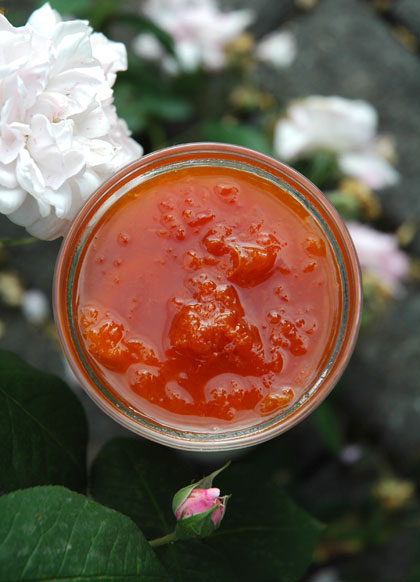
I'm going to try to bring a little order to this 2 and a half year old site by posting certain themed articles on certain days. On Fridays, I plan to post slightly more involved recipes or food projects that are best tackled on the weekends. The first one is this really rather simple recipe for apricot preserves. It's easy to make but the preparation and cooking do take some time - a perfect project for a day off.
Making jam and preserves may seem like an out of date thing to do. The idea of having a pot of boiling sugar and fruit simmering away in the kitchen on a swelteringly hot summer day may seem to be a rather masochistic and unnecessary ritual. If we need to preserve the bounties of a garden, there's always the cooler option of freezing. Besides, nowadays we can just buy delicious jams and preserves from a variety of sources.
Still, I love to make sweet or savory little pots of preserves, pickles and liquors from fresh fruit and vegetables. It goes back to memories of my late oba-chan, my grandmother, making pickled umeboshi plums every summer (which I wrote about a few years ago); or my mother when we used to live in England making gooseberry preserves for the first time. Above all, each pot of jam or preserves seems to capture a little bit of the warm summer months in them, something that impersonal frozen bits of fruit and vegetable can't do.
Last week on on our next to last day in Provence, we went to the amazing Marché Agricole (farmer's market) in Velleron, a small town near Carpentras. One of the purchases we loaded into our car for the trip back home was a 5 kilo (about 11 pounds) crate of "Class II" apricots.
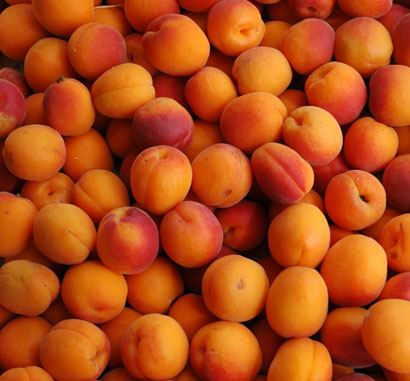
Now I must confess - I am not a big fan of fresh apricots. While they smell like heaven, to me their texture is inferior to that of their cousins, peaches and nectarines. Cooked apricots are another matter though. Once they are heated, the fruit turns golden, fruity and luscious.
As soon as I spotted those large flats of smallish apricots, I was determined to turn them into preserves. Another advantage of making your own preserves is that you can control the amount of sugar in them to some extent, and that's what I did. These preserves are just a bit less sweet than commercial varieties, and are also a bit chunky in texture. I love it on plain yogurt or vanilla ice cream, though it's also terrific on a thick slice of fresh buttered bread.
The great thing about this recipe is that the apricots don't have to be perfect. They can be a little bruised, or even just a bit hard. The cooking will soften them and bring out their flavor. (But please make them when apricots are in season in your area. They will be cheaper then too!)
I've scaled down the recipe to a manageable quantity - just scale it up for larger amounts. If you don't want to go through the bother of properly sterilizing the jars and lids, you can store this in an airtight container in the refrigerator for a month or so, or in the freezer for longer.
Apricot Preserves
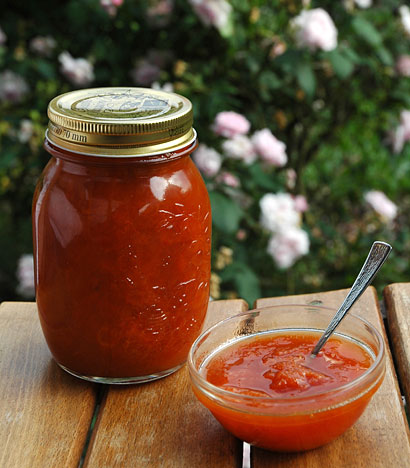
- 1 kg, or 2 lbs plus a few more apricots, of fresh apricots
- 1 1/3 cups of granulated sugar (see notes below)
- 1/4 cup water
- 2 Tbs freshly squeezed lemon juice
Equipment:
- a heavy bottomed non-reactive pan (an enameled cast-iron pan is ideal, or a heavy stainless steel pan. Don't use aluminum or uncoated cast-iron.)
- canning jars with rubber-seal jar lids.
Melt the sugar and water in the pan. Bring to a boil, then simmer until clear and slightly syrupy. (Watch the pot at this stage or you might end up with a potful of hard crystallized sugar!)
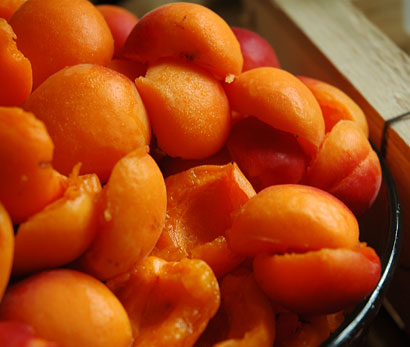
Carefully sort and wash the apricots. Halve them and discard the pits, making sure to get rid of the stem end. (To halve them I just rip them apart with my fingers - far easier than cutting them with a knife.)
Optionally, crack open a few of the pits ([edit:] just a few, no more than a small handful! see the comments) with a nutcracker or hammer (wrap them in a cloth and smash!), wrap them in some cheesecloth and put in the pot. This imparts an intriguing almond flavor to the preserves.
Put about half of the apricots in the sugar syrup and simmer until the fruit is almost falling apart. Put in the rest of the apricots and continue simmering until they are almost falling apart, but not quite. The whole procedure will take about an hour or more, depending on how soft your apricots were to start with.
Add the lemon juice and stir. Simmer an additional 5 minutes, then take off the heat. Take out the cheesecloth with the pits if you put them in.
(If the jam gets burned on the bottom at any point, just pour out the unburned jam into a fresh pot and continue cooking. Don't scrape the burned bits into the new pot!)
Preparing the jars and lids
I always use canning jars with replaceable lids with the rubber seal built into the jar. They are very easy to handle. I re-use the jars, and replace the lids for each fresh batch of jam, preserves or chutney.
While you are simmering the preserves, sterilize the jars and lids. There are a couple of ways of doing this. If your dishwasher can sterilize baby bottles, you can use that setting for the jars and lids. Otherwise use one of the following methods:
- The traditional boiling pot of water: Bring a big pot of water to a boil, and lower the jars into it, immersing them completely. Follow up with the lids. Boil for a few minutes to sterilize. Take them out with clean tongs.
- The low oven method: Put the washed jars and lids into an oven heated to about 110°C/230°F. "Bake" the jars for about 20 minutes, or until the water on them is totally dried out. Take them out carefully using tongs and/or a clean oven mitt. This is the method I use.
Filling the jars
When you are handling the sterilized jars and lids, at no point should you touch the jars inside or on the rims, or inside the lids. Your hands are not sterile even if you wash them well, unless you scrubbed up like a surgeon.
To fill the jars, fill them up to the very rim with the boiling hot preserves, then immediately screw on a lid. Don't worry if some of the liquid spills - and whatever you do, don't try to wipe the exposed rim. Now, leave the jars until you hear and see the lids "popping" - they should be indented now. That's the indication that they are vacuum-sealed. (This happens because the hot air inside the jar contracted.)
Once the jars are cool, wipe off any dribbles outside the jar with a damp cloth, and store in a cool, dark place. Remember that an opened jar must be stored in the refrigerator.
This will make about 2 small jars of preserves. (My 5 kilos yielded 7 1-pint/ half-litre jars, plus a bowlful left over for immediate consumption.)
Regular sugar?
If you want the preserved to have that jellified state that commercial jams have, use either sugar for preserves or add pectin powder. I don't bother with this for these preserves. If they are a little runny don't worry, they will still taste terrific.
Submitted by maki on 2006-06-23 21:22.
If you enjoyed this article, please consider becoming my patron via Patreon. ^_^
 Welcome to Just Hungry, where we serve authentic Japanese recipes and more! I'm








Comments
Kevin
26 June, 2006 - 19:14
Permalink
Weekend Project: Apricot Preserves, Capturing Summer in a Jar
Hello Maki,
been reading your site for sometime now, and I must say thank you very much for your insightful (and most delectable!) posts, especially those on Japanese food. That said, that almond-ish flavour from the apricot stones is due to cyanide. Yep, all members of the Prunus family (including peaches and plums) do produce cyanide in their pits in the form of amygladin, a cyanide-sugar compound. Not really what you'd want in your jam, I guess. ^^;;
Jules
20 June, 2007 - 20:40
Permalink
First off Thank you so much,
First off
Thank you so much, Maki, for posting this recipe. My mother who recently passed away,
was known for her Apricot Jam, that had the ground meat of the pit in it. Unlike you,
she left it in when she sealed the jars. And like you said, it all depends on the amount.
There was never a lot, but just enough that it was her little "secret" to great jam.
And for those who didn't know better, it was a great conversation piece as they stared
at the jars of Gold necter.
This brings back many memories, as my mother never wrote down her recipes.
Thank you! I can't wait to try this out.
max
26 June, 2006 - 20:53
Permalink
Weekend Project: Apricot Preserves, Capturing Summer in a Jar
Kevin: Actually, it is not that bad. It is indeed true that one of the amygladin metabolism products is HCN. However, it is in small dosage, which the human body can convert to a less problematic substance. Also keep in mind that you don't eat the apricot kernels in the jam, as they are kept in a separate bag, and removed before putting the jam into a jar. Also, a major part of that small amount of HCN being released into the jar evaporates during the cooking.
So, it is best to follow the words by the most famous Swiss medicus, Paracelsus, who said "it all depends on the quantity".
So, in order to kill someone with a jar of this apricot jam, you would need quite a lot of kernels, and you probably would be affected beforehand, by the HCN released during the cooking...
maki
26 June, 2006 - 21:30
Permalink
Weekend Project: Apricot Preserves, Capturing Summer in a Jar
Kevin, great point. I want to emphasize that you only want a small quantity of the kernels. Apricot jam has been made with a small amount of kernels to flavor it for hundreds of years I believe, and in small quantities it should be ok. But of course, if it concerns anyone, just leave it out - the preserves will still be delicious!
Kevin
27 June, 2006 - 17:48
Permalink
Weekend Project: Apricot Preserves, Capturing Summer in a Jar
Max and Maki,
sorta figured that out later - still, thanks for the detailed replies. =)
Steve Ankerss
27 August, 2006 - 15:28
Permalink
Weekend Project: Apricot Preserves, Capturing Summer in a Jar
IF ANY ONE STUDIED THE DATA BY PROFESSOR SAGURA AT THE SLONE KETTERING UNIVERSITY BACK IN THE SEVENTIES YOU WOULD REALISE THAT APRICOT KERNEL IN ANY QUANTITIES ARE VERY BENEFICIAL AND ARE NOT HARMFUL IN ANYWAY! THE CHEMISTRY OF ITS METABOLISM IS QUITE SIMPLE AND OFTEN MISUNDERSTOOD! JUST ASK ANY 120 YEAR OLD HUNZA IF THEY ARE FEELING THE EFFECTS OF EATING TOO MANY AP'S??? DON'T THINK SO!
Hiramatsu
29 August, 2006 - 21:55
Permalink
Weekend Project: Apricot Preserves, Capturing Summer in a Jar
Hello Maki,
I made the apricot jam and it is delicious! I wanted to know if the same recipe would work for plums? I probably don't need the lemon juice because plums are more tart than apricots. Please let me know, my plums are almost ready to pick!
maki
29 August, 2006 - 22:29
Permalink
Weekend Project: Apricot Preserves, Capturing Summer in a Jar
Hi Hiramatsu,
It should work quite well for plums. Depending on the kind of plum, it will have a higher pectin content (the thing that makes jam jell) than apricots so it should be more jellified, which isn't a bad thing at all. If the plums are quite tart you may want to add a bit more sugar, but it's up to your taste of course!
maki
29 August, 2006 - 22:30
Permalink
Weekend Project: Apricot Preserves, Capturing Summer in a Jar
oh, by the way, I wouldn't crack the plums for plum jam.
hiramatsu
30 August, 2006 - 20:22
Permalink
Weekend Project: Apricot Preserves, Capturing Summer in a Jar
Thanks Maki for your answer regarding plum jam. I have another question about plums. Are the plums used to make umeboshi the same as plums used to make jam? Do you have a recipe for umeboshi? I live in Idaho and they don't sell it here and I'd love to make my own. I think shiso leaves are needed, and I probably can't get them.
maki
30 August, 2006 - 23:30
Permalink
Weekend Project: Apricot Preserves, Capturing Summer in a Jar
hiramatsu, unfortunately the fruit used for umeboshi, while of the same prunus genus as plums (as well as apricots) isn't really a plum as is known in the West...and I've never seen fresh ume sold outside of Japan. I guess you would have to grow it yourself! Fresh ume are quite hard and smaller than plums, with a sort of yellow-red skin. (My grandmother used to put up a batch of umeboshi ever year.)
I've never really seen red shiso being sold in the U.S. either, though shiso (perilla) is quite easy to grow and a lot of seed catalogs carry it now.
jackie
29 January, 2007 - 21:01
Permalink
canned apricots?
Maki,
could i use canned apricots? I have tons and a few new recipes i want to try call for apricot preserves. I know fresh is best but its winter here in MI. Just a thought.
jackie
angie
1 December, 2007 - 10:10
Permalink
canned jam
I have made apricot jam VERY successfully from canned apricots which I boiled up in a large glass dish in my microwave. It jelled and set perfectly and can't be distinguished from the usual fresh variety that I make except that there are no cracked pits to add that lovely bitter flavour. Dried apricots soaked overnight in water (and then drained) with their weight in sugar also make great jam in a microwave - oops I mean preserves or 'jelly' as americans call jam.
good luck and happy experimenting
Teah Petersen
22 July, 2010 - 20:27
Permalink
Re: canned jam
Jam, jelly and preserves are all different. Jam has bits of fruit in it usually roughly puréed, jelly is clear with only juice - you should be able to see through it, and preserves has the whole smashed fruit in it. (Only stupid americans don't know this. ;) )
Thanks for the recipe - I've got a table full of apricots and I'm going to try making preserves. :)
Teah - an American
maki
31 January, 2007 - 21:03
Permalink
probably not..
Jackie, I probably wouldn't use canned apricots to make jam, since the apricots are quite soft anyway and you can't tell how much sugar to add. I'd just enjoy the canned fruit as-is (I love canned apricots...)
danielle
9 June, 2007 - 04:22
Permalink
apricot jam
Hey Maki,
As its just coming in to summer in Japan all the green ume are for sale for umeboshi and umeshu. I picked up a some ripening ones and let them go ripe, so they look just like apricots. Then I made your jam with them.
They aren't sweet like apricots and bring an amazing sour flavour to the sweetness. Almost like a marmalade.
It worked out great!
Danielle
maki
9 June, 2007 - 08:15
Permalink
ume jam
Ume jam...sounds fantastic!
Kathleen
10 June, 2007 - 18:27
Permalink
Filling the Jars
I have done alot of home canning, using both the method you talk about here and hot water bath canning. In order for a vaccuum seal to form with the method you talk of here it is necessary to fill the jars leaving a half inch space between the preserves and the top. If they are filled to the rim, you risk contamination by leakage through the seal.
Even if refrigerated using these directions, contamination is possible.
It is also a good idea to wipe the rim of the jar after filling (I have used a damp paper towel with no problems) in order to ensure a good seal so a vaccuum will form.
Jennifer
23 June, 2007 - 04:06
Permalink
Can’t wait to try this
Can't wait to try this recipe. We have an apricot tree in the back yard of our new house the the picking has begun!
Annette
24 June, 2007 - 23:47
Permalink
Lids are popping!
Maki,
Thanks for this post! I have an apricot tree in my backyard and have been wanting to make preserves for awhile now. I did a search on recipes and didn't find a lot surprisingly. Anyway, it was the project for the day. I picked 9 pounds of apricots! And ther are more at higher levels. I used the water-bath method, following instructions from Canning for Dummies and your recipe. Can't wait to taste it. I have a plum tree too. I might be doing a repeat soon. Thanks again!
Jennifer
9 July, 2007 - 00:02
Permalink
Thank you so much!
I have an apricot tree and for ages I have wanted to make preserves with the apricots and have often found myself a little afraid of the recipes I have found. This worked beautifully and was the perfect way to use overly ripe apricots. Now I have lovely jars full of sunshine.
anne
12 July, 2007 - 10:00
Permalink
yummy!
thanks for posting this tasty and simple recipe. I used 7.5 pounds of cost-co qpricots -- not the greatest, but they were cheap and the jam came out delicious. I used less sugar (4 cups), and like the tart sweetness. added lemon is a great touch. i just found your site and really like it. tomorrow, plums! By the way, my granma taught me to throw one of the apricot kernels in each jar just before sealing, to add to the flavor.
Chantal
20 July, 2007 - 23:19
Permalink
Perfect results
Hello from Albuquerque, New Mexico!
Apricots grow quite well in Albuquerque and a neighbor recently shared about 6 lbs of his bounty. I canned 5 lbs today using your recipe and instructions. Everything turned out divinely.
Thank you very much.
anon.Carol De Lauder
30 July, 2008 - 06:54
Permalink
Appricot Jam
What about putting Pineapple in with the appricots?
maki
30 July, 2008 - 14:14
Permalink
I haven’t tried it but
I haven't tried it but sounds delicious! Give it a try :)
george e.
27 August, 2008 - 22:52
Permalink
Is it fine using alcohol for sterylising the jars?
Hello, I just have this question in mind in regard of doing more friendly the sterylizing process.
Sincerely,
George.
madison
26 January, 2009 - 19:11
Permalink
Re: Weekend Project: Apricot Preserves, Capturing Summer in ...
The picture of your jam looks awesome, similar to the Harvest Song apricot jam which I just love to eat with yogurt! I never thought of making apricot jam, but your instructions look so simple that next time apricots are in season I will give it a try.
Rajeev
18 March, 2009 - 19:01
Permalink
Re: Weekend Project: Apricot Preserves, Capturing Summer in ...
Sounds great, I will try this recipe this year in july when we get apricot in india. Thanks again
Regards
Rajeev
Kris
28 July, 2009 - 04:15
Permalink
Re: Weekend Project: Apricot Preserves, Capturing Summer in ...
Well I made the jam today!
I had the neighborhood kids pick and split the apricots.
Some were still a little green but after cooking them down the house smelt yummy and sweet.
Thanks for the help.
Rose
9 August, 2009 - 19:12
Permalink
Re: Weekend Project: Apricot Preserves, Capturing Summer in ...
Hi....just wanted to tell you how much I enjoyed making your recipe for apricot preserves. The jars are still cooling and I am listening for the "popping". The taste is amazing and so fresh. I was wondering if I can use the same recipe using Ontario peaches which are now ready. Can I add some almond extract to adjust and enhance the flavour. Thank you for your help!
peg
9 August, 2009 - 21:10
Permalink
Re: Weekend Project: Apricot Preserves, Capturing Summer in ...
wondering if I can forgo the jars with lids and use sterilized jelly jars with melted paraffin poured over tops to seal? (this was how my family often finished their jams and jellies).
any advice welcome! I ahave a bag of fresh apricots in the fridge I am dying to make preserves out of! thanks in advance.
Penny
21 July, 2012 - 21:57
Permalink
Re: Weekend Project: Apricot Preserves, Capturing Summer in ...
WAX SEALING:
Sealing jam jars with paraffin wax is no longer advised for jam-making as the seal does not adequately protect against bacterial contamination.
Bob
5 June, 2010 - 20:20
Permalink
Re: Weekend Project: Apricot Preserves, Capturing Summer in ...
any comment on use of the skins?? the recipe just said to seperate the apricots.
should they be peeled........ or not....... or what ??
maki
6 June, 2010 - 19:05
Permalink
Re: Weekend Project: Apricot Preserves, Capturing Summer in ...
Apricots have very thin skins, so they don't need to be peeled.
Alisa Palmer
9 June, 2010 - 20:02
Permalink
Re: Weekend Project: Apricot Preserves, Capturing Summer in ...
I just think your recipe is genius. The flavor is out of this world. I added my own variations to make other flavors. To the base recipe to "make it my own" I added one vanilla bean, seeds scraped and added. SO GOOD. I also made a spicy version with crushed red pepper, a brown sugar bourbon version and one with cinnamon! You have imparted a lovely gift on me - I have an apricot tree in the front yard of our new house and because of your recipe you got me excited for every year it produces fruit! I plan on passing down this recipe to my kids! Thanks!
sallydraper09
22 June, 2010 - 12:36
Permalink
Re: Weekend Project: Apricot Preserves, Capturing Summer in ...
Thank you so much for this wonderful recipe! I tried it out last week and the preserve is absolutely scrumptious. I keep finding my boyfriend diving into it when I'm not looking! Very easy to make (I had never made jam before) and utterly delicious. Thanks! I'll be posting about it on my blog soon. http://www.queenieandthedew.blogspot.com
Jenny
23 June, 2010 - 03:25
Permalink
Re: Weekend Project: Apricot Preserves, Capturing Summer in ...
I made this last June, and we all loved it. This will be an annual thing for my family now. Thanks for your delightful and delicious recipe!
Samiam
3 July, 2010 - 20:16
Permalink
Re: Weekend Project: Apricot Preserves, Capturing Summer in ...
I just enjoyed some of these apricot preserves with breakfast. This was my first time canning or making preserves, and your recipe and explanation made it easy and delicious! Thank you!
Tonga S. Titcomb
23 July, 2010 - 02:08
Permalink
Re: Weekend Project: Apricot Preserves, Capturing Summer in ...
I am wanting to make your recipe for the Week-end Project Apricot Preserves. I want to add canned pineapple though. Can you tell me how much pineapple to put in and when to add it? I have been trying to find a recipe "Apricot and Pineapple Jam" but I haven't been able to find one at least using fresh apricots. Our tree is so full of wonderful apricots right now. I sure hate to see them go to waste. I hope you can help me with this request. Your recipe sounds so great. Thanks. Tonga S. Titcomb
maki
28 July, 2010 - 19:53
Permalink
Re: Weekend Project: Apricot Preserves, Capturing Summer in ...
I have never added pineapple to apricot preserves, but I would be inclined to add some fresh pineapple, not canned, since canned is already cooked and soft in texture. Maybe try chopping some up and adding it with about 30 minutes to go for the apricots, to add texture.
Charlotte
28 July, 2010 - 19:42
Permalink
Re: Weekend Project: Apricot Preserves, Capturing Summer in ...
I just harvested colander afer colander of apricots. This is the first year
our tree has produce in 8 years. We planted it on the north side
of our house so it wouldn't bloom too early and then get zapped
by frost or snow. Still it insists on blooming in March. We live in
Denver, otherwise known as the mile high city. But the weather was kind this year, even though there were a few touch and go days.
We now have a tree that is so heavy with fruit that it was dragging on the ground until my husband propped it up. I am literally o.d.ing on
apricots and have to do something with them other than eating 10-15
a day. Don't ask why.
I bought canning jars and pectin and have a few wonderful old
cookbooks that I rely on for just this kind of recipe. But to my dismay
they were so home-ec complicated to understand that I googled
through several web-sites until I found this one.
Thank-you, thank-you. I am going to make some preserves with
my bounty and some chutney's some for us and some to save for
Christmas presents. I just sent several pounds of fresh apricots to my mother in NYC, boy was she surprised and delighted.
In the 70's I read that the kernals prevented cancer and since I love
them I ate as many as I could, to the horror of my friends. So yes
I will be adding some kernals to my recipe.
Jaime
29 July, 2010 - 02:08
Permalink
Re: Weekend Project: Apricot Preserves, Capturing Summer in ...
I made this jam last week with a friend with 2+ lbs. of fresh apricots she got at the Portland Farmers Market. In the last three minutes or so we added a sprig of lavander just for fun. It is absolutely wonderful! The apricots were almost ripe and we added a little extra lemon juice. It is really good on toasted whole wheat bread!
mazuku
5 August, 2010 - 00:48
Permalink
Re: Weekend Project: Apricot Preserves, Capturing Summer in ...
Wow, I was so happy to find your page. Santa Fe NM seems to be overflowing with apricots at this time of year but they all sadly go to waste as people don't care to eat them. Thankfully, apricots somehow manage the frost here, which is surprising as we are 7,000 ft above sea level (making us the highest capital city in the U.S.) which painfully kills off many other fruits in the city. Anyhow, Thank you so much for the recipe, it was delicious!
Noor
22 June, 2011 - 18:53
Permalink
Re: Weekend Project: Apricot Preserves, Capturing Summer in ...
All I can say is, "Wow!" (and thank you for a great recipe). I had a box of overripe apricots and was worried they would rot if we didn't eat them, but the kids didn't like their mealy texture so they seemed doomed for the dumpster until I thought about making preserves with them. I have never made preserves but your recipe was easily written and seemed simple enough. It turned those blah tasting apricots into superstars! The preserves were so good and while they started a mellow yellow color, at the end they were that dark, beautiful orange color and tasted like fancy, expensive preserves! Thanks again!
sharie
26 June, 2011 - 17:11
Permalink
Re: Weekend Project: Apricot Preserves, Capturing Summer in ...
Hello,
New to canning and perserves. I love apricots and wanted to make a jam and i plan to try this recipe today. A few questions..
1. How long will it keep in the jar if its not open?
2. Can i use it for baking? Pie filling, cookies, yummies?
3. Could i use this recipe with sweet cherries? They are in season and i miss them all winter :(
Thanks
Sharie
Susan
1 August, 2011 - 00:27
Permalink
Re: Weekend Project: Apricot Preserves, Capturing Summer in ...
I forgot to add the lemon juice. Will the preserves still be ok.?
anon.
15 June, 2012 - 01:35
Permalink
Re: Weekend Project: Apricot Preserves, Capturing Summer in ...
Just want to be clear, as I've never made preserves before: if I put the jam into sterilized jars, I don't need to process it in a water bath? And I have jars that I didn't use to make jam in, but stored things in--do I have to buy new lids?
Thanks! Have lots of apricots, but don't want to poison anyone!
sue
27 June, 2012 - 05:02
Permalink
Re: Weekend Project: Apricot Preserves, Capturing Summer in ...
Just wanted to reply to this from anon, though it may be too late.
To store jams on the shelf, you need BOTH sterilized jars and then to process in a water bath. Basically, you need the jars to start clean, and then once the lids are on, you need the boiling water bath to be sure everything inside with the jam is completely clean.
When I don't feel like doing the water bath, I just keep my jam jars in the freezer. I haven't had any trouble keeping things for at least a year in the freezer.
And if you want the jars to seal properly for shelf storage, I would use new lids. For the freezer, it doesn't matter.
For canning, I've found Eugenia Bone's book Well-Preserved to be a great resource; the Ball Blue Book is also a detailed classic. Online, there is wonderful, clear, science-based food safety information for all kinds of preserving at the Nat'l Center for Home Food Preservation at http://nchfp.uga.edu/.
Good luck! I'm making the apricot jam myself tonight. I just wish I could get the abundance of them that others report! They are not common here!
Ann in BIg D
14 July, 2012 - 00:54
Permalink
Re: Weekend Project: Apricot Preserves, Capturing Summer in ...
The USDA says to process for 20-25 minutes, longer for bigger jars. We just want to be safe. Going to try your recipe tonight. Thanks.
katerina
14 July, 2012 - 16:56
Permalink
Re: Weekend Project: Apricot Preserves, Capturing Summer in ...
Bravo this is an excellent recipe and very easy. I reduce the sugar to one cup per kilo apricots and its still sweet. However, i would like to add that apricot kernels have been discovered to be an excellent anti-oxidant and they are now proven anti-cancer. Cancer is unknown to the Hun tribe who treasure eating the kernels. They do give a nice nutty flavour - i have been making this preserve with different varieties of apricots and have dried the stones in order to remove the kernels - interesting is that the kernels of some varieties are sweet and from others they are similar to bitter almonds.
however, as the ancient Greek philospher said " Everything in moderation is excellent".
Willow
15 July, 2012 - 23:40
Permalink
Re: Weekend Project: Apricot Preserves, Capturing Summer in ...
Hello! Would this recipe work alright for freezing? My boyfriend's mother wants me to make jam or preserves out of the enormous yield of apricots their tree had, but since she doesn't expect them to get used very quickly she wants to put the jam in plastic bags instead of in jars and frozen, which of course means I'd have to let it cool before bagging it. Would this be safe? Also, where are the aforementioned recipes that use alternative sweeteners, since she's diabetic and I need to avoid sugar?
maki
16 July, 2012 - 08:48
Permalink
Re: Weekend Project: Apricot Preserves, Capturing Summer in ...
Hi Willow. For diabetics (since writing this article I have discovered I'm pre-diabetic myself) what I would do is make stewed apricots rather than aiming for a jam-like consistency. That just means you de-stone and cut up/rip apart ripe apricots as per the recipe, and then cook it down until it is a bit syrupy. Then sweeten the cooked apricots with any sweetener of your choice. It will not be jam consistency, but will still be great to mix with yogurt and things like that. Artificial sweeteners just don't work as sugar substitutes in jams and preserves, and if you cook the fruit way down so that it's concentrated, the sugars in the fruit will get concentrated too. You can freeze the stewed fruit in portions that you would use up within a few days, and transfer each portion as needed to your fridge before you need them. Hope that helps!
Becky Little
30 July, 2012 - 00:27
Permalink
Re: Weekend Project: Apricot Preserves, Capturing Summer in ...
I hate to sound stupid but you don't mention whether or not you need to take the skins off of the apricots first. Is this necessary or would you end up with chunkier product without taking off the skins?
maki
31 July, 2012 - 16:23
Permalink
Re: Weekend Project: Apricot Preserves, Capturing Summer in ...
Hi Becky, I never bother to remove the skin of apricots since it's so thin.
anon.
16 August, 2012 - 03:30
Permalink
Re: Weekend Project: Apricot Preserves, Capturing Summer in ...
I just came across your website and I cannot wait to try this recipe. I have been making my own jellies and preserves for about a month (slightly obsessively) and I'm still learning but I find that most of the recipes I have tried come out far too sweet for me. I love the tartness of apricots and I hope your recipe does not disappoint! I will be trying your strawberry jam recipe as well.
I love this website and being French, I can relate to all your food experiences there (and I agree the strawberries in France are simply the best in the world).
Thanks for sharing your recipes!!
Errant
13 June, 2013 - 19:47
Permalink
Re: Weekend Project: Apricot Preserves, Capturing Summer in ...
Thanks for posting this! A coworker brought in apricots and when I mentioned it to my bigger half he immediately replied, "Make me some jam!" LOL
I've never made jam, let alone any other type of canning, so off to the Internet I went! I found your recipe and it came out perfectly! I did use a water bath to seal the jars (I'm at high altitude and wasn't sure the heat from the jam alone would be enough).
Thanks, again!
Man from Modesto
16 July, 2013 - 10:02
Permalink
Re: Weekend Project: Apricot Preserves, Capturing Summer in ...
The pits are becoming famous as cancer cell killers. Might want to save those apricot pits and crack them open later. Chew well and swallow!
Tip for cracking the pits: use a pair of pliers with an adjustable joint. Open the jaws so that the handles fully close leaving a space between the jaws just a bit smaller than the apricot pits.
Peace.
Sunny
31 July, 2013 - 17:21
Permalink
Re: Weekend Project: Apricot Preserves, Capturing Summer in ...
I also love this recipe:
http://www.thenicifarm.com/?p=81
It isn't so sweet.
Namaste
CJ
23 June, 2014 - 18:29
Permalink
Re: Weekend Project: Apricot Preserves, Capturing Summer in ...
I'm in the process of making these preserves as I type.
I hope my apricots will be up to par because I cleaned and pitted my apricots a couple days ago and left them in the fridge because I ran out of time. For future reference, I'm curious, I have an overabundance of fruit so would you recommend doubling the recipe? Also, I've seen on other sights a candy thermometer was used. What's your opinion on this?
Can't wait to try these yummy preserves.
maki
25 June, 2014 - 03:18
Permalink
Re: Weekend Project: Apricot Preserves, Capturing Summer in ...
A candy thermometer does take the guesswork out of things, although the cold-plate method works just as well if you are used to making jam. (The Guy loves using a thermeter though, being an engineer and all. ^_^)
Gary Rosenthal
5 July, 2015 - 22:35
Permalink
Alterations to consider
Great basic recipe. I did make a few alterations I'm quite happy about. The first is I substituted Stevia for most of the sugar, retaining only about 40% of the sugar this recipe called for and the flavor and texture was none the less for this. I also threw in a handful of sliced almonds. But best of all, I added 1/2 of a lemon's zest for each kilo of apricots--superb marriage of sweet and tart that produced the best jam I've ever made.
Judith Farrow
15 July, 2015 - 23:08
Permalink
Apricot Preserves
Just finished a batch and had the bit left over for tasting. YUM! Thank you very much. Hope you are feeling well.