
Japanese Basics: Kaeshi, soba and udon noodle soup or sauce base
 When the weather gets warmer, we eat a lot of cold Japanese noodles: soba (buckwheat noodles), hiyamugi (thin wheat noodles), so-men (even thinner wheat noodles), Sanuki udon (thick wheat noodles- Sanuki is the name of a region famous for udon) and harusame (bean or 'glass' noodles). For most cold noodle dishes a salty sweet soy sauce based soup or dipping sauce called mentsuyu is used. You can buy pre-made mentsuyu concentrate, but to me most of them taste too sweet or are overwhelmed by a too-strong MSG or similar artificial tasting umami flavor. Making mentsuyu at home from scratch is not so difficult, and the difference in taste is quite worth the little extra effort.
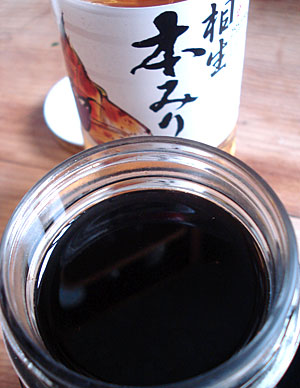
The base of mentsuyu is a mixture of soy sauce, sugar and mirin called kaeshi (or hon-gaeshi: hon means "real" or "authentic"). It can also be used as a flavoring base for many other things. You just need good quality dark soy sauce, white sugar, and good quality mirin. It keeps for months in the refrigerator, or even in the freezer (where it will stay liquid) so I like to make as big a batch as I can afford to price-wise and fridge-space-wise.
This is similar to the Japanese essence mix, but doesn't include the kombu seaweed or bonito. If you are a vegetarian you can use kaeshi safe in the knowledge that it's totally vegan, and combine it with a vegetarian stock. Kaeshi also lasts a lot longer since the basic ingredients are indefinite keepers.
I'll be talking about cold noodles and such in upcoming posts, so if you'd like to follow along, you may want to make some kaeshi to be ready.
This is a very traditional basic recipe.
Kaeshi
This makes about 6 cups.
- 4 1/4 cups (or 1 litre, the standard size for a soy sauce bottle) good quality dark soy sauce
- 3/4 cup / 180ml mirin (hon mirin, the kind with alcohol in it, is preferred)
- 3/4 cup / about 150g granulated or superfine white sugar (see notes)
Put the mirin in a pan and bring up to the boil; lower the heat and let simmer a bit to evaporate much of the alcohol content.
Add sugar and stir until melted. Add the soy sauce, and let it warm up slowly, stirring. It should never boil - once it starts barely bubbling, take it off the heat.
If any cloudy scum has accumulated on the top, skim off carefully. I t can be used right away, but is best when allowed to rest for at least a day.
Let cool and store in a glass or other non-reactive, airtight container in the refrigerator. (I keep it in preserving jars with screwtop lids.) It will keep for several months under refrigeration.
Notes
I like this to be not that sweet, but I am from the Kanto (Tokyo) area. People from the Kansai area would use 1 cup of sugar for this instead of 3/4ths. You may want to adjust the amount of sugar to your taste.
In Japan, use san-on-to- (三温糖) or cooking sugar.
If you are sugar-intolerant in any way, a heat-safe sugar substitute should work, though it's not tested here.
Mirin is a fortified sake with alcohol content, and is primarily used as in cooking rather than for drinking. Honmirin (本みりん)is 'real' mirin, made with traditional methods. You may also see aji mirin or mirin choumiryou for sale - this is an alcohol-free (or very low alcohol) mirin flavoring, a fairly modern invention. I prefer hon mirin since I think it has a better flavor (also, better brands of mirin only come as hon mirin)
Submitted by maki on 2007-05-14 17:18.

 Welcome to Just Hungry, where we serve authentic Japanese recipes and more! I'm







Comments
Rei
14 May, 2007 - 21:10
Permalink
Cold noodles are the best!
Thank you so much for posting this recipe! I've been wanting to make some cold soba or somen now that it's about 100F/38C here in Arizona and I don't really care for the premade bottled mentsuyu out there. My grandpa used to make cold o-somen for us when we'd go visit but I never found out what he used to make his. Anyway, horray for cold noodles!
maki
14 May, 2007 - 22:19
Permalink
dilute with dashi
Rei, just in case, you'd dilute the kaeshi with dashi to make mentsuyu (I'll write about that next time) I'm glad you found it helpful!
Rei
17 May, 2007 - 20:46
Permalink
Cool
Yeah, I kinda figured that out as I was reading the recipe. It sounded way to concentrated to be used on its own, hee!
Greg
17 June, 2007 - 18:26
Permalink
Soy Sauce/Shoyu Type
By dark soy sauce do you mean koikuchi (whats sold as regular shoyu in the US) or another type? If another type, can you recommend a particular brand? Thanks!
Sam
2 July, 2007 - 07:01
Permalink
Dark Soy sauce?
The only Japanese Soy sauce I can find is Kikkoman naturally brewed.
Is that dark enough? Or what soy sauce should I be using? Thanks
maki
3 July, 2007 - 17:21
Permalink
dark soy sauce
Most of the soy sauce you'll see sold generally is dark soy sauce. Light soy (usukuchi) is generally only available in Japanese food stores (it's lighter in color, but actually higher in salt content). So regular Kikkoman is fine.
anon.
6 November, 2007 - 02:00
Permalink
“especially since the
"especially since the better quality mirins only come as hon mirin."
Hon mirin.... just means bottle of mirin. So what are you talking about?
anon.
26 December, 2010 - 01:24
Permalink
Re: “especially since the
Don think thats right, If Hon-mirin meant "bottle of mirin" that would mean the box of powdered dashi I have in my cupboard "hon-dashi" is a bottle of dashi?
maki
26 December, 2010 - 19:54
Permalink
Hon mirin
Whoa, this is a very old comment but I don't think I answered it. To clear up any confusion, the "hon" prefix means "real" or "authentic". Therefore, hon-mirin does not mean bottle of mirin. It means "real" mirin, as opposed to say, "aji-mirin" which indicates it's a processed mirin flavored flavoring ingredient.
Hon-dashi is a brand name, and means 'real' dashi (in actuality it's dashi stock powder or granules).
maki
6 November, 2007 - 07:51
Permalink
mirin
I mean to say that the better quality mirins do not come in an alcohol-free version.
Kakeibo Please
22 July, 2010 - 05:49
Permalink
Re: mirin
Hello,
Can you please tell me of a good brand of honmirin to be found in the US? Would you say that the Eden brand would suffice?
Thanks!
maki
22 July, 2010 - 08:46
Permalink
Re: mirin
I've never tried the Eden brand myself, but Mitsukan is a maker whose products are widely available at Japanese grocery stores, on Amazon, etc.
Meiyun
26 December, 2007 - 15:45
Permalink
Dark Soy Sauce
Hi,
Can I use Chinese dark soy sauce? Is it the same as Jap dark soy sauce? If it is not advisable to use Chinese dark soy sauce, can you recommend a few Japanese brands of dark soy sauce that taste good? We have Japanese supermarket (Isetan) here.
Shockr
11 July, 2010 - 12:03
Permalink
Re: Dark Soy Sauce
Japanese and Chinese soy sauce is made from different ingredients. I prefer the taste of low sodium Yamasa but it is hard to find. Kikoman is found all over the world but the low sodium version is harder to find.
Chinese soy sauce contains mostly soy but Japanese soy sauce is mostly wheat.
Chinese dark soy sauce is actually less salty and thicker (aged?). It is used for stewing, roasting, etc. Chinese lite soy sauce is usually stronger and saltier in taste.
mirror
17 February, 2008 - 10:45
Permalink
Cold soba is my all time
Cold soba is my all time fav. Thanx for this recipe, came in really handy, esp now tat i'm not located where japanese food or sauces are readily available.
jani
5 March, 2008 - 06:04
Permalink
go figure
Wow...and here I thought it was always made with komb, bonito, and those big dried fishies.....saw my mom making it when I was growing up, and always followed the same thing.....its about the only thing I attempt to make without measuring ingredients.
maki
5 March, 2008 - 15:22
Permalink
jani, basic kaeshi doesn’t
jani, basic kaeshi doesn't have the dashi ingredients you mention in it...I think because that would lessen the keeping qualties. I do have a version which has dashi ingredients (see here) but it has to be refrigerated. That's probably closer to what your mother made.
Bryan
15 February, 2009 - 14:27
Permalink
Re: Basics: Kaeshi, soba and udon noodle soup or sauce base
You are the best. Thanks!!! NOw I can enjoy cold soba, where it's difficult to find.
rhiannon
2 May, 2009 - 02:24
Permalink
Re: Basics: Kaeshi, soba and udon noodle soup or sauce base
for some reason I always seem to have problems getting the sugar to dissolve in rice vinegar or mirin. No matter how much I stir or how low or high I heat it, it just sits in the bottom of the pan.
Kim
19 July, 2009 - 00:14
Permalink
What else can I use this in?
I made this recipe for zaru soba with great success. Now I have a lot left over! You mentioned that is can be used as a flavoring base for many other things, and I was wondering if you could add some links to other recipes or uses for Kaeshi. Thanks for making Japanese food so accessible - I love this blog.
anon.
24 July, 2009 - 04:40
Permalink
Re: Basics: Kaeshi, soba and udon noodle soup or sauce base
is superfine/granulated sugar especially important, or is just the normal white sugar fine to use?
Eoin
26 December, 2009 - 17:32
Permalink
Re: Basics: Kaeshi, soba and udon noodle soup or sauce base
My taste buds may be defective, but I don't particularly
like sweet things. In consequence, my kaeshi [if that's
even its proper name] is: 10 parts shoyu to 1 part mirin.
I just need a bit of sweetness to take the edge off the
saltiness of the shoyu. I wonder is this formula
unusual? In any case, it's perfect for me.
Eoin
28 December, 2009 - 20:08
Permalink
Re: Basics: Kaeshi, soba and udon noodle soup or sauce base
On second thought, the ratio seems more like
1 part mirin to 7 parts shoyu- still a bit on the
saltier side.
maki
29 December, 2009 - 02:16
Permalink
Re: Basics: Kaeshi, soba and udon noodle soup or sauce base
The ratio I have given in my recipe is a classic one. You are of course free to vary it, though it's not very classic - more like as you described, soy sauce with the edge taken off.
Eoin
11 January, 2010 - 19:19
Permalink
Re: Basics: Kaeshi, soba and udon noodle soup or sauce base
Thanks, Maki. The proportions I used were
abstracted out of a recipe for Tosa dipping
sauce, which stipulated a 10-to-1 ratio.
After experimentation, I got the ratio down
to 7-to-1. In any case, though I may sometimes
take my own path, I always appreciate your
guidance.
Sara
23 January, 2010 - 00:10
Permalink
Udon soup base
Thanks so much for this base. As a college student, my budget is limited and this soup base is something I can recreate and mess around with the things I have in my fridge. Might not turn out Japanese *at all*, but its something easy I can turn to when I want something that gets me excited about my leftovers (and isn't MSG-filled).
For example, I had a box of decent msg-free chicken broth, low sodium soy sauce, and some random veggies that needed to be used up (carrots, green onion). I love throwing random veggies from my fridge into an otherwise boring pasta or rice dish (which I keep around in bulk).
For the chicken broth version, I didn't have enough soy sauce (and on a freezing cold day when I didn't want to run back to the store), so I used these together with some shiitake mushrooms and it tasted quite good, although not something I would call Japanese. With just a little bit of tofu (also cheap and tasty), it kept my tummy full (and happy) all day.
Now, if only I could find a way to make okonomi yaki on the cheap....
chopchop
8 February, 2010 - 04:59
Permalink
Re: Basics: Kaeshi, soba and udon noodle soup or sauce base
Thanks, I'm going to try this soon. I hate the ingredients list in the soup base available to me in the store, so I'm very happy to find this recipe. I love your blog.
mei
4 December, 2010 - 13:37
Permalink
Re: Basics: Kaeshi, soba and udon noodle soup or sauce base
Dear Maki, I will like to make kaeshi and use it for soba dipping sauce. I went to the Japanese food section of a local supermarket here in Singapore and found this soy sauce: http://www.sushimania.com/uploads/tx_QRS/yamasa_regular_01.jpg
Is this regular or dark soy sauce? Can I use this to make kaeshi? Thanks so much!
maki
4 December, 2010 - 14:41
Permalink
Re: Basics: Kaeshi, soba and udon noodle soup or sauce base
Yes that's regular or dark soy sauce. (Light colored soy sauce really is light colored and may not even look like soy sauce to many people.) You can use that to make kaeshi. :)
mei
6 December, 2010 - 08:52
Permalink
Re: Basics: Kaeshi, soba and udon noodle soup or sauce base
I just bought the shoyu yesterday. Can't wait to make it! Just want to check, after I made the kaeshi, can I dilute it with dashi stock immediately to make soba tsuyu, and store it in the fridge for convenient use later? Thanks!
maki
7 December, 2010 - 10:59
Permalink
Re: Basics: Kaeshi, soba and udon noodle soup or sauce base
If you do dilute it with dashi, you will need to refrigerate it. It should last in the fridge for a few days.
caramaharaa
19 January, 2011 - 18:42
Permalink
Re: Basics: Kaeshi, soba and udon noodle soup or sauce base
I am looking for a recipe that seems like it may be pretty simple. Its a vinegar sauce (clear--not sure but I dont think it has soy sauce in it) that is served with harusame (glass) noodles in a local japanese restaurant that my husband and friends often frequent. That's it--just the noodles in a light vinegar sauce --maybe some sugar in it? Have you ever heard of anything like this? I would love to make it for us because we love it so much and when we are at the restaurant--its only served as a small complementary appetizer--and we feel shy about asking for more! thanks cara
maki
20 January, 2011 - 01:50
Permalink
Re: Basics: Kaeshi, soba and udon noodle soup or sauce base
It's impossible to say unless I taste it myself, but if it's clear, salty-vinegary and a bit sweet, it's probably a sunomono sauce made with rice vinegar, salt and sugar. This page has a recipe for wakame seaweed and cucumber sunomono, which you can work off from perhaps.
konoko
7 March, 2011 - 16:36
Permalink
Re: Japanese Basics: Kaeshi, soba and udon noodle soup or ...
I have a favourite mushroom flavoured dark soy sauce, is this okay to use instead of regular?
Randal Oulton
13 April, 2011 - 22:46
Permalink
Re: Japanese Basics: Kaeshi, soba and udon noodle soup or ...
To make the Kaeshi into Mentsuyu, any advice? How much dashi? Just slap the dashi in or any special steps?
maki
14 April, 2011 - 04:23
Permalink
Re: Japanese Basics: Kaeshi, soba and udon noodle soup or ...
Do you mean something like a mentsuyu concentrate? If so, you may find the Japanese essence is closer to what you're looking for.
ongakuchan
2 June, 2011 - 07:26
Permalink
soy sauce question
Can I use tamari soy sauce to make this recipe?
anon.
6 June, 2011 - 06:06
Permalink
Re: Japanese Basics: Kaeshi, soba and udon noodle soup or ...
Can Kaeshi be used for something other then mentsuyu?
pz
1 November, 2011 - 15:18
Permalink
Japanese Basics: soba sauce
Hi I tried finding mirin, I'm from Singapore but its rather tough finding, so I bought Yamasa Soumen senka soup base, can that be used as well? I'm cooking for 2 people , if I would like to try out your receipe, what would be the directions for the quanity of the sauces for me? Any form of help would be very much appreciated
maki
1 November, 2011 - 17:44
Permalink
Re: Japanese Basics: soba sauce
I am not 100% sure since I have never used that particular product but that sounds like a readymade soup base to me. You only need to dilute it with water to use. The instructions should be on the bottle.
Daryl
26 January, 2012 - 03:54
Permalink
Re: Japanese Basics: soba sauce
You can find honmirin at Meidi-ya Liang Court, but it is expensive. They carry a variety of mirin substitutes though which are labeled as "mirin seasoning" or something similar, for < $5 a bottle.
Fairprice Xtra also has mirin substitutes in the Japanese section, which are affordable and work quite well. I remember buying a bottle for just $3...
To make a cold noodle dipping sauce that tastes good, there is no substitute for using dashi made with kombu and hanakatsuo (you can buy these either at Meidi-ya or the Isetan at Shaw Centre). Sadly, I only realized this after 5 years of trying various bottled tsuyus...
anon.
17 February, 2012 - 03:47
Permalink
Re: Japanese Basics: Kaeshi, soba and udon noodle soup or ...
I love this Japanese dish very much but I am not able to consume mirin or any sauce containing alcohol. Could you suggest an alternative? Thanks.
sergio
19 March, 2013 - 21:40
Permalink
Re: Japanese Basics: Kaeshi, soba and udon noodle soup or ...
Thanks for sharing. Mexican amateur cook !
Eating on Two Wheels
8 June, 2014 - 20:37
Permalink
Re: Japanese Basics: Kaeshi, soba and udon noodle soup or ...
Curious: what is the difference between tsuyu and mentsuyu?
Thanks!