
Homemade Umeboshi (Japanese salt-preserved plums)
Update: I've revised this, possibly the most popular umeboshi recipe in English online, to include some key troubleshooting notes. Originally published June 18, 2009. My mom has been making a batch of umeboshi every year since, and I've also added some more notes from her.
My mother came for a visit this week, bringing along a pot of her homemade umeboshi. I asked her to tell me how she makes them; not only did she write it down for me, she even had pictures she'd taken of her attempts in the past couple of years! So, here is my mom's version of how to make homemade umeboshi. I've freely translated her Japanese explanation to English.
My mother [my grandmother - maki] used to make umeboshi every year. When I lived in New York, I was too busy working to do much cooking, let alone umeboshi! But now that I am retired, I'm trying to remember how to do things the old way. Homemade umeboshi is so much more delicious than store bought, so they are worth the effort.
Ingredients and equipment
You only need 4 ingredients to make umeboshi: Ume plums, coarse sea salt, red shiso leaves and shochu or shouchuu, a type of distilled alcohol beverage that is available all over Japan and is quite inexpensive. If you can't get shochu, you can use vodka or another kind of flavorless distilled beverage.
(Troubleshooting: The ume plums should look like firm, small unripe apricots. You can't really substitute apricots however because they don't have the tartness that gives umeboshi its unique character. You can give it a try with small, unripe, unblemished apricots if you are determined, but there's absolutely no guarantee of success, so don't blame me if it doesn't work! Other fruit like peaches and nectarines are too big to work.)
You also need some bowls, flat baskets, a large, wide-mouth, a deep container made of ceramic or glass or non-reactive plastic (never metal), a weight or a sturdy plastic bag, and large jars to store your umeboshi.
Preparing the ume plums
In Japan, umeboshi are always made in mid to late June, because that's when the ume plums are ready. Ume plums are picked when they are hard and very sour. The kind I use are from the Kishuu region, which is in Wakayama prefecture. Kishuu ume are widely regarded to make the best umeboshi.
I understand that ume plums are now available in the United States. When you buy them, make sure you choose ones that are firm, plump and unblemished. Even small blemishes or cuts on the plums could lead to mold, which is the biggest reason umeboshi can fail.
(Troubleshooting: To repeat, make sure your plums are blemish-free. Blemishes lead to mold!)
Once you have the ume plums, carefully remove any remaining stems. The best way to do this is with a cocktail stick. Try not to pierce the ume plum when you're doing this - again, this can lead to mold.
Once the stems are removed, wash the plums in several changes of water, and then fill a large bowl with cold water and leave the ume plums to soak overnight. This gets rid of some of the bitterness in the plums.
After soaking overnight, drain and dry the plums. Made ready a bowl of shochu or vodka, and dunk the ume plums completely in the alcohol. This is to kill any kind of mold spores on the surface.
Preparing the red shiso leaves
Red shiso or perilla leaves give color and flavor to the umeboshi. Use about 10% of the ume plus in weight of shiso leaves - so for 1 kilo of ume plums, use 100g of shiso leaves. Wash them, take off any tough stems, sprinkle with a little salt and massage the leaves with your hands until they are limp.
Salt to ume ratio
Use a non-iodized, coarse salt. I use a coarse sea salt. You can use kosher salt instead.
The amount of salt, or the ratio of salt to ume plums, determines how salty your umeboshi will end up. My mother used to make very salty umeboshi with about 20% salt! I prefer mine to be quite low in salt, so I use only 8%. The lower the salt content, the more prone to mold the ume become, so beginners may want to start with 12% or 10% salt.
(Troubleshooting: Beginners are highly encouraged to use a higher salt ratio. The lower the salt, the higher the failure rate including mold.)
You can also de-salt the umeboshi a little before you eat them, by soaking them in a weak salt water solution (though this does dilute the flavor too).
Here's the amount of salt vs. ume plums at different percentages:
- 8%: For every 1 kilo of ume plums, use 80 grams of salt
- 10%: For every 1 kilo of ume plums, use 100 grams of salt
- 12%: For every 1 kilo of ume plums, use 120 grams of salt
Make the pickling container ready
Use a large, wide-mouth jar or other fairly deep container. Wash it inside and out thorougly, then disinfect the inside. Some people do this by putting the container in boiling water, but the most common - and convenient - way is to spray it with some shochu or vodka.
Fill the pickling container
Start with a layer of coarse salt. Cover with a layer of ume plums, then a bit of the shiso. Repeat the salt-ume-shiso layers, until the ume are used up. Now, cover the whole thing with a plastic bag or sheet, then put on a weight that is at least half as heavy as the ume plums - in other words, 1 kilo of ume plums requires at least a 500g weight. While there are dedicated ceramic weights available, you can use anything you can find such as a bagful of water (as long as it doesn't leak), a full water bottle, clean rocks in a plastic bag, hand weights or dumbbells, and so on.
Once the container is full and weighted down, cover the top with a clean, porous cloth like a cheesecloth or openweave kitchen towel; secure this with a rubber band or string. Leave in a cool, dark area of your house, until the ume plums become soft and completely immersed in a reddish liquid. This liquid is extracted from the ume plums by the salt. This part of the process will take about a week or more.
(Troubleshooting: If you don't see the liquid coming up to completely cover the plums, try increasing the weight to up to a 1:1 ratio - in other words, for every 1 kg of plums 1 kg of weight.)
Once the liquid is about 2 cm (an inch) above the top of the ume plums, reduce the weight by half, and leave the ume plums in the jar in the liquid until it's time to dry them in the sun.
Drying the plums
The hoshi/boshi part of umeboshi means 'to dry', and the following drying step is very important!
In Japan, we time the umeboshi process so that the ume plums reach the end of the salting stage around Doyou no ushi no hi (土用の丑の日), which falls on a different day every year, but is always around mid to late July. This date is always marked on Japanese calendars, along with other holidays and special days, just like Christian holy days are marked on European calendars. The significance of this day for umeboshi making is that it occurs after the rainy season is over, when the weather becomes hot and relatively dry (this period is called doyou no hi (土用の日), the doyou period). If you are not in Japan, just look at the weather forecast and aim for a period of a few days when it's supposed to be nice and hot and sunny.
Once the ume plums are immersed in the reddish liquid, take the plums and the shiso leaves out of the jar. Reserve the liquid - this is umesu, or ume vinegar, and is delicious! (See instant radish pickle recipe that uses ume vinegar - maki)
Put the ume plums in a single layer on flat baskets, and the shiso leaves in spread-put clumps separately. Here you see that I have lined up the baskets on newspapers out on my apartment balcony. The newspapers protect the top of the table underneath!

Leave the plums like this in a fairly sunny place with good ventilation, for about 3 days. If it rains, take them inside before they get wet. Turn them over at least once a day.
(Troubleshooting: If it rains hard and your plums get very wet, take them in and rinse them off in plain water. Take the ume vinegar out of the jar, wash and re-disinfect the jar with vodka or shochu, and re-immerse your plums in the liquid for a day. Re-dry them on the next sunny day.)
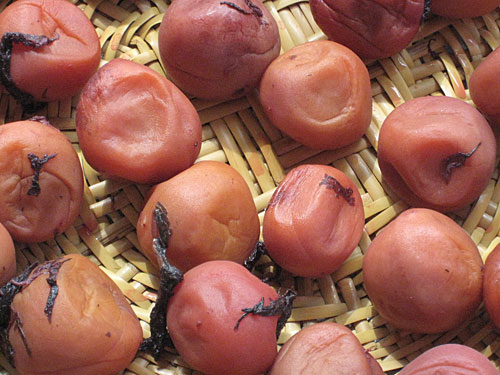
At the end of the drying process, they look like this. The drying tenderizes the plums, giving them a better texture.

The umeboshi are now done. You can store them as-is, in a jar, layering plums with the shiso leaves. Or you can pour back in some of the ume vinegar, to give them a softer texture. This is what I did with this batch.

Here's another batch (from last year). I stored some wet in disinfected glass jars, and some dry in a ceramic jar.

Umeboshi improves with age for a few years. I usually start eating them 3 years after making them, though you can eat them the same year. At around 5 years I think they are at their best. After about 10 years or so they start to disintegrate and become mushy if kept wet, and rather shriveled like an old lady if kept dry - but they are still edible!
An alternate type of umeboshi: White umeboshi
You can make umeboshi without the red shiso leaves. This results in light brown umeboshi and an almost clear ume vinegar.
I hope you have enjoyed this how-to of a very traditional Japanese preserved food!
Submitted by maki on 2011-06-15 09:14.
If you enjoyed this article, please consider becoming my patron via Patreon. ^_^
 Welcome to Just Hungry, where we serve authentic Japanese recipes and more! I'm








Comments
karaimame
18 June, 2009 - 16:04
Permalink
Re: Homemade Umeboshi (Japanese salty pickled plums)
This is so great ! Thank you so much for sharing your mom´s recipe (and way of making) ! Ume plums have so wonderful aroma.. (and one can think it is sweet judging by the smell..). Back at parent´s home we have an Ume tree. Too bad it doesn´t give plums every year (sadly, flowers don´t resist hard winds in tropical storms). My batyan also makes umeboshi herself. It tastes so good... without being packed with sodium glutamate (at least the brand I find here tastes that :( )
wow. I can almost assure that I won´t find ume plums here...
reiyano
18 June, 2009 - 16:41
Permalink
Re: Homemade Umeboshi (Japanese salty pickled plums)
I could never gather the courage to try one of these guys out while I was in Japan (about 10 years ago) to my regret. I really want to try one now. unfortunately if it is high in sodium I cant now! I have high blood pressure so its out of the question... what a bummer!
Mike
10 May, 2012 - 04:59
Permalink
Re: Homemade Umeboshi (Japanese salty pickled plums)
Rei:
All recipes for the umeboshi call for 'sea salt' not iodized salt that is murderous for those of us w/hbp. Sea salt's actually very beneficial for you, high in all types of magnesiums, great for your brain. One that I use is mixture: 1/2 Mediterranean & 1/2 Alaela Hawaiian. Works for me.
marnen
10 May, 2013 - 05:25
Permalink
Re: Homemade Umeboshi (Japanese salty pickled plums)
Salt should have about the same effect on your blood pressure whether or not it's iodized. Sea salt is no better or worse for you than any other kind, really.
Jiru
18 June, 2009 - 16:42
Permalink
Re: Homemade Umeboshi (Japanese salty pickled plums)
Thank you for this tutorial! I love umeboshi, but it's hard to find it without preservatives here. Your mother's photos of the process are wonderful!
Since you're on the topic of ume, do you or your mother happen to have a good recipe for umeshu?
Tracy
18 June, 2009 - 18:12
Permalink
Re: Homemade Umeboshi (Japanese salty pickled plums)
Goodness. My mouth is watering. I have no idea where to find an ume tree so I'm stuck paying an arm and a leg at the Japanese market. It's neat to see the process. So many things get lost as our older generation passes on. Thanks for sharing!
yuko
18 June, 2009 - 19:07
Permalink
Re: Homemade Umeboshi (Japanese salty pickled plums)
I remember my grandfather climbing the ume tree in his backyard to collect the fruit every year. His umeboshi was the best. I was so sad when my mom set up her private practice on the property and converted the yard into a parking lot. I eat store bought umeboshi but it just isn't the same. Most of the commercial umeboshi contain sugar, MSG and other flavoring ingredients since many people don't prefer the sour and salty taste of traditional umeboshi. This post reminded me to ask my gradfather for his recipe. He's getting old and rather senile so I better do it soon.
Milady
19 June, 2009 - 01:26
Permalink
Re: Homemade Umeboshi (Japanese salty pickled plums)
Lovely post on umeboshi! I buy them here in London, usually Clearspring ones and they are pretty nice, and no colouring. My japanese friend used to bring me 'karikko' ones, (I think I am remembering that correctly), which were crunchy. Are these made very differently?
wonderful blog!
hapa bento
19 June, 2009 - 02:46
Permalink
Re: Homemade Umeboshi (Japanese salty pickled plums)
Thank you Maki and Maki's Mom! You description and photos make my mouth water. I've made my own tsukemono, but never tried making umeboshi. It's now on my "to do" list.
Do you know if there is an English name for the ume plums? Or are they just sold with that description?
Thanks again.
Alfox
10 September, 2015 - 21:11
Permalink
There is no english name for
There is no english name for Ume plums or Umeboshi, but sometimes they're called "Japanese Salt Plums", "Japanese Pickled Plums", "Pickled Ume Plums", or just "Pickled Ume" in the grocery store.
anon.
19 June, 2009 - 03:32
Permalink
Re: Homemade Umeboshi (Japanese salty pickled plums)
Mariko Ito, thank you so much for spotlighting this treasure of Japanese cuisine! Over time umeboshi has become
a staple in my kitchen. I've been fortunate to get the paste, the whole plums, and ume vinegar from a company that
imports Mitoku from Japan (Natural Import Company.)
I've just dived into the bento blog and am getting the feel
for making bento boxes for my lunch which include umeshiso
in rice wrapped in nori. I look forward to seeing your
presentations about using umeshiso,too.
Arigato, Blueirises
Shelly FL
19 June, 2009 - 04:21
Permalink
Re: Homemade Umeboshi (Japanese salty pickled plums)
I wonder if it's possible to make umeboshi with any other type of plum? Otherwise, do you know the scientific name of the ume tree so I can see if they are available in the USA? Thanks!
chieko
13 July, 2010 - 12:00
Permalink
Re: Homemade Umeboshi (Japanese salty pickled plums)
Very small plums, about 1 inch in diameter can be used. Unfortunately they are hard to find in stores. Anything bigger will just turn to mush. I was fortunate enough at one time to have an apricot tree that produced very small apricots, just the perfect size for umeboshi. They turned out wonderfully.
kumiko/sidney
30 October, 2010 - 01:19
Permalink
Re: Homemade Umeboshi (Japanese salty pickled plums)
yes that is what my grandma used to make umeboshi
Jimmy
14 April, 2012 - 03:07
Permalink
Re: Homemade Umeboshi (Japanese salty pickled plums)
I have 6 "japanese plumb trees” They are yellow, sweet and about the size of apricots. Would they be good. or should I try and grow a ume tree?
rieko.
18 October, 2011 - 08:18
Permalink
Re: Homemade Umeboshi (Japanese salty pickled plums)
my aunt in canada missed having umeboshi so she started growing the red shiso leaves and made umeboshi's with apricot when they were still green. they will turn out with a milder taste but if you can't get ume these are the perfect substitute.
anon
14 April, 2012 - 00:19
Permalink
Re: Homemade Umeboshi (Japanese salty pickled plums)
great blog and comments
i've made 4 batches of ume over the past 10 years..and still have some from the first batch.
I didn't know what to use either, but had planted a Shiro Plum here in the Kootenays in BC, so have been using them with great success. The trick is to pick them when green and hard....just before they start turning yellow. They are bigger than what people are talking about as Ume plums, but don't seem to suffer from getting mushy...i too have stored them both dry and in the juice. Shiso is easy to grow and last year i also lucked out with a Japanese friend who had a big plant with lots of babies...i collected the seeds and hopefully will grow my own this year. apricots...i'll look for those small ones ...as i live in a fruit growing area and there are some older trees with lovely small fruit...a different variety than the larger ones. good luck everyone...
maki
19 June, 2009 - 05:24
Permalink
Re: Homemade Umeboshi (Japanese salty pickled plums)
The botanical/latin name for the ume tree according to Wikipedia is Prunus mume. I've heard from people in Washington State, California and Georgia that ume plums are available. Good luck to everyone trying to make their own umeboshi!
hapa bento
19 June, 2009 - 05:30
Permalink
Re: Homemade Umeboshi (Japanese salty pickled plums)
Another question...what is outcome if green shiso leaves are used instead of the red? i realize the red leaves provide the nice color, but I'm wondering if the green adds flavor or color.
Thanks again.
maki
19 June, 2009 - 22:05
Permalink
Re: Homemade Umeboshi (Japanese salty pickled plums)
Green shiso won't give the ume a good color, and it also tastes rather different from the red kind (which has quite a strong flavor and is unsuitable for eating fresh really). Green shiso is best eaten fresh!
Koryu
24 June, 2011 - 13:50
Permalink
Re: Homemade Umeboshi (Japanese salty pickled plums)
That is really interesting. Green growers in the UK are trying to grow red shiso and sell it, but they claim its the same as the green leaves. Do you have any info how they are different and how you would use each normally?
I wish I could buy grown red shiso and those plums to make umeboshi...one day!
Monica Wong
19 June, 2009 - 05:31
Permalink
Homemade Umeboshi (Japanese salty pickled plums)
Hi Maki,
Have come to your blogs few times, it is so great and I love your blog and recipes very much!
This Homemade Umeboshi is lovely and looking so yummy!
serena
19 June, 2009 - 05:55
Permalink
Re: Homemade Umeboshi (Japanese salty pickled plums)
Thank you so much for sharing your mom's recipe! I LOVE Umeboshi!
I would love to make these but have no idea where to find ume plums in Winnipeg, its probably impossible!
Soo
19 June, 2009 - 07:22
Permalink
Re: Homemade Umeboshi (Japanese salty pickled plums)
is very nice.. but I am not sure if I would be able to get any Ume in Sydney. What is the common name for Ume? or is there any other plums which I can replace it with?
Thanks
Soo/Sydney
Jeg
28 June, 2011 - 07:50
Permalink
Re: Homemade Umeboshi (Japanese salty pickled plums)
I buy my umeboshi in town at Maruyu,283 Clarence St, it is just at the corner of the QV on Druitt St...
hagu
30 December, 2012 - 16:25
Permalink
Re: Homemade Umeboshi (Japanese salty pickled plums)
Hi Jeg, umm sorry, the question was actually about where to find ume in Sydney - not about where to buy (additive-laden) umeboshi in Sydney.
maki-sama, subarasii saito.
iheartsyntax
19 June, 2009 - 07:27
Permalink
Re: Homemade Umeboshi (Japanese salty pickled plums)
Thanks for the great English explanation!
I just started a batch of umeboshi for the first time, using NHK's "Kyo no Ryori" recipe in this month's magazine. I didn't dunk my ume in shochu (not mentioned in the magazine), and I think there were some minor blemishes on my some of my ume as well... Oh! Now I'm worried about mold! Well, if things don't work out, I know what to do better next time...
S in Morioka, Japan
Nina
19 June, 2009 - 14:50
Permalink
Ume in California
My Nikkei mother planted a few unpreserved ume plums in our front yard in California many years ago. Now we have three huge trees and bountiful ume for umeshu and umeboshi every year. It's also fun to see people walk by and try to bite into a raw ume... =)
Thank you so much for this authoritative recipe, my mom has been using many different recipes and trial and error to make the perfect ume products over the years. I just sent her your recipe, which is so detailed and so are the photos! Arigato and ganbarimasu!
sushidushi
19 June, 2009 - 16:49
Permalink
Re: Homemade Umeboshi (Japanese salty pickled plums)
I'd love to try making these - but I haven't been able to get hold of the ume or the shiso. They might be a little bit lacking in flavour without those two ingredients!
Katie
20 June, 2009 - 15:18
Permalink
Re: Homemade Umeboshi (Japanese salty pickled plums)
That is so awesome to see how this is done, even if it's just to see the process without ever having the intention to make it. I wonder if a similar process could be undertaken with another fruit.
Nikki.Y
21 June, 2009 - 22:04
Permalink
Re: Homemade Umeboshi (Japanese salty pickled plums)
This sounds like the next big party snack. That is, of course, if you can find the perfect plums so they don't mold. Casino en ligne francais
Lala
22 June, 2009 - 01:17
Permalink
Re: Homemade Umeboshi (Japanese salty pickled plums)
Wow Maki, this was a fantastic post! My Gichan made homemade ume years ago and I've always wondered how he did it. I love your blog and read often. Thank you so much.
Q
22 June, 2009 - 07:41
Permalink
Re: Homemade Umeboshi (Japanese salty pickled plums)
Oh wow! Thank you so very much for posting your mothers recipe!(And please thank your mother for the recipe as well!) I have been trying to find umeboshi to buy for a long time(I'm in a small area), but I will just make my own instead!
This post has made me so very very happy!
Capsi
22 June, 2009 - 08:26
Permalink
Umeboshi in Mexico
Thanks again Maki for another awesome recipe!
I can't find ume here in Mexico.
Umeboshi isn't widely available in Mexico but there is this thing we call Chamoy though, which is essentially the same (sour salty..red, pickle.). Its made from a very sour variety of apricot (chabacano acido?)
In Mexico Chamoy is considered a type of candy, isn't that odd? Dagashi kind of stuff. There's also the sauce version of it which is used as a dip and as a popular ice cream flavor.
I have a theory that a long time ago someone from Japan brought Umeboshi to Mexico , it then became a hit but nobody ever bothered to write down the recipe, so ... what remains now is just a bastardized version of it.
This year I'll try using these apricots to make Umeboshi the Japanese way. Wish me luck!
marnen
10 May, 2013 - 05:30
Permalink
Re: Umeboshi in Mexico
Your theory's not too far off. As far as I can tell, Mexican chamoy are likely to have derived either from umeboshi or (perhaps more likely?) from a similar but sweeter Chinese preserved fruit.
Nicholas Lam
11 July, 2009 - 17:49
Permalink
Re: Homemade Umeboshi (Japanese salty pickled plums)
Hi Makiko,
Really great information on Japanese foods here, and my interest lies specifically in Japanese Wagashi and Japanese-style western desserts and pastry. Look forward to reading more of your posts on these subjects.
Cheers!
crissy
13 July, 2009 - 21:41
Permalink
Re: Homemade Umeboshi (Japanese salty pickled plums)
this is so cool! big thank you to your mother for writing that all down and taking photos!!! i wonder if ume plums are available in new york city? will have to inquire at the farmer's market! thank you for posting!
Belle
29 July, 2009 - 18:34
Permalink
Re: Homemade Umeboshi (Japanese salty pickled plums)
Merci/Thanks for the idea and pictures of how to make this pickle. I will be trying it in France and using plums which are similar in texture, size etc. My red shisho leaves are a little slow at growing this year so I might just be able to add only a few. My (Japanese) husband will be happy when these are ready to eat!
Nice blog!
Torta
18 August, 2009 - 04:55
Permalink
Re: Homemade Umeboshi (Japanese salty pickled plums)
Thank you soo much for posting your mother's recipie! It looks really good. I'm just wondering one thing though, is there an alternative way to sterilizing the plums without using alchohol?
maki
18 August, 2009 - 08:29
Permalink
Re: Homemade Umeboshi (Japanese salty pickled plums)
Well, you can try heat sterialization initially of the jar and tools you will be using, but that gets difficult obviously once you have started the process! If you have a problem with alcohol (most of it evaporates after use) you will just have to try keeping your tools, the jar, etc. impeccably clean and hope you don't get funny molds.
anon.
11 September, 2009 - 05:18
Permalink
Re: Homemade Umeboshi (Japanese salty pickled plums)
As a couple others have asked (I know just from reading a couple of other of your articles that you hate when people do this, but I have yet to see an answer), is it possible to use ordinary apricots for this purpose?
Other, side questions that aren't as important as that one:
If I do that, would I be able to adjust the flavor by adding the citric acid that would be missing?
I see some other recipes call to add the shochu to the pickling vessel. Is this advisable, and why?
maki
11 September, 2009 - 06:29
Permalink
Re: Homemade Umeboshi (Japanese salty pickled plums)
I thought I answered this already, but anyway - the thing about ume plums is that they are still very sour when ripe. Apricots are never deeply sour, even when unripe (they are sort of mildly sour). So while the texture would be right the flavor would not be at all. I don't think adding sour/acid would change that - the sourness of ume is quite distinctive. So - you could try making salt-pickled apricots, and they may even turn out good, but they are not going to taste anything like umeboshi. (I prefer to just make apricot preserves with them myself, or just simply stew them a bit with minimal sugar.)
Dani
26 September, 2009 - 07:46
Permalink
Re: Homemade Umeboshi (Japanese salty pickled plums)
Just curious to see if anyone knows a store where I could find red shiso in the Atlanta, Ga area?
ruriko hoffman
2 July, 2014 - 22:31
Permalink
Re: Homemade Umeboshi (Japanese salty pickled plums)
I live in Warner robins Ga. I have both red and green shiso growing in my back yard. But I do not have any idea where to get green umeboshi ume.
If you like I can give you red shiso seeds this fall.
Can you get my email address from this site?
Karen Guthrie
13 October, 2009 - 13:23
Permalink
Re: Homemade Umeboshi (Japanese salty pickled plums)
I have made a very good but not authentic version of this with English bullaces, a kind of small sour wild plum commonly found in hedgerows etc. It was very good!
See http://www.somewhere.org.uk/blog/947
kigurumigirl
3 November, 2009 - 22:09
Permalink
Re: Homemade Umeboshi (Japanese salty pickled plums)
Hi!
I would love to make these but is vodka really ok to use instead. I hate vodka by itself YUCK! Does the umeboshi taste the same with vodka? Can you even taste the alcohol?
nataliamarietta
28 October, 2012 - 07:45
Permalink
Re: Homemade Umeboshi (Japanese salty pickled plums)
The vodka is only used to disinfect the plums. You don't leave the plums in the vodka for any amount of time so there wouldn't really be much of a chance for the plums to
soak up any vodka
dragan
27 December, 2009 - 04:54
Permalink
Re: Homemade Umeboshi (Japanese salty pickled plums)
I live in Queensland Australia and need Japanese plums for my health, I found them in health food store but they are very expensive, could anyone tell me where to buy and I would picle them myself, Many thenks
Ichimoto Family
3 January, 2010 - 04:06
Permalink
Re: Homemade Umeboshi (Japanese salty pickled plums)
Our Family replaces the plums with apricots that are just starting to turn yellow. We also use a nearly one to one mixture of sugar and vinegar to soak the salted and dry fruit. The shiso is salted and dried and added after the apricots and vinegar/sugar mixture has soaked for three days.
maki
3 January, 2010 - 12:15
Permalink
Re: Homemade Umeboshi (Japanese salty pickled plums)
Are the unripe apricots sour enough? Because the thing about umeboshi that makes it umeboshi is that distinctive sourness. If it does work with unripe apricots that would be great for me since they are way easier to get here!
michelle emiko
22 May, 2010 - 01:50
Permalink
Re: Homemade Umeboshi (Japanese salty pickled plums)
My friend's ojisan made "umeboshi" with apricots and they're awesome! They're not very sour but still have the distict flavor. I don't know how he made them, but I highly recommend using apricots.
michelle emiko
22 May, 2010 - 04:03
Permalink
Re: Homemade Umeboshi (Japanese salty pickled plums)
I looked up this recipe because I noticed that my local market had "Sour Plums" in the produce section, and I wondered if they were ume plums and got excited to try to make umeboshi since all the store-bought ones are full of artificial colors and preservatives and chemicals. It's a middle eastern-ish market and apparently the plums are just eaten as-is (green and crunchy) with salt. They must be very seasonal because I've never seen them there before, but I'll definitely get a bunch and try this recipe!
marnen
10 May, 2013 - 05:32
Permalink
Re: Homemade Umeboshi (Japanese salty pickled plums)
FWIW, you can get store-bought ones that aren't artificially colored, though it may take some looking. I like Iida's hachimitsu (honey) umeboshi -- no bad ingredients, not too expensive, nice flavor.
Michi
31 May, 2010 - 20:12
Permalink
Re: Homemade Umeboshi (Japanese salty pickled plums)
Thank you for this recipe. Umeboshi is one of my favorite pickle foods.
I can get umeboshi at a local health food store (Whole Foods carries it) but it's not the true gourmet version. I am at the end of a tiny crock of gourmet umeboshi sent to me from my sister that was probably close to $40. I'd love to become an expert at this and start making a batch every year.
I found your blog by googling "umeboshi recipe" after I stumbled upon an Asian food market (specializing mostly in Korean) and they had fresh ume and shiso leaves. I bought a small bunch of ume and my first batch ever is being pressed right now. It's coming along very nicely but I think I may have used too much salt. I need to go find some bamboo baskets for the drying process. I'm also going to go back to the market and buy a bunch more ume and try a few more batches. After all, I will probably break into them early so I need more batches to make it to the prime 3-5 yrs.
Thank you again for this recipe!
Kristina
7 June, 2010 - 18:53
Permalink
Re: Homemade Umeboshi (Japanese salty pickled plums)
My mother just sent me an enormous box of ume plums from her tree and I started making the umeboshi today. So fun!
Joan Lambert Bailey
1 August, 2010 - 09:14
Permalink
Re: Homemade Umeboshi (Japanese salty pickled plums)
I used your recipe in combination with another from a friend, and now my ume are happily drying. My question for you is, what do I do with the dried shiso? Add it to rice after cooking? Soups? Miso? And can I use it before it dries to make rice? I thought the color and flavor might be interesting. Thanks!
maki
1 August, 2010 - 09:46
Permalink
Re: Homemade Umeboshi (Japanese salty pickled plums)
Hi Joan, congratulations on making umeboshi! The leftover shiso leaves are traditionally dried, and them pounded into a powder to make yukari, a type of furikake (stuff to sprinkle on rice and other things). It's usually dried in the sun, but you could dry it in a very low oven, turning frequently, until crispy and dry, then whiz it up in a food processor. Store it in airtight containers and enjoy! I hope you kept the pickling liquid also - that's called ume-su or ume vinegar, and is a wonderful flavoring condiment.
kumiko
2 August, 2010 - 08:24
Permalink
something similar
a couple months ago my obaa-san made something similar to umeboshi but it was some kind of citrus maybe a tangerine or something but it was as small as a cherry tomato the juice it was soaked it made the greatest lemonade like drink i remember as if it was yesterday i asked her what is this she said she was making something sort of different from umebohi but something similar as well :]
maki
2 August, 2010 - 21:58
Permalink
Re: something similar
I wonder if that could have been karin (the botanical name is Chaenomeles sinensis) - that makes a gorgeous cordial or liquor. But a lot of fruits are turned into cordials in Japan, it could have been something else too!
kumiko/sidney
30 October, 2010 - 01:34
Permalink
Re: something similar
it wasn't karin but maybe i should send you a picture sometime it could or could not be japanese related ahah my family make all sorts of food from different cultures but who know but i am starting to think they are apricots but it is hard for me to decipher since i dont eat them so i am not really sure what it looks like ow would you want me to send the picture?
kumiko
11 November, 2010 - 04:55
Permalink
Re: something similar
it was a kumquat so is that japanese related i was just told it was similar to umeboshi
maki
15 November, 2010 - 11:54
Permalink
Re: something similar
Uh, kumquats (called kinkan in Japanese) are tiny citrus fruits, and are nothing at all like umeboshi. In Japan they are often cooked in sugar syrup and used as a cold remedy. They're also used as garnishes, in jams/marmelades, and such.
lynn
2 August, 2010 - 18:52
Permalink
Re: Homemade Umeboshi (Japanese salty pickled plums)
Good info--thank you!
Just connect with a farmer and order some immature plums. I used plums from my golden plum tree when they were at the green stage. They looked and tasted just like umeboshi.
My first attempts were with confusing instructions, so many had mold. But, soaking for months (years?) in the salty liquid seemed to kill the mold eventually--I still ate them! Not good perhaps, but when you like umeboshi,...
Joe D.
19 October, 2010 - 01:41
Permalink
Re: Homemade Umeboshi (Japanese salty pickled plums)
Thanks for sharing the recipe. One of these days we need to try our hand at making these. My daughter Hana (10) eats umeboshi like candy. We actually have to limit how many she eats. My wife's sister makes them back in Okinawa and occasionally sends us a batch. You are right, home made are much better than store bought.
Joe
Simon
14 January, 2011 - 20:11
Permalink
Re: Homemade Umeboshi (Japanese salty pickled plums)
Thanks for great recepy
I have been using Prunus cerasifera for umeboshi with great results. This is also a "plum" that is actually closer related to the apricot, just like Prunus mume.
I dont use any alcohol, didnt know about it being used, the salt prevented any molds. The ume -"vinegar" is also great.
Here in central Europe Prunus cerasifera is called mirabelle (that is wrong actually), so I call my umeboshi miraboshi instead.
Simon
maki
15 January, 2011 - 01:49
Permalink
Re: Homemade Umeboshi (Japanese salty pickled plums)
Interesting - is Prunus cerasifera the same or different from what's sold as 'mirabelle' in France?
Mikw
22 May, 2011 - 00:20
Permalink
Re: Homemade Umeboshi (Japanese salty pickled plums)
I wonder if prunus cerasifera is the kind of tree growing up the block from me here in Philadelphia. The leaves are purple all summer long, and the fruits are also purple from the beginning. They're about 1" in diameter and pretty sour. I just took my two little daughters with me to pick some, because they're already falling from the tree. I know there is red shiso in the neighborhood, but I don't know if I'll find it in time to include it in the recipe. My plums are soaking now!
sonya norton
11 June, 2015 - 16:23
Permalink
good morning, Mikw and Maki!
good morning, Mikw and Maki! i believe i went all the way to the current time in the comments, but didn't see how the fruit from the red flowering plum turned out as umeboshe. i am trying the same, and hope that my impatience won't prove i wasted my time: i picked about ten pounds (i want to make chutney, too) and the fruit came away from the tree with their stems, proving they were not yet ripe. this is fine for the chutney i make, but is it the un-making of my erzatz umeboshi? i am about to use a non-iodized fine grain salt; will that also affect the flavor and/or structure of the finished pickle? please wish me luck and comment back!
arigatou!
Shari
6 June, 2011 - 06:39
Permalink
Re: Homemade Umeboshi (Japanese salty pickled plums)
Thank you for posting such a detailed recipe, I can't wait to try it. Back when I was living in Japan, I tried making these once, but they came out way too salty. While I make umeshu every year, I haven't yet tried making umeboshi again, but I armed with your mother's recipe, I'm ready to give it another go. Thanks!
jen maiser
14 June, 2011 - 21:06
Permalink
Re: Homemade Umeboshi (Japanese salty pickled plums)
Hi, Maki. We are talking about your recipe over in the comments section of this post at Serious Eats.
http://www.seriouseats.com/2011/06/market-scene-ferry-plaza-farmers-mark...
My ume have been in for about 10 days (I just added the shiso leaves a couple days ago), but there is not enough liquid to cover the plums. Is it necessary for them to be *covered*, or is it sufficient to have them weighted down, salted, and pickling?
Thanks!
maki
15 June, 2011 - 11:23
Permalink
Re: Homemade Umeboshi (Japanese salty pickled plums)
Hi Jen, (I checked this with my mother) the liquid should come up to completely cover the plums. The weight was probably not heavy enough, or you didn't have enough salt to draw out enough liquid - or (though rather unlikely unless the plums were old) the plums were too dry to start with. Did you add at least 8% salt? Beginners have a lot more luck with at least 10-12%. You might try adding a bit more salt, and making the weight heavier too. (FWIW, dumbbells work well). Good luck!
Danny Dawson
16 June, 2011 - 17:37
Permalink
Re: Homemade Umeboshi (Japanese salty pickled plums)
Hey Maki, thanks for updating this post. I've also been using this recipe as a base for some pickled Santa Rosa plums I'm making with excess fruit from our backyard tree, and it's been very helpful. One thing that is not clear to me: after the ume liquor reaches the point where it covers the plums, you say to leave the plums in the liquid until it's time to dry. About how long is this period normally? A few days? Weeks? Would a couple months be okay?
Also, given that I live in the often-foggy Inner Sunset of San Francisco, I'm considering using my food dehydrator on the lowest-temperature setting to handle the drying phase. This is more or less equivalent to putting them in front of a fan indoors. Is this ever done in Japan in less-sunny years? Does the lack of sun exposure make a difference in the end result?
Again, thanks so much for sharing this recipe, and for your wonderful food advice more generally.
maki
17 June, 2011 - 09:45
Permalink
Re: Homemade Umeboshi (Japanese salty pickled plums)
Hi Danny, the period is not exact - basically, usually the ume plums are available before fresh red shiso leaves are, so my mom leaves the ume in the liquid until she can get hold of the shiso. She says it's usually like 7-10 days.
Using a food dehydrator may be an option, and it's possible commercial umeboshi use this kind of drying method. Keep in mind though that the sun's rays also help to kill off any mold-causing bacteria, so if possible it's best to dry them in the sun. Beware not to over-dry the plums if you're using a food dehydrator.
Quentin
30 June, 2013 - 03:06
Permalink
Re: Homemade Umeboshi (Japanese salty pickled plums)
Hey Danny
I love umeboshi and I have a very prolific Santa Rosa Plum tree in my garden here in Roseville (Sacramento area). I'm curious if you continue to make umeboshi from your SR plums and if you have any tips and tricks to share? Especially at what stage do you pick the green plums? (Obviously not right now in June!) We are making plum jelly this week and it made me think of umeboshi. BTW we have plenty of sunshine.here in Sacto so bring them here to dry!
Quentin
Martha
16 June, 2011 - 06:36
Permalink
Umeboshi: What type of shochu does your Mom use?
I live in southern CA in the U.S. and have an ume tree. This recipe was really helpful. Does the type of shochu matter or is it just for disinfectant purposes and not flavor? I have sweet potato and barley shochu at home, but also like, when I can find it, sesame seed and rice shochu. If it does add flavor, does your Mom recommend a particular type and/or brand?
Thanks.
maki
17 June, 2011 - 09:41
Permalink
Re: Umeboshi: What type of shochu does your Mom use?
Hi Martha, the flavor of the shochu doesn't really matter (ther other flavors will overwhelm it anyway) - it's just for disinfecting purposes. (She just uses a generic cheap shochu she says.)
Jeannie
17 June, 2011 - 22:07
Permalink
Re: Homemade Umeboshi (Japanese salty pickled plums) - now ...
One of my most favorite foods. Thank you, thank you, thank you!!!
gail
24 June, 2011 - 05:32
Permalink
Re: Homemade Umeboshi (Japanese salty pickled plums) - now ...
For those interested in the trees they called Prunus Mume here in Oz & available in most nurseries for $30-$50. Now I need to know where to get the red shiso leaves please
gail
anon.
3 July, 2011 - 01:05
Permalink
Re: Homemade Umeboshi (Japanese salty pickled plums) - now ...
Gail,
You said you are "here in Oz" - do you mean that you are in Kansas, USA? I am in eastern Kansas, and several years ago my husband bought a red shiso plant at the farmers market not knowing what it was - he just thought that it was interesting looking. I forget what name he was given for it when he bought it, I think maybe "beefsteak plant" but I was pretty sure that it was shiso, and it is. It never actually got planted in our garden or yard, but has flourished in the "temporary" container in which he planted it. He was told that it was hard to grow from seed; however, not only is the original plant flourishing, we have volunteers all over our garden and yard. So, I guess if it seeds itself, it is not so difficult.
anon.
27 July, 2011 - 18:02
Permalink
Re: Homemade Umeboshi (Japanese salty pickled plums) - now ...
hi - i think you got OZ wrong. OZ is short for Australia.
OZtralia. I have never heard of Kansas being called Oz, and if it was it seems a cheesy reference to the wizard of oz...
Thanks for the info Gail, i will get myself one of these trees so i can make myself some umeboshi. Love this. Along with my kalamata olives... mmm mm. (Yes i am Greek but could have been Japanese in a past life such is my addiction to Ume, miso and tempeh)
Well actually i want to preserve it as the paste, rather than as whole plums. Does anyone know how long the paste lasts for? is it better to keep ume whole rather than paste?
Thanks for the great post - and send your mum love from down under OZtralia!! Some Aussies love ume!
Janice Lee
29 June, 2011 - 06:54
Permalink
Re: Homemade Umeboshi (Japanese salty pickled plums) - now ...
How lovely! Thank you to both you and your mother for sharing this. I can't wait to give this a try!
Yoshi
30 June, 2011 - 08:38
Permalink
Re: Homemade Umeboshi (Japanese salty pickled plums) - now ...
Ok, thank you very much for this. I am definitely trying this out. I didn't realize they last so long! I'm definitely going to try this out and make some good umeboshi. I <3 umeboshi so much! Thank you thank you thank you!
Rikke
20 July, 2011 - 20:46
Permalink
Re: Homemade Umeboshi (Japanese salty pickled plums) - now ...
I suppose Japanese umeboshi are different from Chinese salt pickled plum? (Ingredients say salt, water and plums).
Can I "Japanize" them? I recall Japanese are more sour than the Chinese ones I have; is this because of the alchohol?
I can't seems to find shiso anywhere (which I'm really sorry as I love them).
I love your blog, and it's my no. 1 Japanese food resource!
anon.
30 July, 2011 - 22:45
Permalink
Re: Homemade Umeboshi (Japanese salty pickled plums) - now ...
Love the effort you put in, and just when I started checking online regarding availability of these plums, I see the three year wait period soft note. Amazing, but I’m greedy.
anon.
5 August, 2011 - 02:39
Permalink
Re: Homemade Umeboshi (Japanese salty pickled plums) - now ...
Thank you for this great recipe. My father has a friend in Japan who still makes umeboshi for us but he doesn't get there much anymore. She makes hers with a little honey which is how my daughter loves it. Do you know about making them a little sweet?
Miya
8 August, 2011 - 21:43
Permalink
Re: Homemade Umeboshi (Japanese salty pickled plums) - now ...
ohhh i miss them so much... i love dried Umeboshi as snacks :)
JC
10 August, 2011 - 16:18
Permalink
Re: Homemade Umeboshi (Japanese salty pickled plums) - now ...
I enjoyed reading your description on how umeboshi is made. I find it interesting and enlightening. I have never eaten umeboshi. However, after learning about it in Japanese cuisine, I have checked it out at our Aeon/Jusco supermarket. It makes me want to learn more about Japanese food and cooking. Thank you very much for sharing this recipe in your blog with everyone and teaching us another new thing about your tradition and culture!
minami
9 September, 2011 - 20:05
Permalink
Re: Homemade Umeboshi (Japanese salty pickled plums) - now ...
I also like dried Umeboshi from Okinawa...they are even sweet!
Guia
26 September, 2011 - 09:19
Permalink
Re: Homemade Umeboshi (Japanese salty pickled plums) - now ...
That was so yummy!I wanna taste that,i hope that is also available in the market near me :(
Burta
23 October, 2011 - 06:55
Permalink
Re: Homemade Umeboshi (Japanese salty pickled plums) - now ...
Hi,
I have heard so many good things about UMEBOSHI PLUMS, told to be poisonous when they are picked from the tree Is it true?
Is ithere a suggestted amount to consume it? Like 5 or most 6
What about the paste of umeboshi?
anon.
6 December, 2011 - 08:24
Permalink
Re: Homemade Umeboshi (Japanese salty pickled plums) - now ...
Do you have the recipe for the dry, crunchy and salty version? The packaged ones are very pricey and I tend to go through them in minutes!!!
anon.
20 December, 2011 - 13:19
Permalink
Re: Homemade Umeboshi (Japanese salty pickled plums) - now ...
So, you can get the ume fruit on the East coast apparently. I saw some websites where the trees are sold, and they are okay in this climate. Prunus Mume is the variety of tree.
I'm trying this now with apricots. I know, i know, its not the same, but wanted to experiment. we had a problem with mold. We also are unsure about whether there was too much booze and/or salt. Oh well, its fun to try.
Emma
14 February, 2012 - 17:33
Permalink
Re: Homemade Umeboshi (Japanese salty pickled plums) - now ...
Are shiso leaves essential for making umeboshi?
I'm in Liverpool (UK) and saw a little jar of ume in my local Chinese supermarket.
anon.
2 March, 2012 - 11:22
Permalink
Re: Homemade Umeboshi (Japanese salty pickled plums) - now ...
Hi
Can I use vinegar, instead of alcohol?
If so, what vinegar would you recommend?
thanks
gambit
2 March, 2012 - 15:49
Permalink
Re: Homemade Umeboshi (Japanese salty pickled plums) - now ...
Hi
Can I use vinegar instead of alcohol? If so, which one would you recommend please?
I posted this before but i didn't choose the notification option, apologies for repetition.
thanks!
mustelid
24 June, 2012 - 16:55
Permalink
Re: Homemade Umeboshi (Japanese salty pickled plums) - now ...
Thank you for this tutorial! I was wondering, is there anything special you have to do to make umeboshi paste from these? Or is it just pureed umeboshi?
Serendipity
29 June, 2012 - 19:33
Permalink
Re: Homemade Umeboshi (Japanese salty pickled plums) - now ...
Great recipe! I can't wait to try it, but it would be a miracle if I could find real ume plums (I live in France). Does anyone know what would happen if I used another kind of plum? What about apricots or peaches? I won't be able to resist giving it a shot out of pure curiosity; I just hope I don't poison myself!
Shari
1 July, 2012 - 20:35
Permalink
Re: Homemade Umeboshi (Japanese salty pickled plums) - now ...
Help, please!
Hi Maki! I hope that you still read these posts and will take the time to reply, I'm running into problems with making my umeboshi. This is my second try, I tried a previous year with little luck, and so far, I'm not having much luck again.
On June 9th I started the umeboshi, using 11% salt and 50% weight on top of the ume; I weighed everything out on my kitchen scale. Things looked as though they were going well, and liquid was rising nicely. Then it seemed to have stalled about halfway up ume layers (2), so on June 26th I added another 50% weight, bringing the weight on top of the umeboshi to 100%. I'm using a clean bag of clean rocks as weight. It doesn't seem to be helping much, though admittedly at this point, it's only been about four days since I added that extra weight.
My questions are: Should I wait and see? Should I add more weight? Add more salt? More salt and more weight?
(And how long should it take for the liquid to come up over the top of the umeboshi? Any idea how much longer than a week?) Help, onegaishimasu!
I really want these to work, I hope you can take the time to give me some tips on how to fix my umeboshi. I didn't see anyone else in the comments with a problem like this, so I don't think that I'm duplicating a question you've answered.
Thank you so much!
marnen
22 July, 2013 - 04:17
Permalink
Re: Homemade Umeboshi (Japanese salty pickled plums) - now ...
I found that I had to use well over 100% of the weight of the ume in order to get the juice to come out.
Shari
9 July, 2012 - 15:32
Permalink
Re: Homemade Umeboshi (Japanese salty pickled plums) - now ...
If anyone else other than Maki has any tips on my umeboshi troubles (see previous post above; in short, my ume don't seem to be releasing liquid as they should and I don't know what I should do) I'd love to hear them. I can't really find any information on umeboshi-making issues out there, and I'm at a loss. I'd hate to have to throw this batch out, they were doing so well, and the ume are ridiculously expensive here!
Marilyn
23 July, 2012 - 17:27
Permalink
Re: Homemade Umeboshi (Japanese salty pickled plums) - now ...
So glad to find this page. I'm an umeboshi newbie in eastern Washington state and finally stopped tiptoeing and jumped in a couple of weeks ago using wild Prunus americanus I came upon while driving in the country. They were pristine, cherry-sized, pale green and sour, just verging on turning yellow, and I have 20 lbs fermenting along nicely in about 12% salt in a food-grade plastic former commercial 5-gallon pickle bucket I begged from a restaurant in town. I'm following a recipe that adds the red shiso (leached with salt and squeezed dry) after the drying, then covers again with their own vinegar and returns, covered, to storage for a year. (Or longer, say you.) Your mama's recipe confirms the amount of shiso I could hardly believe: 10% of original weight of fruit. So it's 2 lbs my niece will be mailing to me from a Japanese grocery in the Seattle area. If this turns out worth repeating, for my next batch I'll figure out how to grow my own red shiso. A tree nursery in the Willamette Valley offers P. ume, but I'm too motivated by my hunter-gatherer gene to wait that long.
Thanks to all for sharing your experiences!
Marilyn
24 July, 2012 - 16:20
Permalink
Re: Homemade Umeboshi (Japanese salty pickled plums) - now ...
Re troubles with getting brine to cover: I'm wondering if it might be a matter of volume. It would be interesting to know the quantity (weight, especially, but volume, too) Maki's mother starts her batch with and how much you are starting yours with. Just a hunch, I don't know the answer, and of course you're paying for the fruit, and paying well, you say. Good luck with saving this season's trial. I'm on my first go and wishing I could come up with beautiful baskets, like the ones pictured here, for the drying.
Shari
27 July, 2012 - 12:53
Permalink
Re: Homemade Umeboshi (Japanese salty pickled plums) - now ...
I'd have to double check, but I think that I'm working with about a kilo of fruit. It runs anywhere from $15-$20/lb here, so needless to say, I wasn't going to be buying a lot of ume.
I would love for Maki to chime in here with more details and some help. I've added yet more weight (so I'm now over the 1:1 ratio of weight, I'm around 1:1.5 now) and I sprinkled on a little more salt. I just don't know if at this point I should be tossing the whole thing out and wait for next year.
Marilyn
28 July, 2012 - 07:01
Permalink
What about using dried shisho leaf?
I, too, am looking at possibly abandoning my lovely start and trying again next season--in my case for want of red shiso. Right now I'm shopping around a color photo of a potted one in hopes someone will say hey-I-know! A produce manager told my niece he only has the red leaf for about two weeks in the spring but his customers often purchase dried shiso for their pickled plums. Do you know of this, Maki, or is the produce manager perhaps referring to the already pickled and dried leaf that customers might buy to use as the yukari you were describing to us. If it's the right dried leaf to substitute for the fresh leaf, would maybe a third of the amount by weight be equivalent? I was glad to go back and read that your mum lets the plums wait in their brine "until she can get hold of the shiso." That's what I'm doing!
maki
28 July, 2012 - 23:10
Permalink
Re: What about using dried shisho leaf?
Hi Marilyn, dried red shiso sounds like yukari. I've never heard of anyone using dried leaves for making homemade umeboshi.
Shari
31 July, 2012 - 02:56
Permalink
Re: What about using dried shisho leaf?
Hi Maki,
Would be be able to help/comment on my question that I had left a little while ago? My umeboshi have stopped giving up liquid, and what's in the jar doesn't rise above the top level of the ume. I'm now at a 1:1.5 weight ratio. Should I add more weight, add more salt, both? Or is this a batch that cannot be saved? I would love to hear any ideas you (or your mum) may have. Please help! Thank you. :)
maki
31 July, 2012 - 16:22
Permalink
Re: What about using dried shisho leaf?
Hi Shari. I would try adding more weight first and see how it goes. If you added too little salt though you may have a problem. If it starts to get moldy in any way you can't save it, but if not (and the weight doesn't work) try mixing in a bit more salt, then transferring to a thick plastic bag (or double-bag), liquid and all. Seal securely then massage it gently, and put it in the refrigerator, on a plate to catch the drips. Massage the bag and turn it 1-2 a day or so. You may be able to salvage it this way.
marnen
2 June, 2013 - 20:29
Permalink
Mold
I've been seeing other umeboshi recipes and blog posts (such as http://health.dir.groups.yahoo.com/group/Microbial_Nutrition/message/106... and http://umamimart.com/2012/07/motoism-nyc-umeboshi-project-year-two/ ) that suggest that it's actually possible to salvage moldy umeboshi. Any thoughts on this? (A few of mine got moldy, so I'm planning to try one of these processes now that I've removed the moldy plums; I just want to make sure I wind up with something safe to eat!)
I assume that ume are too high in acid for C. botulinum, which is my main worry...
maki
4 June, 2013 - 02:48
Permalink
Re: Mold
The method described at the first link should work. But always trust your palate - if the remaining umeboshi have any hint of moldy flavor the mold has probably spread too far.
Marilyn
28 July, 2012 - 07:32
Permalink
Oh! White umeboshi!
Saved! It pays to read even a third time: If I fail utterly to score any shiso leaf this year, there's shisoless white umeboshi to be made, yay!
Marilyn
28 July, 2012 - 08:59
Permalink
Oh! White umeboshi!
Saved! It pays to read even a third time: If I fail utterly to score any shiso leaf this year, there's still shisoless white umeboshi to be made, yay!
Shannon
2 August, 2012 - 00:51
Permalink
Re: Homemade Umeboshi (Japanese salty pickled plums) - now ...
I live in the Midwest part of the United States, and have a very close Japanese friend who taught me to appreciate Japanese foods. I make umeboshi using our wild plums, and they taste almost identical to Japanese plums. My Japanese friend even agreed. I love using the vinegar or brine from making them in salads and for cooking.
Marilyn
3 August, 2012 - 17:28
Permalink
short ration red shiso
All responses to the below most welcome:
I'm about to score a pound of red shiso leaf, which is only half the amount specified by both your mom's recipe and the recipe I actually embarked upon before I found this blog for the 20 pounds of plums (in this case wild, not ume) I started with. The method I'm using salts the cleaned leaves lightly to wilt, squeezes out the liquid released, then mixes and lays down the leaves together with the sun-dried plums and covers them again with the reserved brine to cure for a year. I figure there must be a flavor benefit to leaching the leaves and have also read that the leaves have antiseptic properties; surely that will aid in preserving the pickles.
Hmm, I'll go ahead and ask for opinion about the effect of a short shiso ration, but as I write this out, I'm thinking what I might do is put up only half the dried plums with these leaves and keep trying to get more leaves. Again, comments welcome, don't hold your punches!
Maki, I only just came upon the part of your blog about your grave health matters. Please know I'm visualizing your body in glowing health and adding my spiritual vibes to all those coming your way for your complete recovery and long life.
Marilyn Putney
9 August, 2012 - 06:36
Permalink
Oh, what fun!
Hello, Maki,
My pound of leaves arrived today by express post in what appeared to be excellent condition, crisp and crinkly. To me the scent was similar to that of cumin and most appetizing! After rinsing away the silt and separating the stemmy parts, the usable weight obviously dropped some, then the light sprinkling of salt and squeezing reduced the volume that had nearly filled my sink to a mere double handful. So that's what the surprising quantities in the recipe were about! This amount, interspersed with half the dried plums and half the reserved brine, now comes to about one gallon, and I'm pursuing a new lead for another pound-plus of red shiso leaf for the other half of my dried plums.
A quandary, though, Maki, along the lines of Shari's above, that I hope is a small one: Half the reserved brine does not quite cover the gallon; perhaps a cup more is needed, and probably more, considering that some of it will be taken up again by the plums. How would Japanese tradition solve this? (should it ever happen, that is. Actually I'm betting there's always apt to be somebody's extra vinegar, maybe even well aged, available for topping up.)
One thing I noticed when dipping up the plums for drying: There was perhaps a tablespoonful of undissolved salt in the bottom of the crock, evidence that the brine is just at the saturation point for salt. Then the extraction of water from the plums by the sun-drying might be expected, on reconstituting them in the brine, to raise the salt level again. So won't I have a little wiggle room to top up with a bit of water without losing the plums to mold?
I love reading over all these posts. I was trying to find where you or somebody told how adding water with just a little salt in it gets the salt moving to redistribute better than adding plain water does. And the one from Lynn two Augusts ago that said the long brine curing seemed to solve her mold problems so she ate them anyway, wonderful!
My family have all chimed in ("What the heck are you making?") from their far-flung locations up and down the west coast and have joined my shiso search. And I loved knowing I was only two days off this year's date for Doyou no ushi no hi and had a run of seven hot, sunny days for the drying. Maybe you would tell us if there's an eel run in the rivers at that time, or what?
Keith Stratton
9 September, 2012 - 12:18
Permalink
Making umeboshi in the UK?
Hello,
I live in the UK and I haven't found anywhere I can buy umeboshi and to buy it online would make it extremely expensive, especially considering I've never tried it so may not like it.
My main question is could I hypothetically make an umeboshi substitute using nectarines?
Hope to hear from you soon.
Keith.
craig frazier
29 April, 2013 - 08:41
Permalink
Re: Homemade Umeboshi (Japanese salty pickled plums) - now ...
For everyone's information. the Plum used for umeboshi is just called a plum, it is actually an apricot called scientifically as "prunus mume". It along with the "red shiso" seeds can be bought at amazon.
marnen
21 May, 2013 - 18:54
Permalink
Got some!
Found some ume over the weekend at Mitsuwa in New Jersey. Now for pickling: https://twitter.com/marnen/status/336883816264253441
maki
21 May, 2013 - 22:55
Permalink
Re: Got some!
Good luck!
marnen
22 July, 2013 - 04:19
Permalink
Re: Got some!
Thanks! I lost a few to mold because the juice didn't come up quickly enough, but I think I salvaged the batch. A friend just scored me some shiso, so that's going in this week.
bsand
28 May, 2013 - 16:23
Permalink
Re: Homemade Umeboshi (Japanese salty pickled plums) - now ...
I made this last year. Here are some things I tried that work:
1. Instead of Red shiso leaves I used red basil, it's the same family, it is available year around and it worked great!
2. drying out the umeboshi - I never did get around to taking the umeboshi outside for drying, but my husband found the undried ones too fruity so I dehydrated them in the oven around 180 degrees overnight. This created very dried umeboshi just like my husband likes, if you want them slightly dry I would dry for less time 4 hrs may be?
This year we are planning to make even more. Great recipe, thank you.
anon.
29 May, 2013 - 02:36
Permalink
Re: Homemade Umeboshi (Japanese salty pickled plums) - now ...
Hi!Do you think that one of those plastic japanese pickle presses used form making tsukemono would work for the umeboshi? or do you think that there might be adverse effects from the long incubation?
maki
29 May, 2013 - 04:31
Permalink
Re: Homemade Umeboshi (Japanese salty pickled plums) - now ...
You don't need to press the ume fruit, and in fact doing so would ruin them. I would not use plastic either, because of the acid and salt. Best to stick to glass or ceramic, or enamel (making sure it has no chips or anything) for making umeboshi.
Denise
15 June, 2013 - 04:47
Permalink
Re: Homemade Umeboshi (Japanese salty pickled plums) - now ...
Thanks so much for writing this blog. I used it to make my umeboshi. I started about a month ago and today I took them out of the brine to dry. I even ate one because they looked so good and it was delicious. I am sure they will get even better with age. I love this blog and your bento blog too. Thanks for your help!
Hari Har Kaur K...
10 March, 2014 - 05:44
Permalink
Re: Homemade Umeboshi (Japanese salty pickled plums) - now ...
Can I use an European style ceramic fermenting crock such as a Harsch? It has a lid that fits in a gutter of water so it lets air out but not in. These pickling cocks are used for kimchi and sauerkraut. They come with stone weights. See wisemen.com
=maki]
_Update: I've revised this, possibly the most popular umeboshi recipe in English online, to include some key troubleshooting notes. Originally published June 18, 2009. My mom has been making a batch of umeboshi every year since, and I've also added some more notes from her._
_My mother came for a visit this week, bringing along a pot of her homemade umeboshi. I asked her to tell me how she makes them; not only did she write it down for me, she even had pictures she'd taken of her attempts in the past couple of years! So, here is my mom's version of how to make homemade umeboshi. I've freely translated her Japanese explanation to English._
My mother [_my grandmother - maki_] used to make umeboshi every year. When I lived in New York, I was too busy working to do much cooking, let alone umeboshi! But now that I am retired, I'm trying to remember how to do things the old way. Homemade umeboshi is so much more delicious than store bought, so they are worth the effort.
###Ingredients and equipment
You only need 4 ingredients to make umeboshi: Ume plums, coarse sea salt, red shiso leaves and shochu or shouchuu, a type of distilled alcohol beverage that is available all over Japan and is quite inexpensive. If you can't get shochu, you can use vodka or another kind of flavorless distilled beverage.
__(Troubleshooting: The ume plums should look like firm, small unripe apricots. You can't really substitute apricots however because they don't have the tartness that gives umeboshi its unique character. You can give it a try with small, unripe, unblemished apricots if you are determined, but there's absolutely no guarantee of success, so don't blame me if it doesn't work! Other fruit like peaches and nectarines are too big to work.)__
You also need some bowls, flat baskets, a large, wide-mouth, a deep container made of ceramic or glass or non-reactive plastic (never metal), a weight or a sturdy plastic bag, and large jars to store your umeboshi.
###Preparing the ume plums
In Japan, umeboshi are always made in mid to late June, because that's when the ume plums are ready. Ume plums are picked when they are hard and very sour. The kind I use are from the Kishuu region, which is in Wakayama prefecture. Kishuu ume are widely regarded to make the best umeboshi.
I understand that ume plums are now available in the United States. When you buy them, make sure you choose ones that are firm, plump and unblemished. Even small blemishes or cuts on the plums could lead to mold, which is the biggest reason umeboshi can fail.
__(Troubleshooting: To repeat, make sure your plums are blemish-free. Blemishes lead to mold!)__
Once you have the ume plums, carefully remove any remaining stems. The best way to do this is with a cocktail stick. Try not to pierce the ume plum when you're doing this - again, this can lead to mold.
Once the stems are removed, wash the plums in several changes of water, and then __fill a large bowl with cold water and leave the ume plums to soak overnight__. This gets rid of some of the bitterness in the plums.
After soaking overnight, drain and dry the plums. Made ready a bowl of shochu or vodka, and dunk the ume plums completely in the alcohol. This is to kill any kind of mold spores on the surface.
###Preparing the red shiso leaves
Red shiso or perilla leaves give color and flavor to the umeboshi. Use about 10% of the ume plus in weight of shiso leaves - so for 1 kilo of ume plums, use 100g of shiso leaves. Wash them, take off any tough stems, sprinkle with a little salt and massage the leaves with your hands until they are limp.
###Salt to ume ratio
Use a non-iodized, coarse salt. I use a coarse sea salt. You can use kosher salt instead.
The amount of salt, or the ratio of salt to ume plums, determines how salty your umeboshi will end up. My mother used to make very salty umeboshi with about 20% salt! I prefer mine to be quite low in salt, so I use only 8%. The lower the salt content, the more prone to mold the ume become, so beginners may want to start with 12% or 10% salt.
__(Troubleshooting: Beginners are highly encouraged to use a higher salt ratio. The lower the salt, the higher the failure rate including mold.)__
You can also de-salt the umeboshi a little before you eat them, by soaking them in a weak salt water solution (though this does dilute the flavor too).
Here's the amount of salt vs. ume plums at different percentages:
* 8%: For every 1 kilo of ume plums, use 80 grams of salt
* 10%: For every 1 kilo of ume plums, use 100 grams of salt
* 12%: For every 1 kilo of ume plums, use 120 grams of salt
###Make the pickling container ready
Use a large, wide-mouth jar or other fairly deep container. Wash it inside and out thorougly, then disinfect the inside. Some people do this by putting the container in boiling water, but the most common - and convenient - way is to spray it with some shochu or vodka.
###Fill the pickling container
Start with a layer of coarse salt. Cover with a layer of ume plums, then a bit of the shiso. Repeat the salt-ume-shiso layers, until the ume are used up. Now, cover the whole thing with a plastic bag or sheet, then put on a weight that is at least half as heavy as the ume plums - in other words, 1 kilo of ume plums requires at least a 500g weight. While there are dedicated ceramic weights available, you can use anything you can find such as a bagful of water (as long as it doesn't leak), a full water bottle, clean rocks in a plastic bag, hand weights or dumbbells, and so on.
Once the container is full and weighted down, cover the top with a clean, porous cloth like a cheesecloth or openweave kitchen towel; secure this with a rubber band or string. Leave in a cool, dark area of your house, until the ume plums become soft and __completely immersed in a reddish liquid__. This liquid is extracted from the ume plums by the salt. This part of the process will take about a week or more.
__(Troubleshooting: If you don't see the liquid coming up to completely cover the plums, try increasing the weight to up to a 1:1 ratio - in other words, for every 1 kg of plums 1 kg of weight.)__
Once the liquid is about 2 cm (an inch) above the top of the ume plums, reduce the weight by half, and leave the ume plums in the jar in the liquid until it's time to dry them in the sun.
###Drying the plums
The _hoshi/boshi_ part of umeboshi means 'to dry', and the following drying step is very important!
In Japan, we time the umeboshi process so that the ume plums reach the end of the salting stage around _Doyou no ushi no hi_ (土用の丑の日), which falls on a different day every year, but is always around mid to late July. This date is always marked on Japanese calendars, along with other holidays and special days, just like Christian holy days are marked on European calendars. The significance of this day for umeboshi making is that it occurs after the rainy season is over, when the weather becomes hot and relatively dry (this period is called _doyou no hi_ (土用の日), the doyou period). If you are not in Japan, just look at the weather forecast and aim for a period of a few days when it's supposed to be nice and hot and sunny.
Once the ume plums are immersed in the reddish liquid, take the plums and the shiso leaves out of the jar. Reserve the liquid - this is umesu, or ume vinegar, and is delicious! (_See instant radish pickle recipe that uses ume vinegar - maki_)
Put the ume plums in a single layer on flat baskets, and the shiso leaves in spread-put clumps separately. Here you see that I have lined up the baskets on newspapers out on my apartment balcony. The newspapers protect the top of the table underneath!
Leave the plums like this in a fairly sunny place with good ventilation, for about 3 days. If it rains, take them inside before they get wet. Turn them over at least once a day.
__(Troubleshooting: If it rains hard and your plums get very wet, take them in and rinse them off in plain water. Take the ume vinegar out of the jar, wash and re-disinfect the jar with vodka or shochu, and re-immerse your plums in the liquid for a day. Re-dry them on the next sunny day.)__
At the end of the drying process, they look like this. The drying tenderizes the plums, giving them a better texture.
The umeboshi are now done. You can store them as-is, in a jar, layering plums with the shiso leaves. Or you can pour back in some of the ume vinegar, to give them a softer texture. This is what I did with this batch.
Here's another batch (from last year). I stored some wet in disinfected glass jars, and some dry in a ceramic jar.
Umeboshi improves with age for a few years. I usually start eating them 3 years after making them, though you can eat them the same year. At around 5 years I think they are at their best. After about 10 years or so they start to disintegrate and become mushy if kept wet, and rather shriveled like an old lady if kept dry - but they are still edible!
###An alternate type of umeboshi: White umeboshi
You can make umeboshi without the red shiso leaves. This results in light brown umeboshi and an almost clear ume vinegar.
I hope you have enjoyed this how-to of a very traditional Japanese preserved food![/quote]
lucie
8 April, 2014 - 05:36
Permalink
Re: Homemade Umeboshi (Japanese salty pickled plums) - now ...
After i dried ume, on the skin of ume, which appear the white dote. May i know is it ok? thank you
mae
7 May, 2014 - 09:06
Permalink
Re: Homemade Umeboshi (Japanese salty pickled plums) - now ...
Thank you for the recipe. I'm hoping to try it very soon, but I was reading the questions and answers in your comments section to see if anybody asked about how humidity affects the drying stage. I didn't see anything so I will post my question: I live in Hawaii, a nice, hot, and sunny place...but it's also humid. It's currently 78% humidity. Are there any other options to drying the ume in the sun? Thank you.
maki
7 May, 2014 - 10:33
Permalink
Re: Homemade Umeboshi (Japanese salty pickled plums) - now ...
Most of Japan is very humid in the summer too. If you don't want to dry the umeboshi in the sun, you could try the oven at a very low setting, but you will need to watch out for over-drying.
J Mizuno Kays
28 August, 2014 - 21:51
Permalink
Re: Homemade Umeboshi (Japanese salty pickled plums) - now ...
My Japanese grandmother made these also--sooo good with hot rice! I have a somewhat related question: Do you have a recipe for pickling aka-jiso with salt and vinegar? I used to help my dad harvest, wash, and pack the jars--putting salt between the layers of leaves and then adding the vinegar. I recently read a recipe that recommends squeezing the black liquid out of the leaves before preserving them. I do not recall that we did that step, and the pickles always turned out amazing-no bitterness, etc. Alas, I do not have the recipe--only a memory of using about 1/3 c salt and adding vinegar. Thanks!
fredmmeldis
26 November, 2014 - 06:57
Permalink
Re: Homemade Umeboshi (Japanese salty pickled plums) - now ...
My mother [my grandmother - maki] used to make umeboshi every year. When I lived in New York, I was too busy working to do much cooking, let alone umeboshi! But now that I am retired, Ungagged
anon.
28 November, 2014 - 20:34
Permalink
Re: Homemade Umeboshi (Japanese salty pickled plums) - now ...
Just trying out my umeboshi made this past summer. Looks good but too salty and a bit too hard. Should I water down the liquid or just keep aging them? Also, can I add shaved bonito to some of them?
Thanks!
Sara
4 June, 2015 - 09:04
Permalink
availability of fresh ume fruit in US
I ordered some gorgeous green ume fruit from
Ms. Chera Kim in California, contact her at 760.797.5087---she ships throughout US and season usually ends mid-June.
cat
9 June, 2015 - 14:58
Permalink
Storage recommendations?
hi Maki-san--
thank you for posting this process and all the tips and tricks you've learned from your mom! I'm in the middle of my first attempt at making umeboshi and so far everything is looking good. yay! ;) I did have a few questions about storage... you mention umeboshi taste better with time and recommend a three year "aging" process. what's the best way to store them during this time--do they need to be refrigerated or are they shelf stable? I was planning to split the batch and add umesu back into only half the batch. would that matter for storage?
thanks in advance for your time and help with this inquiry. I'm so happy with my jar of umeboshi and can't wait to try them!
Maky
19 July, 2015 - 18:17
Permalink
Thank you so much for the
Thank you so much for the recipe.
This year we finally have maybe enough small wild plums to try it out and i'm growing red shiso. keeping an eye on the plums so they not over ripe.
will let you know how it turns out.
Mitch
20 August, 2015 - 10:30
Permalink
I have never tried umeboshi
I have never tried umeboshi before but they look so interesting here. Thanks for sharing your tips.
MotherOwl
10 September, 2015 - 10:42
Permalink
Umeboshi drying
Last year I tried, it was a glorious failure, as mold grew everywhere. Now I try again, but this year white umeboshi, as my one shiso plant is ca. 2 cm tall now and have 4 little leaves (laugh if you want to). I matke it with small, tart plums from a nearby wood, as ume does not grow in Denmark and I found out they're near cousins.
Now my question. When (if) I reach the drying stage, could I then use a dehydrator, as our autumn is windy and rainy, or does the Sunshine give something extra?