
The Supersizers Go... on BBC Two: A fun look back at food in history
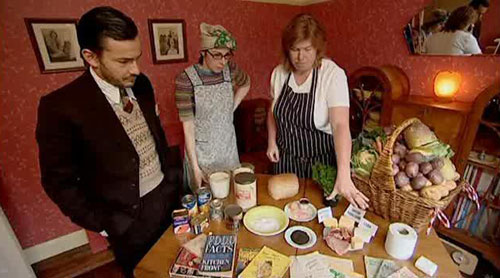
Giles, Sue and Allegra examine a week's worth of rations during WWII.
Last year, a very interesting hour-long program(me) called Edwardian Supersize Me aired on BBC Four. Taking their cue from the hit documentary Supersize Me, Giles Coren, food critic for The Times, and writer/actress/comedienne Sue Perkins spent a week eating as the middle-class Edwardians did - meaning a lot. The pair are back, upgraded to BBC Two, in a new multipart series called The Supersizers Go.... The premise is the same as Edwardian Supersize Me - in each show Sue and Giles spend a week eating as people did in a certain historical era. The first episode aired last night, and the era was World War II.
The Supersizers Go... is a bit more jokey than Edwardian Supersize Me was, but just as fun and informative. Giles and Sue have gotten used to each other it seems, and are are lot more comfortable with each other. The visual details were great - they found a typical 1930s semi-detached house, decorated it inside as it would have been in the 1940s, and both of them dressed in clothing of the era. I could have done without the scenes of Sue chomping on grass and the like, and perhaps the tone was a bit too lighthearted for a period which was probably not much fun at all. Still, these are minor quibbles.
The most interesting part for me of course was look into how people ate during the war. I already sort of knew that food was strictly rationed then, especially things like sugar, fats (butter in particular), meat and eggs. What I didn't know though was that people were required by law to "eat up": it was even a crime to waste food, and some people even went to jail for it! Imagine if that were the case now - most of us would be spending some time behind bars.
The government sent a lot of instructions on how food was to be eaten. There was something called the National Loaf, made with "more of the grain than white bread"; it was fortified with calcium and vitamins and was required eating. It was dry and grey, and was nicknamed Hitler's Secret Weapon. There was also something called Special Margerine included in the weekly rations, also laced with vitamins. Vegetables however were not rationed. People were encouraged to Eat for Victory. And there were those infamous dried eggs, imported from America.
To supplement the rationed food, the British people grew tons of vegetables in their gardens (encouraged to "Dig for Victory") and resorted to foraging in the wild for things like nettles and snails. A black market also sprang up for forbidden foods. Housewives desperate to liven up the table also resorted to a weird range of foods that pretended to be something else - Mock Duck formed from sausage meat, Mock pies, and more. (The Mock part reminded me somewhat of the tendency of some current day vegetarians to try to make Mock versions of meat-based dishes...Tofurkey anyone?)
It seems that food served at designated British Restaurants, initially set up to feed people who had beem bombed out, was not rationed, so eating out became very popular.
Generally though, people ate a lot of carbohydrates, especially potatoes and National Loaf; much less fat and meat, and tons of vegetables - though it seems prepared in ways that sound rather awful from a modern perspective. The most famous wartime recipe was something called Woolton Pie, made by cooking equal parts of potatoes, cauliflowers, carrots and swedes (large turnips) with water and 'vegetable extract' (I assume this is something like Marmite) with water to a mushy state, then topping with a potato or whole wheat (wholemeal) pie crust. On the show Sue did most of the cooking, guided by chef and nutrionist Allegra McEvedy (who's also one of the Guardian Word of Mouth bloggers), though Giles did step into the kitchen when the American G.I.s (bearing nylon stockings as gifts of course) came to visit and whipped up some horrific sounding cake that used paraffin as the fat.
The result of this kind of eating was that by the end of the war, the British people were much healthier than they had ever been - and probably a lot healthier than current day Brits. After a week of WWII eating, both Giles and Sue lost weight and improved their overall fitness indicators. This is probably why there are some calls to return to a 'wartime diet' (most prominently from that improvement-minded guy Jamie Oliver).
In any case, the first episode was The Supersizers Go.. was a lot of fun, and I'm looking forward to the rest of the series. Next week's historical era is the Restoration. Looks like Sue and Giles will be imbibing a lot of alcohol.
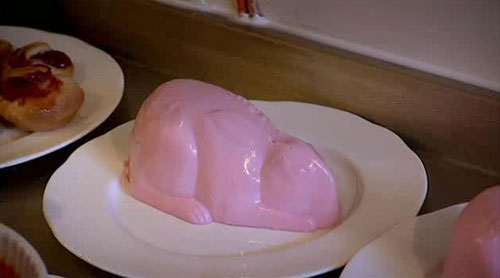
The scariest looking food in the episode: a 'rabbit blancmange' served at a post-war Victory Party.
Links
Disappointingly, the Beeb haven't set up a dedicated site or even a page for the series as of yet. I hope they will, because I really wanted to read more about the subject. In the meantime here are some related sites I've found:
- Giles Coren writes about the whole series. He says each era left him healthier at the end!
- Home Sweet Home Front has a lot of interesting information about life during WWII, including rationing.
- This World War II site also has information on food rationing.
- The World War II era on the British Nutrition Foundation site.
- For digging further into the World War II era, this reprint of the official Ministry of Information book Eating For Victory sounds interesting.
- The Old Foodie is one of my favorite blogs, serving up a snippet of food history daily.
A list of the foods and recipes mentioned in this episode
Breakfast:
- Wheaties (made from stale bread cut into cubes and dried in oven)
- National Loaf (nicknamed Hitler's Secret Weapon)
- Scrambled eggs (made with powdered dried eggs imported from America; only one real egg per week per person allowed in rations)
- Tea
Dinner:
- Woolton Pie
- Oatmeal Sauce
- Raw Cabbage Salad
- Sherry
- Beer
Giles on night watch:
- Spam sandwich (can of Spam on National Loaf bread)
Sue's midnight snack:
- Cold lamb chop
At the British Restaurant (John Lewis' staff canteen - bananas seen there were strictly forbidden during the war):
- Skilly (a much hated soup)
- Cottage Pie
- Carrot and Swede
- Apple Crumble
Mock Dinner:
- Mock Crab with Mock Mayonnaise (margarine, dried egg, vinegar, cheese, salad cream)
- Mock Duck (sausage meat, onion, grated apple, sage, shaped into a duck)
- Mock Apricot Tart with Mock Cream (grated carrot, almond essence, plum jam; cream is made of margarine, sugar, flour)
- Mock Coffee
Lunch with the G.I.s:
- Sue's face painted with beetroot juice
- Sue's legs painted with gravy (to simulate stockings)
- Lettuce and Margarine Sandwiches
- Mock Hamburgers
- American Pinwheels
- Lemon Sponge (made with paraffin in lieu of butter)
- Custard
- Ersatz Coffee (roasted chicory and dandelion root)
- Nylons and a can of pineapple given by the G.I.s to Sue
Winston Churchill's wartime lunch (he didn't ration himself, apparently):
- Native Oysters
- Petite Marmite (a soup)
- Roast Venison with Mushrooms
- Ice Cream and Raspberries
- Stilton
- Apples, Grapes and Walnuts
- Pol Roger Champagne
- Chardonnay
- Claret
- Port
- Cognac
- Cigars
Foraging in the fields lunch:
- Snail and Nettle Consommé
- Rabbit Casserole with Ear Fungus
- Steamed Alexander Bracken
Sunday lunch:
- Snoek Piquante (snoek was a fish imported from South Africa)
- Braised Sheep Hearts (hearts obtained on the black market)
- Wartime Trifle
- Sherry
- Red wine
Supper in the Tube (sheltering from the bombing):
- Cheese and Crackers
- Turnip Soup
- Wartime Sausages (3% meat)
- Cocoa
Victory Lunch (a party after V-E Day):
- Victory Scotch Eggs
- Pilchard Sandwiches
- Cheese Dreams (cheese and beetroot sandwiches fried in margarine)
- Mock Banana
- Fish Eyes and Goo (tapioca custard pudding)
- Jam Tarts
- Rabbit Blancmange
- Orange Squash Jelly
- Toffee Carrots (unpeeled carrots on sticks dipped in melted sugar)
- Honey Chocolate
- Carrot Fudge
- Patriotic Pudding
- Eggless Victory Cake (with lots of icing made with black market sugar)
- Onions as raffle prizes (onions were in very short supply)
Supersizers Go recaps
- Edwardian Supersize Me, not part of the series, but sort of the pilot that aired in 2007
- Description of the whole series, plus World War II (episode 1)
- Restoration (episode 2)
- Victorian (episode 3)
- 1970s (episode 4)
- Elizabethan (episode 5)
- Regency (episode 6, last in series)
Submitted by maki on 2008-05-21 11:20.
If you enjoyed this article, please consider becoming my patron via Patreon. ^_^
 Welcome to Just Hungry, where we serve authentic Japanese recipes and more! I'm








Comments
Lyvvie
23 May, 2008 - 19:40
Permalink
I missed the first one?!
I missed the first one?! Darnnit! I'll have to watch out for the re-run. I loved the Edwardian series. I didn't know that cleaning one's plate was law either!
maki
24 May, 2008 - 10:55
Permalink
It will be repeated tonight
It will be repeated tonight (Saturday May 24) at 7pm UK / 8pm CET time. (after which we can melt into our couches and watch ...Eurovision!)
Lyvvie
27 May, 2008 - 15:42
Permalink
I was able to catch it on
I was able to catch it on BBC online, and the Husband was peeking over my shoulder and trying to pry the headphones off me so he could hear too - so yes we watched it again on the 24th - what an interesting show! I'm quite excited about the Restoration Period show on tonight.
I wasn't allowed to watch Eurovision. Husband put his foot down and forbade it on our telly. He's so cute when he forbids.
maki
27 May, 2008 - 20:37
Permalink
With Eurovision, you
With Eurovision, you didn't miss much...
This is a night where the DVR goes into overdrive for me, with the Apprentice on opposite Supersizers, not to mention (uhh) Britain's Got Talent (uhh) :)
manthursday
6 June, 2009 - 00:56
Permalink
Re: The Supersizers Go... on BBC Two: A fun look back at ...
It's now June, 2009, and I've only just caught up with this programme via this very page. I couldn't resist making a comment because of the way you perpetuate myths about the National Loaf. There was no way that it could have been dry and grey. It was simply bread made with 85% flour, which made it one step short of wholemeal (ie 100% flour). It was fortified with calcium because after 1941 it was compulsory to add calcium to all flour other than wholemeal, and I believe this remains the case to the present day.
The British public was used to nutritionally poor white bread, so something close to wholemeal was bound to come as a culture shock. I can understand some people calling it grey and dry at the time, but journalists should really train themselves not to serve up past prejudices as if they were objective truth.
Your description of Woolton Pie is also a quite dreadful misrepresentation. The original recipe says that the ingredients should be put into a saucepan with just enough water to cover and cooked for ten minutes. A mushy state in ten minutes? I don't think so. But then reporting the facts doesn't make for smart sounding put-downs of the droll past, which I assume is the main intention of this series.
Debbie from Win...
28 June, 2010 - 00:38
Permalink
Re: The Supersizers Go... on BBC Two: A fun look back at ...
Hi,
I have just finished watching the whole series on the Food Network here in Canada and I really loved it. It was very informative along with being very funny. I looked forward to each episode.
anon.
1 April, 2011 - 21:10
Permalink
Re: The Supersizers Go... on BBC Two: A fun look back at ...
This is fun show. Have not seen all of them. Are the two seasons ever going to put on DVD?
Thanks
Tanya Jones
4 April, 2011 - 00:10
Permalink
Re: The Supersizers Go... on BBC Two: A fun look back at ...
A friend of mine lived on WW2 rations recently for 8 months. His comments make interesting reading! http://ontheration.blogspot.com/
noelani
19 February, 2012 - 05:34
Permalink
Re: The Supersizers Go... on BBC Two: A fun look back at ...
Either I have just noticed it recently, or it just started airing here in America, on the Cooking Channel. I have only seen a few episodes but my favorite, so far, is the one about the 1920s. That was the era when my grandparents were growing up. Both of my parents were born within the last 13 months of the decade. I find all kinds of things about the era fascinating and I love how the "Supersizers" go all out to dress in the era, eat as food would have been prepared at the time, and add other interesting tidbits about life during the decade. I absolutely love Sue's fashions and think she looked adorable in the "Colleen Moore" hairstyle. I hope they will make many more programs!
On a more sour note, their 1920s discussion of weight reducing during the 1920s is the first time I have heard that laxatives were used liberally by dieters. My maternal grandmother, born in 1908, had a figure that would have been envied in the years both previously and later on, but was out of fashion when she was a teenager and young adult. I now wonder if a desire to be fashionably thin and flat chested might have been what started her life-long need to use laxatives, and such.
jeffrey leeds
5 March, 2012 - 08:21
Permalink
Re: The Supersizers Go...back to the Rennaissance.
Watching the "Rennaissance" period in England, you spoke as a cure for a ladies'rounded bellies and unusual amounts of cellulite. It proclaimed the benefits of taking a bath in claret, slong with chamomile flowers, wormwood, and other various spices and herbs.
I wonder if there is anywhere,to your knowledge, where I might be able to find the original recipe.
I would be ever so gratful.
Jeffrey Leeds
Sofyan
8 June, 2012 - 20:10
Permalink
Scegli elementi per creme anti-cellulite naturale
Creme per la cellulite può essere scelta non dovrebbe vuole investire molto denaro per realizzare la liposuzione . Questo è esattamente il motivo per cui l'uso di creme per la cellulite diventa il metodo più semplice per eliminare la cellulite sul nostro fisico dal momento che è più conveniente e più semplice. Probabilmente, hai ancora molte domande se fosse brava a sbarazzarsi della cellulite cellulite crema dal troverete marche disponibili sul mercato che offre tutti con il sole e la pioggia e la sicurezza dell'approvvigionamento. Non è facile ottenere la crema giusta cellulite, però, devono stare attenti con la lettura attraverso con gli elementi. La merce è di gran lunga migliore per eliminare la cellulite è davvero una crema che utilizza elementi naturali. Come un cliente, è necessario essere saggio approfittare di elementi naturali, perché non dà effetti indesiderati. Probabilmente, vi è anche una grande quantità di elementi sintetici che offrono risultati più rapidi, tuttavia può danneggiare ulteriormente la pelle. Inoltre, durante la gravidanza non è possibile utilizzare creme anticellulite sintetici.
Kevin
18 March, 2013 - 08:59
Permalink
Re: The Supersizers Go... on BBC Two: A fun look back at ...
Tea lovers cannot resist trying the varieties of herbal teas available in the market but using Dandelion Root Tea will be a memorable experience. It would not merely be based on its taste and aroma but for its medicinal value as well.