
Konnyaku and shirataki FAQ: The almost zero-calorie, weird wobbly food from Japan
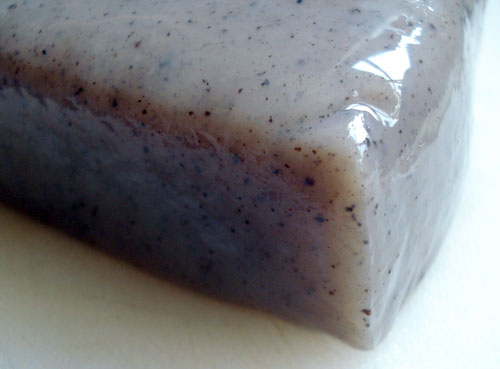
From the archives. For some reason I've been getting several email questions about konnyaku recently, so here is my definitive (I hope) guide to preparing konnyaku and konnyaku noodles, or shirataki, with a small update. Originally published in January 2007.
The quintessential Japanese foods that (may) help you lose weight, are konnyaku and shirataki. Both are made from the same substance, the corm of the konnyaku or konjac plant, also known as the Devil's Tongue plant. Shirataki is also known as konnyaku noodles, to further confuse things, but I prefer to call it shirataki, which means "white waterfall". It's basically konnyaku shaped like long thin noodles.
Konnyaku is about as close to a zero-calorie food as you can get. No wonder, since it's about 97% water. The remaining 3% is mostly fiber in the form of a viscous substance called glucomannan, plus some traces of protein, starch and minerals like calcium. It's the glucomannan that makes it so interesting as a weight loss food though. A big block of konnyaku has about 10 calories, but it's very filling. It's long been called a 'broom for the stomach' (胃のほうき) in Japan because of that.
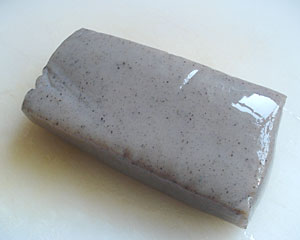 While there are several kinds of konnyaku available in Japan, outside of Japan we can usually only get ita konnyaku, basic slabs of konnyaku. Some konnyaku are white and translucent, and some are grey. Transclucent/white konnyaku is plain konnyaku made from dessicated konnyaku powder, while the grey kind is usually grey because of the addition of a powdered seaweed called arame.
True konnyaku made from raw ground up konnyaku corms, called nama-konnyaku (raw konnyaku), is actually quite grey, and the seaweed-added grey industrial konnyaku is meant to look like that. (It's still made in some areas of Saitama prefecture and other places. My mother is from Saitama and I remember those grey, rather rough konnayku showing up a lot for dinner at my grandmother's house.) Other types of konnyaku mostly seen just in Japan include sashimi konnyaku, which is konnyaku with various flavorful additives in it like powdered nori or citrus skin (mostly yuzu, but other citrus too), ito konnyaku, thick noodle-shaped konnyaku similar to shirataki but slightly thicker, and tama konnyaku, ball-shaped konnyaku. This Japanese page on a konnyaku manufacturer's site has pictures of these.
There is very little difference in flavor or texture between industrial white and grey konnyaku, so it's mostly a matter of aesthetics. I like the grey kind myself, but that's probably because I grew up eating the real grey kind.
Konnyaku itself has very little flavor. It's the texture that will either be interesting or completely off-putting to the eater. It's gelatinous and firm, rather like agar-agar (kanten) but firmer and a bit rubbery. Since it has little flavor of its own, and because it's almost all water, it takes on the flavor of whatever it's cooked in. So, if the texture is okay for you you can add it to all kinds of food for the added almost-no-calorie bulk to fill up those spaces in your belly.
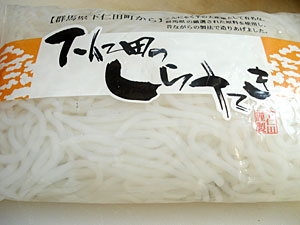 Shirataki has been getting some attention in the U.S. recently because it's noodle-shaped, and there seems to be this obsession with finding noodle and pasta-shaped food that isn't so high in calories and carbs as the real thing, like spaghetti squash strands (which are nothing like pasta either). A lot of people are disappointed when they actually try the shirataki because the texture is nothing like pasta and noodles made from flour. But again - it's a matter of getting used to it perhaps.
[Edit:]Note that there is something called "Tofu Shirataki" or "Noodle Tofu" sold by House Foods America - this is made from tofu and konnyaku yam. It's a little bit higher in calories. They're not the shirataki I'm talking about here, which are called "Yam Shirataki" or "Yam Noodles" - these say they have 5 calories or so per 100g. "Tofu Shirataki" is not very traditional, but shirataki has been around for centuries. You can however use "Tofu Shirataki" in most recipes that call for plain shirataki.
I happen to like konnyaku better than shirataki, because shirataki is often so thin that it's almost not there. Konnyaku is substantial enough to get your teeth into.
More recent konnyaku innovations include sweet konnyaku jellies, chewy gummy-like konnyaku chips, and grain shaped konnyaku to mix in with rice so that you are fooled into thinking you're eating rice while taking in less calores.
How to prepare konnyaku and shirataki for cooking
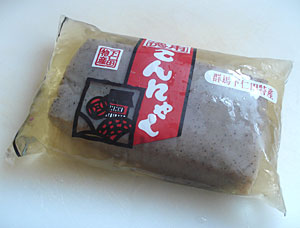 Both konnyaku and shirataki come packed in water - no wonder, since they are mostly water anyway. Open the package in a bowl or over the sink. The water will smell a odd; drain it all away. Drain away the liquid in the bag, rinse the konnyaku or shirataki briefly under cold running water, then blanch in boiling water for a few minutes, or until the water comes up to a boil, and drain well before using. This step cannot be missed, or that 'odd' flavor will linger on your konnyaku or shirataki! If you can let the konnyaku or shirataki sit for a while to dry out more, it will taste better. (Update: another konnyaku recipe with a slightly different method for prepping the konnyaku.)
Shirataki may need to be cut up into manageable lengths. Konnyaku can either be cut up into cubes or slices, or torn apart into rough chunks with your hands. The torn chunks are good for putting into soups or stews, since the rough surfaces help to absorb more flavor. For stir-frying, sautéeing and such the cubes or chunks allow for more surface to be in contact with the hot pan.
The longer konnyaku cooks, the more it takes on flavors. It's really like a sponge in that sense.
The easiest way to try konnyaku is to put some small pieces into a well flavored soup or stew. Putting some chunks into miso soup is a good place to start - just be sure to cook the konnyaku in the dashi stock for a while, so the flavors can penetrate. Traditionally shirataki is put into sukiyaki and mizutaki, both of which are flavorful sort of stews. It's also put into small bags made from fried tofu (aburaage) which are put into an oden, another kind of stew with lots of fish cakes, root vegetables and so on in it.
Some caveats
Since konnyaku is almost zero-calorie, high fiber and very filling. But since it has no significant nutrients other than fiber, be sure not to overuse it. A well known Japanese journalist and writer in the 1960s called Soichi Ohyake was rumored to have died of malnutrition after attempting to lose weight by eating excessive amounts of konnyaku!
If you're serving konnyaku to kids (if they'll eat it...) make sure that the pieces are small enough, and that they chew it well, before attempting to swallow. This was a problem a few years ago with sweet konnyaku jellies that could get stuck in the throat - since konnyaku is so glutinous it was considered to be a choking hazard. (Konnyaku jellies nowadays are manufactured in smaller or different shapes to avoid this, but they have been banned in the United States and Canada.)
Recipe: Stir-fried konnyaku with tuna and garlic chives
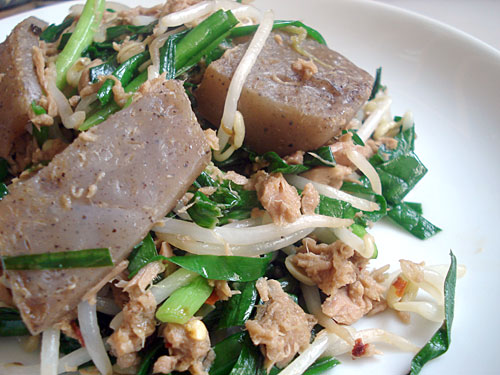
I rather like konnyaku that's been stir-fried or sautéed. It will brown up a little bit in whatever oil you are using, and take on the flavor of the oil besides. I've used a combination of sesame oil and even butter. Here I have used a can of tuna instead of bonito flakes, which I might use normally, but you can use any kind of flavorful protein instead (ground beef may be good..) The garlic chives (nira), which are available at Asian groceries, add a lot of flavor too.
This whole thing is about 400 calories in total, very low-carb, and yields at least 4 servings. It's very filling indeed, and a great one-dish lunch. (Since I'm not following a low-carb regimen I add a cup of rice or something to this.)
- 1 1lb or 450g pack of grey or white konnyaku, pre-prepared following the directions above
- 1 Tbs. butter
- 1 Tbs. dark sesame oil
- 1 small can of water-packed tuna
- 1 large bunch of garlic chives (nira), or substitute green onions and add a couple of cloves of garlic
- About 2 cups of bean sprouts
- Dried red pepper flakes
- Soy sauce
- Salt and pepper
Cut up the konnyaku into slices, and dry the surface well with a paper towel. Cut the garlic chives into approximately 10cm/4 inch pieces. Drain the can of tuna very well and flake. Wash the bean sprouts.
Preheat a wok. Once it's very hot add the konnyaku to the dry pan. It will make squeaky noises as it dries up on the surface. Add about 2 tablespoons of soy sauce, and half the butter and sesame oil, and sauté until the pieces are a bit brown on the ouside and the liquids are absorbed.
Add the red pepper flakes (as little or as much as you like), and the rest of the butter and sesame oil. Add the tuna, then add the vegetables. Stir fry until the vegetables are done. Season with salt, pepper and a bit more soy sauce to your taste.
Links and resources
- As mentioned above, there are several recipes using shirataki in particular on Just Bento, such as this vegetable-rich one.
- Sukiyaki is a classic 'hotpot' type of dish that uses shirataki. Here's my recipe, or rather my mother's recipe!
- Konnyaku Day has links to several konnyaku recipes (mostly with a traditional Japanese bent)
- A few konnyaku recipes are on the House Foods America web site. You're most likely to encounter this brand in groceries, especially in the U.S.
- Japan Konnyaku Association site (Japanese)
Take a look at this spicy Korean flavored shirataki recipe, and this konnyaku gyuudon (beef bowl). Both are perfect for bento!
June 2009 update: Noodles in a can?
I picked up this little can recently at a Japanese grocery store:
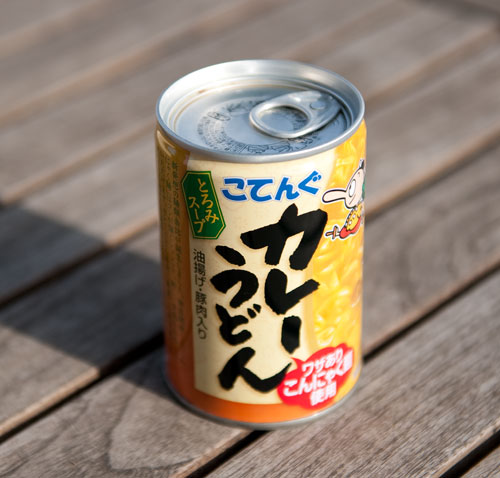
It's a can of what they claim to be curry udon noodles. It's actually not real udon, which are made from wheat flour, but shirataki noodles in a curry-flavored broth. The shirataki noodles do remain chewy, unlike those very soft canned pasta products that you may be familiar with.
Unfortunately, the soup they used tasted and looked like crap. But I did think it was an interesting idea to use shirataki noodles in a can. Think about it: very low-cal, potentially gluten-free 'cup' (or can, anyway) noodles!
Submitted by maki on 2009-06-03 20:23.
If you enjoyed this article, please consider becoming my patron via Patreon. ^_^
 Welcome to Just Hungry, where we serve authentic Japanese recipes and more! I'm






Comments
Rebecca
16 January, 2007 - 20:22
Permalink
Konnyaku and shirataki (OJFTMHYLW no. 1)
Great post. I just tried shirataki for the first time in noodle form, loved it, and recommended it to a friend who recently learned she is gluten-intolerant and really misses pasta. While the texture is not like traditional pasta,I think the form is important too- the mouth-feel of eating noodle-shaped food- in helping with the craving for that type of food.
Jul
16 January, 2007 - 23:37
Permalink
Konnyaku and shirataki (OJFTMHYLW no. 1)
I may have missed this in a previous post somewhere, but do you have a favorite Asian store in Zurich? I've been to one near Oerlikon but would love to hear your suggestions.
Sarah
17 January, 2007 - 03:04
Permalink
Konnyaku and shirataki (OJFTMHYLW no. 1)
I use shirataki sometimes, and have eaten konnyaku, but haven't cooked with it much myself. This recipe looks like a great way to get started! Though my husband is already a little weirded out by shirataki, so I don't know how he'll take the konnyaku . . .
maki
17 January, 2007 - 11:33
Permalink
Konnyaku and shirataki (OJFTMHYLW no. 1)
Rebecca, I do agree about the similar shape helping with some cravings. I didn't want people to think that shirataki is 'just like' real noodles though, as I've seen written up elsewhere.
Jul, answered in a whole post! :)
Sarah, I hope you give it a try (and that your husband likes it! :))
Kent J
9 April, 2007 - 21:05
Permalink
Soup
I have found that putting the noodles in a spicy soup over night really does wonders. It makes them less rubbery and they take on the flavor of the soup. There are many spicy oriental soups that are very low calorie but very high flavor!
I have also found that frying them in peanut oil for a good chunk of time will also turn them more noodle like.
anon.
19 June, 2007 - 14:30
Permalink
hi does anybody here know
hi does anybody here know where i can buy these konnyaku noodles from in sydney?
anon.
7 August, 2007 - 10:33
Permalink
re: hi does anybody here know
Any Asian grocery in Chinatown, Sydney. You should be able to find it in the Japanese section or the cold fridge section near tofu and fresh noodles. Good luck.
Beth
19 January, 2008 - 18:23
Permalink
shirataki
I tried House Foods brand of Tofu Shirataki (spaghetti-shaped) noodles in a chicken-veggie stirfry for the first time. I enjoyed the noodles, and am now going to implement them into my diet program (www.annecollins.com). Since my diet program is basically calorie-counting and keeping to 1350g calories per day, this noodle (and I will try konnyaku too) will play a big part in helping me stay at my calorie limits!
Karie
16 March, 2008 - 18:23
Permalink
How to make noodles from Konjac
Hi there,
I have been scouring the internet for some info on making noodles from the glucommanon powder I bought. I was taking it as a supplement and then graduated to buying the shirataki noodles from House Foods. I LOVE them, but they get a bit pricey when feeding a family of six!! So, I bought the flour from Konjac Foods and the slaked lime it calls for...but I can't seem to get more than a bunch of jelly-like curds! Nothing at all like noodles, and I can't stomach it.
I am hoping to find someone who can tell me how to go about shaping it into noodles, or getting it firm enough to hold block form.
If any of you have info on this, or experience doing this, I would really love to hear from you!
Thanks a bunch!
Karie
anon.
23 July, 2008 - 10:40
Permalink
noodle konnyaku
hi, i am like u tryin to make konnyaku noodle, though i havent buy any of them yet but i am doin a internet research and found your message. drop me a mail, boafever@hotmail.com , i guess u might need to up the konjac powder to firm it, i wil opt out the pickling lime.
anon.
8 May, 2009 - 21:48
Permalink
Re: How to make noodles from Konjac
Check out the forum at miraclenoodle.com . they have instructions there.
anon.
31 July, 2008 - 06:41
Permalink
konnyaku noodles - the real thing?
I was just wondering if the noodles (which look similar to rice noodles) that are wrapped in bundles (and sold immersed in water) are konnyaku noodles? It says so on the label, but it seems that the ones I find at the grocery store are from China... and there is no real mention of it here on this entry.
Beth
13 October, 2008 - 10:57
Permalink
High carb Konnyaku Noodles?
I also bought Konnyaku noodles from the local Asian store here (in Adelaide) and discovered that the carb value that is given on the package is very high (56g per 100g). Fibre isn't mentioned on the Nutrition Information sticker that is attached. These noodles are from China, like yours, and I'm wondering if there is something else in them that pushes up the carb content. All the writing on the package, apart from Konnyaku, is in Chinese, so I can't tell what else might be in the noodles.
maki
13 October, 2008 - 12:53
Permalink
The only substance that I
The only substance that I can think of that would push up the carb count so high is sugar. Maybe those noodles are in a sweet liquid or something?
I only buy shirataki and konnyaku from Japan...because, well, it's sure to be what I expect it to be!
Here's the nutritional information I have from packet of Japanese shirataki:
per 100g: calories - 9; carbohydrate - 3.5g; fiber - 1.8g; calcium: 105.3 mg. All other values are zero or negligible.
MitarashiDango
16 April, 2009 - 06:07
Permalink
Re: High carb Konnyaku Noodles?
that could probably have been rice noodles instead of konyakku. the color is almost the same but not the ingredients. try to check and see what they are before buying ;)
Malia
10 September, 2008 - 01:31
Permalink
Shirataki in the NY Times
Look, shirataki and dieting in the NY Times!
Katie
1 October, 2008 - 17:37
Permalink
Could the two
Could the two be used interchangably in recipes? For instance, could I use shirataki instead of konnyaku in oden?
anon.
19 January, 2009 - 00:30
Permalink
How long will konnyaku keep?
Once a package of konnyaku is opened, how long can it be refrigerated/frozen (can you freeze it?) before it goes off? I can only find larger slabs of konnyaku, and I have nobody willing to share it with me. :)
maki
20 January, 2009 - 00:17
Permalink
Re: How long will konnyaku keep?
If you keep it in its sealed bag, in the refrigerator, konnyaku lasts for a pretty long time. I would not recommend freezing it -it changes the texture and makes it sort of like dense and chewy sponge. Some people like it (and there is even a frozen kind of konnyaku) but I find it sort of unpleasant. (But you may like it so you can experiment!)
sk
2 February, 2009 - 07:50
Permalink
Delicious way to eat it
I recently discovered a simple and tasty way to consume the stuff.
I simply eat it like cold chilled soba, dipping it into soba broth before slurping it up. No cooking-related hassle, negligible added calories (unless you drink the broth which is hardly possible considering how salty it is), only healthy, fulfilling satiety.
:)
I like.
Susy
21 April, 2009 - 16:09
Permalink
Re: Konnyaku and shirataki FAQ
Traditionally, this is used in a Japanese dish called sukiyaki as seen on this link:
http://japanesefood.about.com/od/beef/r/beefsukiyaki.htm
My mother served it from time to time, and always mentioned how this was diet food. I never believed her, but she was right.
katethebake
4 June, 2009 - 16:30
Permalink
Re: Konnyaku and shirataki FAQ: The almost zero-calorie, ...
Thank you :)
I have discovered both konnyaku and your blog within the same few days. I am loving reading your hugely informative posts and now know what to do with the strange slimey blocks of jelly I inquisitively bought from the japanese supermarket last week. What perfect timing you have!
kuri
4 June, 2009 - 21:47
Permalink
Re: Konnyaku and shirataki FAQ: The almost zero-calorie, ...
I was very skeptical of konnyaku at first - especially after stir-frying it (wow! so noisy!) I love it, but have used only a few recipes so far. This sounds so good, I'm going to have to try it - thank you!
Pat
5 June, 2009 - 21:27
Permalink
Re: Konnyaku and shirataki FAQ: The almost zero-calorie, ...
I tried that konnyaku w/ garlic chive recipe; it's a tasty way to eat konnyaku. That reminds me...I have a block of it in the fridge. Speaking of noodle in a can, I recently saw oden in a can the size of cat food can. It's so weird! The cans have cute design, but I can't imagine "enjoying" the food inside.
Sugar Bean
7 June, 2009 - 18:18
Permalink
Re: Konnyaku and shirataki FAQ: The almost zero-calorie, ...
I love shirataki but didn't know that it can be a weight loss food. Usually cook it in a nabe, didn't know that I could stir fry it too. Thanks for the information! Would try it out by myself next time. :)
anon.
9 June, 2009 - 19:51
Permalink
Jelly Cups
I remember when jelly cups got banned but I'm certain they're back in Canada (At the very least Vancouver) with the little lichee bits and all. Not all of them are actualy konyaku, but they certainly exist! :)
Marnen Laibow-Koser
10 June, 2009 - 20:56
Permalink
Re: Jelly Cups
Come to think of it, I may have seen them in the US as well. I'll have to investigate and see if they are indeed konnyaku.
curious
10 June, 2009 - 06:58
Permalink
Re: Konnyaku and shirataki FAQ: The almost zero-calorie, ...
i just tried konnyaku (white) i ate a couple of slivers plain your right no taste at all. abt 15min later i was flushed. im trying to lose weight naturally with healthy foods natural foods and exercise i hope this works out to benefit my health. can u eat a chunk of konnyaku once a day to help your digestive system?
Kansai_Gal
13 June, 2009 - 07:07
Permalink
Re: Konnyaku and shirataki FAQ: The almost zero-calorie, ...
It's not very Japanese, but shirataki is wonderful in pesto with a bit of cheese mixed in. It still absorbs the flavors if you just chuck it in the fridge without any special heating/mixing.
Sadly, when I froze a bit of it, it didn't /just/ change the texture- it turned it into inedible threads of plastic floating in water. I couldn't even attempt to eat it. That was a very unhappy lunch.
Neverwhere
13 June, 2009 - 09:14
Permalink
Re: Konnyaku and shirataki FAQ: The almost zero-calorie, ...
Oh, thank god for you - I've tried and failed to cook konnyaku properly several times, and now I think I might finally be able to do it! I never knew I was supposed to boil it before throwing in the pan, I'm sure that alone will improve things immensely, THANK YOU. :)
I can't wait to read through the rest of your delicious blog, I'm sure I'll find faaaaaar too many things to tempt and delight me. *grins*
:D
16 June, 2009 - 19:47
Permalink
Re: Konnyaku and shirataki FAQ: The almost zero-calorie, ...
I recently discovered Tofu Shirataki in our grocery store. I acutally love it. It's chewey (like vermicelli or clear glass noodles). I usually make miso soup and add the noodles to the miso soup along with tofu, wakame, green leafy vegetables, cooked salmon, soft-cooked egg and some green onion for garnish. That is one satisfying, healthy complete meal.
Lina
16 June, 2009 - 22:31
Permalink
Re: Konnyaku and shirataki FAQ: The almost zero-calorie, ...
Great post! Any idea how long I can leave this stuff in the fridge once opened? I can never use it all at once.
Maria Calandra
6 August, 2009 - 05:46
Permalink
Re: Konnyaku and shirataki FAQ: The almost zero-calorie, ...
Hello,
Do you sell these noodles?
I live in Sydney Australia.
What would be the minimum order and how much would the postage be?
If you don’t sell them, do you know anyone in Australia (Sydeny) who does?
Thank you
Maria
Love learning t...
28 August, 2009 - 04:24
Permalink
Re: Konnyaku and shirataki FAQ: The almost zero-calorie, ...
Thanks so much Maki - I love your pages by the way.
I made a really tasty stir fry with this, onion, bean shoots, snow peas, capsicum, oyster and shitake mushrooms with a garlic and black bean sauce - it definately improved with time and soaking in excess juices.
Thanks so much also for the tip on the rinsing and the smell - I might have been put off otherwise!!
anon.
7 September, 2009 - 07:51
Permalink
Re: Canada?
~Does anyone know where I can find this stuff in canada?
Ive looked all over in stores and asian stores and cant seem to find it. If anyone here has found it could you please tell me which store (not online)? Thank you!
laurelb
21 September, 2009 - 17:12
Permalink
Re: Canada?
Hi anon. I just purchase shirataki at Fujiya market on Clark and Veneables in Vancouver. Great store with lots of wonderful stuff to try!
HTH...
maki
7 September, 2009 - 10:51
Permalink
Re: Konnyaku and shirataki FAQ: The almost zero-calorie, ...
Anon, try the Japanese grocery listing for Canada and go to the Japanese stores, not general Asian/Chinese. Second choice would be Korean stores.
qcakie
28 October, 2009 - 17:06
Permalink
Re: Konnyaku and shirataki FAQ: The almost zero-calorie, ...
Saw a new product in my local grocery store. Its instant konnyaku noodles. Pretty yummy. I like the wasabi flavored one. Its by Konnysof and one bowl has 12 calories! Pretty good if you want something fast and healthy. I bring a box to work every day and just mix the packages inside together to make my lunch.
maryjane
4 November, 2009 - 09:57
Permalink
Re: Konnyaku and shirataki FAQ: The almost zero-calorie, ...
may i know where to get this in Singapore? really feel like trying it.
Cand86
20 December, 2009 - 01:20
Permalink
Re: Konnyaku and shirataki FAQ: The almost zero-calorie, ...
I had no idea you could stir-fry konnyaku! I must try that- so far, I've only ever had it in nabe or oden (and while I've seen them, I've for some reason never tried the shirataki noodles).
It's always fun to serve it to my fairly picky, suspicious-of-foreign-food family- everybody will inevitably pick it up, eyeing it with disgust and asking "What is this?". One bite of its crazy texture and they generally decide it is an inedible alien product, which is perfectly fine- more for me!
I love that it's such a great diet food, too. I honestly don't much care for the texture of tofu (no matter how I prepare it), but konnyaku is much more palatable, so I totally need to experiment with throwing it in dishes other than nabe!
anon.
15 July, 2010 - 14:33
Permalink
Another NY Times mention
http://www.nytimes.com/2010/07/14/dining/14hungry.html
Will definitely look for this in my Tampa grocer.
Diane_Tampa
2 April, 2011 - 04:32
Permalink
Re: Another NY Times mention-Tampa vendor ?
Hi! Where did you buy this in Tampa?
Diane
Amy
14 August, 2010 - 06:24
Permalink
Just tried!
I've had both konnyaku and shirataki sitting in my fridge waiting to be tried, today I tested the shirataki. I made a yellow curry shrimp sort of thing, with just a little coconut milk. I usually use bean thread noodles when I make this dish, which are fairly high calorie. I ended up hiding a ton of spinach and a carrot in this, and loved it- especially since it came in under 200 cal/serving. I actually like the shirataki better! Thank you Maki!
Amy
(Looking forward to the book!)
The Mouse
24 August, 2010 - 09:12
Permalink
Re: Konnyaku and shirataki FAQ: The almost zero-calorie, ...
Thanks for the advice to blanch the konnyaku. I wouldn't have known otherwise. You're right, there is a definite smell to the konnyaku, kind of reminds me of kamaboko. Get well soon.
Kevin
25 August, 2010 - 07:13
Permalink
Re: Konnyaku and shirataki FAQ: The almost zero-calorie, ...
Greeting from Indonesia. I'm producting Konyaku Powder. But I only can do this in January until May. In January until May, I can producting 250 tons of Konyaku Powder. I make them from my own Konyaku. The Konyaku will be dried to be a chips and I'll grind them all to be a powder. And Finally, I'll package it. Are you interested with my Konyaku Powder? But, I don't know how much is the price. It's your offer. If you don't interested with it, please help me are you know where I can sell them all?
Thank You,
please reply me to : dudutpisan@yahoo.co.id
Angela
12 October, 2010 - 01:05
Permalink
Re: Konnyaku and shirataki FAQ: The almost zero-calorie, ...
Thank you, thank you! I'm on a low-carb diet (since eating even a little carbs makes me feel like crap), but I love noodle dishes. Just tried shirataki in a stir-fry and it's great! The texture is very close to rice noodles IMO. I'm going to have to try this in other types of food - like the person above me who used it with pesto.
Cindy
15 October, 2010 - 20:13
Permalink
Re: Konnyaku and shirataki FAQ: The almost zero-calorie, ...
I have had a few packages of yam noodles in my fridge for five months. They do not have an expiry date. Do you know if these still safe to eat?
Anthony McDavid
21 November, 2010 - 05:56
Permalink
Very Low Calorie Breakfast Meal
Ingredients (22 Cal)
Shirataki noodles (200g): 12 Cal
Walden Farms Pancake Syrup (1/4 cup): 5 Cal (no more than; they say 0, but I know it's between 0 and 5).
Cinnamon (2g): 5 Cal
Boil shirataki, then dry cook in heated skillet for a bit. Add the syrup and cinnamon and let the flavors meld for a few minutes on a medium-low heat setting. Serve.
This is the closest thing of which I know to zero calorie pancakes and syrup, which doesn't exist. This may be too small of a meal for some. The 44 Calories from doubling the ingredients is still very modest for the fullness this provides. Make sure to drink plenty of water. All of these ingredients feel somewhat dehydrating on the body.
anon.
17 August, 2011 - 16:25
Permalink
Re: Very Low Calorie Breakfast Meal
I don't believe it's a good idea to "fool" one's body like this. The body knows very well when it's not getting enough calories and nutrients, and then it's gonna rebel. But if you eat "normal" after that breakfast, getting appropiate amounts of calories/nutrients, I guess you will be fine.
Just don't fool your body. Be nice to it. Then it will be nice to you.
anon.
6 December, 2012 - 19:52
Permalink
Re: Very Low Calorie Breakfast Meal
One's body wants to be fat. That's the problem. It's not about fooling anything. It's about training the stomach to produce less ghrelin without going crazy in the process. Eating less and less over time is a good idea, but in reality, dieting is a huge shock to the body and is rarely introduced gradually.
Zero calorie foods like these help make the process more gradual and acceptable to the brain, which can only make change so fast.
KASANDRA ANTOINE
21 February, 2011 - 11:27
Permalink
Re: Konnyaku and shirataki FAQ: The almost zero-calorie, ...
Hey I am living in South Korea. And I was wondering if I can buy the noodle version of this somewhere. Thanks.
Bayu Wibisono
12 April, 2011 - 17:36
Permalink
Re: Konnyaku and shirataki FAQ: The almost zero-calorie, ...
Hi all,
I am from Jember, East Java, Indonesia and recently I am planting about 20.000 of konyaku potato. Hopefully next year I will harvest at least 10-15 tons of raw konyaku potato.
Just to inform you. Thanks.
anon
12 May, 2011 - 07:42
Permalink
Re: Konnyaku and shirataki FAQ: The almost zero-calorie, ...
I am living in Australia. We can buy Konnyaku and Shirataki online asian food shop at www.AsianGroceryStore.com.au
It is nice and can buy online as my place to asian shop need to be drive 45 minutes and it is only a small asian shop, small range products.
jelboe
17 June, 2011 - 05:23
Permalink
Re: Konnyaku and shirataki FAQ: The almost zero-calorie, ...
would like to find sources for both konnyaku and shirataki noodles in Southwest Michigan area.
Jacob
20 July, 2011 - 07:17
Permalink
Re: Konnyaku and shirataki FAQ: The almost zero-calorie, ...
I work at a health food store, and for the longest time we have been selling the shirataki tofu noodles that come in a bag. Then I noticed this new product called Nama konnyaku, in a bag. my co-worker was confused about what konnyaku was. Now I'm glad to say that I will inform him of what it is. Thanks for the info!
anon.
10 September, 2011 - 15:53
Permalink
Re: Konnyaku and shirataki FAQ: The almost zero-calorie, ...
I love shirataki noodles. Ive been buying them online at Diet Noodle Shop. They have delicious recipes and a great selection of products.
Dawn.
12 September, 2011 - 18:34
Permalink
Re: Konnyaku and shirataki FAQ: The almost zero-calorie, ...
I love your recipes! Can you share a dessert recipe using the shirataki noodles?
maki
12 September, 2011 - 19:16
Permalink
Re: Konnyaku and shirataki FAQ: The almost zero-calorie, ...
Well, the texture of shirataki noodles don't really lend to sweet dishes IMHO. Plus I'm anti-artificial sweeteners... However, quite a lot of traditional sweets in Japan are made with kanten (agar-agar) which is another very low or no-calorie food. The texture is much more jelly-like. You can probably find agar-agar recipes all around the internets. (I dont' have any here because...well, I don't have any up yet ^_^;)
Diet
13 February, 2012 - 08:18
Permalink
Re: Konnyaku and shirataki FAQ: The almost zero-calorie, ...
When my daughter was a little girl, I used to use konyak for a diet.
I used it instead of Tofu, noodle and pasta noodle.
Nowdays, my cholesterol level is high.
I started to use Konyak again.
Lulu
16 February, 2012 - 18:44
Permalink
Re: Konnyaku and shirataki FAQ: The almost zero-calorie, ...
Just bought my first packet of noodles, really looking forward to using it. It's far too much for me for a helping. Would it best to prepare the packet, then refigerate what I don't use, or refrigerate the unused portion in its own liquid? Either way, how long do you think it would keep, please? Many thanks for your help.
Mira
21 April, 2012 - 20:41
Permalink
Re: Konnyaku and shirataki FAQ: The almost zero-calorie, ...
I just make my first kannayaku stir fry and it passes the test as my husband loves it! I love scourring the local Asia food stores and hardly found it. I am wondering about a "sweet potato vermicelli" that I purchased. It is dry, made into nests and when I added it to a broth it had very much the same texture as the fresh konnayaku. Only the calorie and nutrition label said Ograms fibre,calories from fat 10 and 200 calories per 50 gram serving. It's very confusing and it doesn't say cooked serving or dry. It came from FUZHOU YONGLONGXING FOOD CO. LTD. What do you think? Mira from Toronto
Toshi
2 August, 2012 - 18:25
Permalink
Re: Konnyaku and shirataki FAQ: The almost zero-calorie, ...
Our Japanese mom used shirataki noodles regularly and my little brother and I grew up calling them rubber-band noodles! I love the texture.
You should have seen the face my mom made when I told her they are also available made out of tofu now. haha
Jack Boch
14 August, 2012 - 01:13
Permalink
Re: Konnyaku and shirataki FAQ: The almost zero-calorie, ...
I just made a shirataki dish with a raw cashew sauce... after the initial "I don't know about this" (the texture was not what I was expecting) I really enjoyed the meal. Served with some sauted mushrooms and eggplant, I have to say that this is most filling low-calorie meal I have had since my doctor instructed me to reduce my caloric intake. I almost feel TOO full!
I did use the House Foods Tofu Shirataki (which actually is almost made from yam) and loved that two servings were merely 40 calories!
yllawwally
22 August, 2012 - 19:58
Permalink
Re: Konnyaku and shirataki FAQ: The almost zero-calorie, ...
A raw cashew sauce sounds interesting. How do you make it? I thought raw cashews cause severe reactions, it has the same stuff as poison ivy. Where do you buy them raw? I
Al Roy
18 November, 2013 - 03:04
Permalink
Re: Konnyaku and shirataki FAQ: The almost zero-calorie, ...
Just wondering if anyone here can recommend a store in the greater Vancouver, BC area where I might be able to purchase bulk konnyaku powder.
I'm looking at it from the perspective of a bulking agent to keep my calorie intake down. I suspect that konnyaku powder may be significantly cheaper (assuming that I can find a place to purchase it) than supplements marketed as 'konjac' or 'glucomannan' powder. Funny thing, that. Call it one thing, and it's cheap. Call it something else, especially a 'weight loss supplement', and suddenly the prices are jacked up a dozen fold or more (especially if it's in capsule form).
I've never really cared for konnyaku, but your recipes above have got me thinking that I may take a second look at it as a food staple. I eat a lot of Korean food, and I suspect that I may be able to incorporate the jellied stuff into some recipes.
Thanks for posting the article.
kannan
28 January, 2014 - 12:22
Permalink
Re: Konnyaku and shirataki FAQ: The almost zero-calorie, ...
Thank you so much for the wonderful post about the preparation of konnyaku and shirataki for cooking. This certainly helped me make use of the near zero fat containing food products. I was really lucky to maintain my diet with this. microneedle roller skin care
Mokus
16 February, 2014 - 11:15
Permalink
Re: Konnyaku and shirataki FAQ: The almost zero-calorie, ...
Dear Makiko!
I'm a big fan of your sites and I've been your reader for years, but this is the first time I comment- because I'd like to ask you about shirataki, of course.
I'm studying in China now and I've been very happy to find out that konnyaku, shirataki and all the related products are easily accessible here. The Chinese however, have a really careless attitude towards calorie tables- I've bought dry moyu noodles (I guess you know that moyu is chinese for konnyaku root) and the package states no other ingredients apart from konnyaku starch and vegetable oil. Taste and texture-wise I'm pretty sure it is indeed shirataki. The calorie count on the other hand is totally off, kind of similar to any wheat pasta- 80grs CH, 10ish grams of protein, 360 kcal per 100 grams.
So, my question would be, is it possible that it is afterall plain shirataki (as i find it strange that all brands outside of china are water-packed, and dry version cannot be found anywhere) and i should just ignore the nutritional values on the package, or the dry version would be this calorific...? Google hasn't been very helpful :(
100 grs reconstituted are about 250 grams, so the 360 kcal would drop to 120 per 100 grs of ready-to-eat noodles, but even that sounds a bit weird. What do you think? Does plain, dry shirataki exist at all in this form...?
Sorry for the long comment and thank you for the answer! :)
Michèle Gervais
3 January, 2015 - 02:13
Permalink
Re: Konnyaku and shirataki FAQ: The almost zero-calorie, ...
Dear Mokus,
The calories are from the vegetable oil. The shiritaki that I eat is not packed in oil but in water so it has no calories.