
Mitarashi dango, rice dough dumplings with sweet-salty sauce
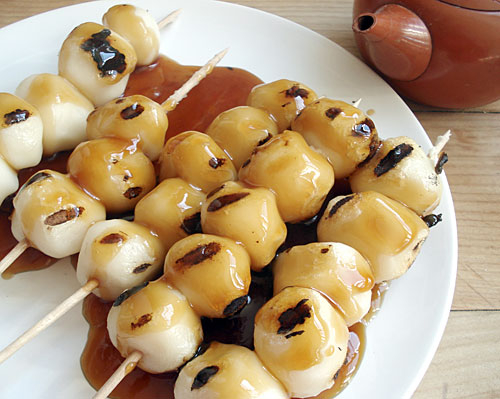
Even if I am Japanese and certainly love most Japanese food, I don't like all Japanese food. And I must confess that I am not too fond of a lot of traditional Japanese sweets that are based on sweetened beans. For the most part they are way too sweet for me, and if I make them for myself I'm always adjusting the sweetness level, as with my ohagi or botamochi.
Mitarashi dango, however, are my absolute favorite traditional sweet. They are not really that sweet really - that shiny caramel colored sauce (which is called mitarashi sauce) is sweet and savory at the same time. It goes perfectly with the bland, slightly chewy dango or dumplings. (Dango is the name for unfilled solid dumplings.)
You will probably see the dango just plained boiled more often than not. But grilling the dango makes them taste much better, in my opinion.
IMPORTANT: Please read before proceeding
Many people have written in over the years wondering about substitutions for the two rice flours, which are the traditional flours used to make mitarashi dango. I've suggested a couple, but this recipe really does work best if you can locate the flours here. They are very commonly available in Japan, and any well stocked Japanese (as in JAPANESE, not generic Asian/Chinese/Korean) grocery store should carry both - or, at least they should carry the shiratama-ko.
Another reason some people have trouble with this recipe is that they do not follow the instructions! Do read through carefully and follow them. You must adjust the consistency of the dough and knead it until smooth before cooking. If you don't do this you are going to have hard dumplings or ones that disintegrate in the water. Follow the instructions! If you can't do that you will fail. Thank you.
2 different rice flours
2 kinds of rice flours are used here. The combination makes a dumpling that is chewy and bouncy but not too sticky.
Joushinko or Johshinko (上新粉, sometimes spelled Jyoshinko) is made from regular Japanese rice (uruchi-mai).
Shiratamako (白玉粉)is sweet or glutinous rice flour, or mochiko, mixed with a little corn starch or potato starch. If you can't find shiramako, you can use mochiko with about 1 tablespoon of cornstarch or potato starch flour added. You can find all of these flours at a Japanese grocery store. You might be able to find them at a health food store too, since rice flour is more popular nowadays as a gluten-free thickening agent for sauces.
The hardest part of this whole recipe is finding the two rice flours. Look for them at a Japanese grocery store - a general Asian grocery store may not carry them.
If you can't find joushinko and/or shiratamako or mochiko...
You must use rice flour. Wheat flours or other grain flours will not work!
For the joushinko, substitute regular rice flour - one that's not labeled "sweet" or "glutinous". For the shiratamako or mochiko, substitute 'sweet' rice flour (one that is labeled 'sweet' or 'glutionous'), which is not actually sweet to taste like sugar; it's just more sticky. You can find these rice flours at general Asian or Chinese grocery stores, as well as some health food stores. Please note that using these different rice flours will change the flavor and texture of the dango, but at least you will have dango with more or less the correct consistency. (You can even experiment with things like red rice flour instead of johshinko.)
(Edited to add:) Can you use all mochiko? You could, but the dango will be of a different texture, gooey and hard to mix up. Please do try to find the non-glutinous type of rice flour to add to mochiko. I have seen both kinds sold at many Chinese grocery stores, so it should not be that hard to find if you have access to a Chinese or general Asian grocery store.
Recipe: Mitarashi Dango
[UPDATE:] I have revised this recipe to use ml ONLY, to avoid confusion, since 1. cup sizes differ depending on where you are (in the U.S. 1 cup = 236ml, in Japan 1 cup = 200 ml, in the UK 1 cup = 250ml. Please use a cup with ml measurements on it to have better chance of success. Please note that the ratio of flours to water is the most important thing! You want 2 parts joushinko or rice flour made from medium grain rice, 1 part shiratamako or mochiko (plus 1 tablespoon cornstarch or potato starch in the case of mochiko), and 2 1/4 parts water. Always add the water gradually until you have the right doughy consistency!
Once you have found the rice flours, the rest is a breeze.
This amount makes about 25 dumplings (5 skewers).
For the dango (dumplings):
- 220ml joushinko
- 110ml shiratamako, or mochiko plus 1 Tbs. of cornstarch or potato starch
- 265ml or so of hot tap water (water that's hot if you put your hand in, but doesn't burn you)
- A pot of boiling salted water
For the mitarashi sauce:
- 1/4 cup (55 ml) sugar
- 1/2 cup (105ml) water, with 1 Tbs. cornstarch or potato starch or arrowroot dissolved in it
- 1/8 cup (28 ml) soy sauce
- 1 Tbs. mirin
- 1/2 Tbs. rice vinegar
Equipment needed:
- a pot for boiling the dumplings
- a bowl for mixing the dough
- the same bowl or another one to cool the dumplings
- a grill or grill pan
- a small pan to cook the sauce
- bamboo or wooden skewers
Mix together the joushinko and the hot water. Add the shiratamako. Mix until it forms a soft dough that feels a bit dry to the touch. It's a very pleasant dough to handle.
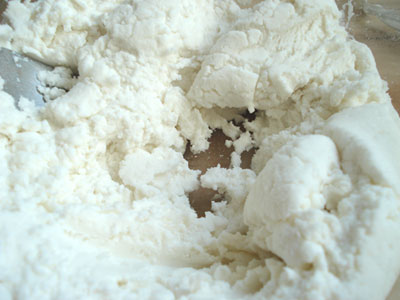
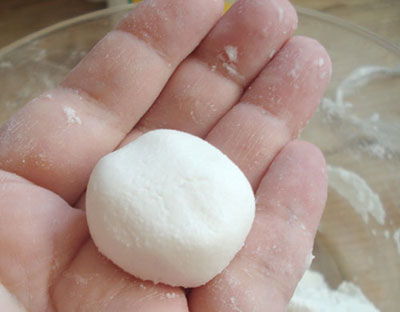
Divide the dough into 25 pieces (you can do this by forming a long log and cutting it, or just divide it up in the bowl and eyeball it). Make each piece into a little round ball. It doesn't have to be perfect in shape - a little bumpiness is fine.
Bring a pot of water to a boil and add salt, as you would for boiling pasta. Add the dumplings a few at a time to the pot. After a few minutes, the dumplings will come floating to the surface. Boil for a further 3-4 minutes, then scoop out with a slotted spoon or similar.
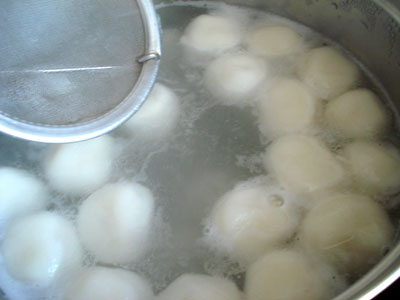
Immediately dump the dumplings into a bowl of cold water.
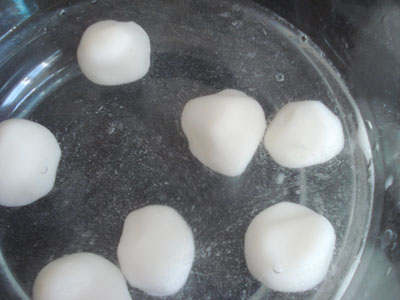
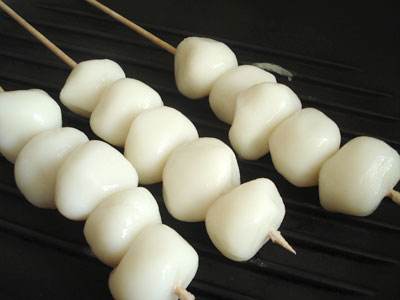
Put the dumplings on skewers, 4 or 5 per skewer. Try to pierce the dumplings in the middle.
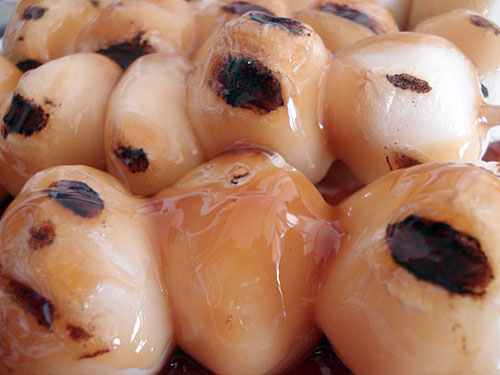
Grill the skewered dumplings on a grill or a grill pan, turning several times, until nice burn marks form over them.
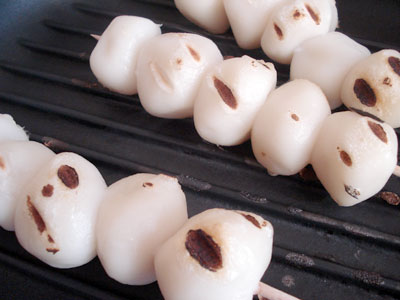
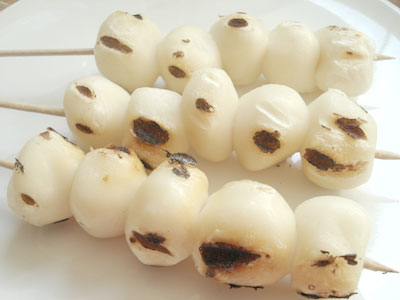
Here are some finished grilled dango skewers.
While you're grilling the dumplings, make the mitarashi sauce. Combine all the ingredients for the sauce in a small pan and bring to a boil. Cook until the sauce has thickened. The more it cools, the more viscous it will get. You can make the sauce in advance too.
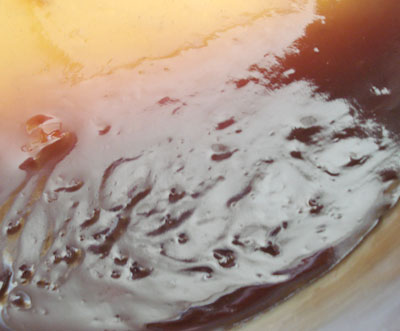
Pour the sauce over the still warm skewered dumplings. They are best eaten right away, but you can make them in advance too, as long as you bring them to room temperature before eating.
Variations
You may have seen these with a sweet azuki bean paste on them. I don't like them that way, but if you do, you can use this tsubuan recipe, perhaps mashing up the beans a bit more to make it smoother.
The dumplings can also be eaten grilled and just brushed with soy sauce. Apparently, this is the way they were eaten until sometime in the 20th century. (Mitarashi dango as we know them now were invented in the 1930s at a dango shop in the Kansai area.)
Plain maple syrup is a nice sauce for these too, if not too traditional.
Submitted by maki on 2008-02-26 14:28.
If you enjoyed this article, please consider becoming my patron via Patreon. ^_^
 Welcome to Just Hungry, where we serve authentic Japanese recipes and more! I'm








Comments
Kevin
27 February, 2008 - 04:57
Permalink
I have been wanting to try
I have been wanting to try dango for a while now. Bookmarked to try.
anon.
27 February, 2008 - 11:20
Permalink
LOL. I just bookmarked it
LOL. I just bookmarked it too. I don't even really cook but I gotta try this maybe during the upcoming weekend.
ode
27 February, 2008 - 11:30
Permalink
mmm yum
Hi Maki,
I remember eating this dish as a little girl. South America does not offer the rice flour your talking about just the basic white one and that's it. But its nice to be taken back to those wonderful memories as a child.
Ciao,
O
Mocha
27 February, 2008 - 16:25
Permalink
I am trying not to lick the
I am trying not to lick the screen at work! :-p
Definitely going to make those, thanks for sharing your recipes!
M.
maki
28 February, 2008 - 14:51
Permalink
Some people accuse me of
Some people accuse me of licking the plate afterwards when i make this, though i won't admit to it... :P
anon.
16 July, 2013 - 16:18
Permalink
Multiple failures T.T
I've tried making the dough with plain rice flour and glutinous rice flour with cornstarch as the recipe suggests, but mine always turns into just a mass of soup....
Whyyy..? T.T
maki
18 July, 2013 - 15:04
Permalink
Re: Multiple failures T.T
You probably need less water. Try adding it little by little and mixing it between additions, and stop when it gets to the right consistency (a dough you can easily knead).
Wakkun
27 February, 2008 - 16:51
Permalink
Looks so yummy!
Maki,
This looks delish.....
Audrey
28 February, 2008 - 08:32
Permalink
There is a similar chinese
There is a similar chinese dessert eaten during winter solstice called "Tang Yuan", normally chinese eat them with sweet syrup/sweet soup but I noticed Japanese eat them with atsuki bean soup.
http://en.wikipedia.org/wiki/Tangyuan
I know how to make these, but I wonder whether whether I can just skewer them up and call them Mitarashi dango? :o
maki
28 February, 2008 - 14:49
Permalink
Audrey, it’s really the
Audrey, it's really the sauce that makes it 'mitarashi' so you could probably use any kind of rice dumplings. (Japanese people do eat shiratama (soft rice dumplings) with a sweet sugar syrup too, chilled, in the summer with fruit, some boiled whole azuki beans, and sometimes kanten (agar-agar) cubes. It's called 'anmitsu'. )
Audrey
28 February, 2008 - 16:14
Permalink
Ohh :)
Do you usually use the same flour recipe for shiratama and dango?
they feel a bit different from what I've tasted.
The Tang Yuan I made, I've only used the glutinous rice flour and thats it. But when I eat mitarashi dango I know its much more chewy and with more substance. One can get full just by eating dango.
maki
29 February, 2008 - 01:14
Permalink
Yep that’s why I use a
Yep that's why I use a mixture of flours in the mitarashi dango recipe. For anmitsu I use just shiratama flour (which is just sweet rice flour with potato starch), which are quite a bit softer. But I do know people who use shiratama only for dango - it turns out ok, if a bit soft.
Ami
29 February, 2008 - 04:04
Permalink
hi! I’ve been looking for
hi!
I've been looking for this recipe ever since I saw it in the anime Samurai Champloo!! I hope my local Japanese store has all these ingredients ^_^
Thank you for sharing and what a fabulous website you have! ^_^
anil
1 April, 2010 - 17:24
Permalink
Re: hi! I’ve been looking for
That is exactly my story. Thanks for the recipe, will try it soon.
ichigo-chan
6 March, 2008 - 14:02
Permalink
Dango daifuku
i made once before dango with an other recipe wich contained to steam the dumplings in a mushiki... it didn't work well at all...
but this recipe was very nice everyone loved it...
now i have the same problem with a Daifuku recipe (i love daifuku once my dad brought two for me forom his buisnesstravel) ... it just doestn't work the way i want... so i wanted to ask you if you know a good recipe...
Thanks in advance
Have a nice day
ichigo
julie
15 March, 2008 - 09:08
Permalink
Thank you!
Oh, wow, I just stumbled onto this site, and I'm so glad I did. I lived in Japan for a few years, and I love these things. Never really thought about making them at home, but I am now eager to do so. Yum. Thanks for this recipe.
David
16 March, 2008 - 04:22
Permalink
Hey, I’m not used to
Hey,
I'm not used to dealing with rice flour. When I mix the joushinko, water and mochiko/starch mixture, it never reaches the consistency of soft dough - it says a sort of gelatinous liquid. Is the amount of water correct? Is there something about rice flour that I'm not aware of?
Thanks,
David
anon.
25 August, 2009 - 01:44
Permalink
Re: Hey, I’m not used to
Hi,
This answer from me is probably WAY too old to be helpful for you, but I had the same problem today when following this recipe. To fix the gelatinous problem, I simply put in less water, and I slowly added the water while mixing it into the dough to make sure that things didn't get too soggy. Even then it was a little bit droopy and wouldn't form balls, so I put in more corn starch. They ended up coming out pretty darn good.
Loretta
18 March, 2008 - 12:31
Permalink
Heaven!
My favourite Japanese dessert is the aburi mochi served at Ichiwa in Kyoto (near Imamiya Shrine).
These Mitarashi dango really are the next best thing. I love them!
They're great as they are, but my own variation is to sprinkle on a very light dusting of ground sesame (just a pinch or two). Memories of Kyoto then come flooding back.
I've just eaten a portion of dango with a cup of sencha and feel a warm, delicious contentment.
David,
I'd never made dango before but by following Maki's recipe exactly my own batch came out just as she described.
My own impression is that you haven't got the right rice flours for this.
I had a little trouble sourcing my own yesterday, yet London's Japan Centre must be one of Europe's easier stores for this kind of ingredient. It's obviously not easy.
The joushinko wasn't labelled as such in English. On the back it just said 'Rice Flour' ingredients: rice. On the front the only thing written in Hiragana was Mitake no (みたけの)then 3 kanji - 上新粉. Also I could see Dango written in hiragana in a corner.
The shiratamako I had to ask for as it hadn't been unpacked yet. Tricky as I hadn't brought notes (impulse purchase) and couldn't remember the name. In English it said 'Rice Flour' ingredients: gelatinous rice flour, corn starch. On the front, in hiragana, is usagi (うさぎ) next to the kanji 白玉粉 - the kanji on this packet is so stylised I personally can't read them, even 白 (white - shiro) looks completely different.
Maki, when I bought the ingredients the store assistant who had helped me find the shiratamako gave me a friendly warning that dango were hard to make. I appreciate your recipe - it really was a breeze!
Loretta
18 March, 2008 - 15:15
Permalink
Aburimochi
Just found some photos of the dessert your dango have helped quell my vicious cravings for:
http://regex.info/blog/2008-01-16/693
&
http://blogs.yahoo.co.jp/tamahiyo9/18530595.html
(the shop is listed in Diane Durston's 'Old Kyoto')
Carla_chan
1 April, 2008 - 17:13
Permalink
i would like to try this
dango looks good..i havent tried it before..im not a good cook..and im not sure if asian stores here in my place sells dangos..i want to try one really bad..
Saki
7 June, 2008 - 04:06
Permalink
Wow thanks, I saw this
Wow thanks, I saw this recipe in Samurai Champloo (thank god i'm not the only one) and I have to try it! But I cant find the flour...Anywhere... That might be a problem.
Sara
9 July, 2008 - 10:05
Permalink
I love DANGO
Well... I am new in Japan and I am basically trying to cook anything japanese.
I use to make Dango covered with sesame seeds, coconut and sugar. Filipino friends taught me the recipe but I know that it comes from China. I would like to know if this is considered Tang Yuan as well. If not, I would like to know the real name of it?
I am definitely going to make "Mitarashi Dango", I love anything that involves Dango any ways. I love this website, it really shows the right way to cook japanese food and the pictures are a great addition by the way.
Arigato Gozaimasu!
Sara
14 July, 2008 - 14:05
Permalink
I could not find mirin
I couldn't find mirin... can I make the dessert without this ingredient or is there a way to replace it with something else?
Thanks,
Sara
maki
14 July, 2008 - 16:29
Permalink
Normally I would say you can
Normally I would say you can leave mirin out, or use something like sweet sherry...but in this case the mirin is quite an important part of the sauce. I'm surprised you couldn't find mirin though...it should be stocked by any Japanese grocery store, since it is a very commonly used ingredient. (Amazon.com sells it if you can't get it locally)
Sara
14 July, 2008 - 16:35
Permalink
What about Plum Wine or Sake
I have plum wine and sake at home... do you think that might work?
By the way... I made the onigiri with your technique and it was a success! thank you. I love umeboshi it is really good. I also made the japanese potatoe salad and loved it. I have all the ingredients for Mitarashi Dango except the mirin. We will see
:) Sara
Marnen Laibow-Koser
10 June, 2009 - 18:36
Permalink
Re: What about Plum Wine or Sake
Sake with sugar (and maybe a splash of dry plum wine) might work, but it would be a pretty inadequate substitute, I would think.
Sara
15 July, 2008 - 14:07
Permalink
MISSION ACCOMPLISHED!
Dear Maki,
I finally made "Mitarashi dango" today. It was so EASY! I think the hardest thing was washing the grill pan, seriously.
I used the plum wine and it was really good. I don't know yet how it taste with mirin, but I will very soon. I did have to add more shiratamako to the mix in order to get the right texture, but it came out perfect!
Thank you very much for the recipe it was nice eating something like that with such a rich flavor but at the same time the burn marks really make it. I have left overs though and did not have an idea what to do since you say you have to eat it right away while they are warm, so I just put them on a plate with saran wrap in the fridge and plan to warm them up in the toaster over tomorrow and see how they taste like.
I will keep trying your recipes! Thank you
Sara
Nolwenn
18 August, 2008 - 15:06
Permalink
I was sure to find this
I was sure to find this recipe here ;) I ate mitarashi-dango last week in a real japanese restaurant and then I'm obsessed by finded the recipe to make it at home !
Does "glutinous rice flour" alone is enough for making the dango ?
maki
18 August, 2008 - 21:24
Permalink
I’m not sure how Chinese
I'm not sure how Chinese 'glutinous rice flour' compares to the Japanese rice flours, but you can sure give it a try and see how the texture is!
愛万多「Amanda」
26 August, 2008 - 05:19
Permalink
Recipe from a book = (
I won't mention the name of the book, unless asked, not sure if I should... but i'm pretty disappointed in it...seems their instructions for amounts and things are off....like they said use 2/3 cup Jyoshinko + 2 Tablespoons sugar + 1 1/3 cup hot water. I did that and then it said to knead it, but that was impossible because it was so liquidy!!! So i added like the whole small bag of Jyoshinko trying to thicken it up, added some more sugar too. Then it said in a separate bowl to use 1/2 cup Shiratamako + 1/4 cup hot water, that turned out well, like what it's suppose to be, dough-like. Then it told me to add it together. I tried to knead the two together, but the gooiness of the Jyoshinko overpowered the doughiness of the Shiratamako. I realized since i had increased the amount of Jyoshinko that I should also increase the Shiratamako, so I did, helped a little. So I was able to use spoons to form round like balls to drop in the boiling water, after they were floating i removed them. They taste ok but then again, my experience with dango is limited and never had homemade ones.
I'm sorry this is a little long, but guess just wondering whats up with the recipe in this book = /
Another day I will try the above recipe, when I feel like it again...this has kind of sapped my energy because don't think it turned out well and no one else will probably eat it and I really don't want to eat anymore, it's so sad....what a waste (T_T)
Dairypie
26 January, 2011 - 22:18
Permalink
Re: Recipe from a book = (
Me too! Same book same issue! I didn't even get it to make balls! Now I ahve a plat full of cooked syurpy rice T.T It ruined my snowday! Now I will try to amke theses w/ what I ahve left. Tomorrow.
Nyu
23 September, 2008 - 19:55
Permalink
I’m gonna make this today
I'm gonna make this today so wish me luck >.< couse I'm not a good cook
maki
23 September, 2008 - 20:24
Permalink
Good luck! ^_^
Good luck! ^_^
Nyu
23 September, 2008 - 22:02
Permalink
I’ve just finnished ^^
I've just finnished ^^
Nyu
23 September, 2008 - 22:03
Permalink
Tnx^^
Tnx^^
Angie
25 September, 2008 - 21:16
Permalink
Oh my goodness, I looked all
Oh my goodness, I looked all over for a recipe for these but I had no idea what they were called until I went through list of 100 Japanese foods to try (I just called them mochi on a stick with almost teriyaki sauce). I've always bought mitarashi dango in frozen form (with the sauce) at my little Japanese grocery store and let them thaw out. I'm really excited to try to make these on my own now! Thank you thank you thank you!
TangLime
27 September, 2008 - 02:06
Permalink
Bake Sale Dangos!
I am acctually going to make these for a bakesale!
sethrae
28 September, 2008 - 09:01
Permalink
Do you add the cornstarch to
Do you add the cornstarch to just the mochiko or also the shiratamako if you decide to use it... i mean it kinda makes it sound like you should only use the cornstarch if you have to use mochiko... any help?
maki
26 October, 2008 - 20:04
Permalink
Oops…I forgot to answer
Oops...I forgot to answer this one. You just add the cornstarch if you're not using shiratamako (since shiratamako already has potato starch (katakuriko) in it).
Fleur
25 October, 2008 - 20:44
Permalink
Eh. I couldn’t find the
Eh. I couldn't find the mentioned types of flour anywhere (nor any type of rice-flour), but I was determined to make this so I used normal flour...
Didn't turn out too well- they were quite chewy and bouncy- a little bit too chewy and were very filling. The taste was disappointing as well. Maybe I just messed up in general... Either way, don't try to use normal flour, it doesn't work out well D:
maki
26 October, 2008 - 20:01
Permalink
yeah…wheat flour
yeah...wheat flour wouldn't really work for this I'm afraid...
anon.
11 December, 2008 - 06:35
Permalink
Very nice recipe, i have not
Very nice recipe, i have not tried it yet though. If you need help finding any ingrediants on that list just go to www.ichibajunction.com they have everything on that list except the skewers/bamboo. All of it cost about $20 :D.
anon.
12 December, 2008 - 00:14
Permalink
Hmmm could this be a sub.
Hmmm could this be a sub. for the Joushinko? http://importfood.com/fger1601.html
maki
12 December, 2008 - 10:10
Permalink
That seems to be a glutinous
That seems to be a glutinous rice flour, so it would be a substitute for the mochiko. See if they have a regular (not 'sweet', 'sticky', 'glutinous' etc) rice flour.
FishyGoRoar
13 December, 2008 - 23:56
Permalink
Could anyone tell me what
Could anyone tell me what would be a good sub. for Joshinko? I live in the US and I can not find it any where...
maki
14 December, 2008 - 06:49
Permalink
I’ve edited this article
I've edited this article to suggest more easily obtainable (probably) rice flours for johshinko and shiratamako or mochiko. I've seen rice flours on Amazon.com if you can't find them locally, but try a local Asian grocery or health food store first.
Wheat flour is NOT a workable substitute for this btw.
Roro
17 March, 2009 - 09:42
Permalink
Re: Mitarashi dango, rice dough dumplings with sweet-salty ...
When I was trying to make these, I tried two times and the dough was way too watery. I realized after the first time that 220 ml is actually only barely more than a cup, not so much 1 1/2 cups. But even with just a cup the second time, it was still too much.
So the third time I only used 1/3 cup with the rice flour, and then added the glutinous rice flour. After that I gradually added more until it amounted to somewhere between 2/3 and 3/4 cups. I even had to add a tiny bit more of each flour. So, if anyone else is having the same problem, I'd just suggest starting off with a lot less water and adding more until the consistency is right. If it worked for everyone else, I don't really have any idea why I had this problem.
But when I finished them after the third try, they were delicious!
anon.
10 April, 2009 - 00:06
Permalink
Re: Mitarashi dango, rice dough dumplings with sweet-salty ...
The only thing I would suggest changing is the amoung of soy sauce and switching the amounts of rices Mochiko rice makes the dango fluffier so I'd use more of that instead of Jushinko and too much soy sauce makes the sauce very dark not like traditional, but maybe that's just me with the soy sauce cause the picture looks correct. but definately too thick a dango with the portions of rice flour here.
Aly
21 April, 2009 - 16:56
Permalink
Re: Mitarashi dango, rice dough dumplings with sweet-salty ...
Thanks for the tip about Ichiba Junction! They had all the stuff I needed! I'll tell you how my dango turned out when I make it!!!
angela
27 April, 2009 - 22:04
Permalink
Re: Mitarashi dango, rice dough dumplings with sweet-salty ...
I ate these about 10 years ago at a shop in Okinawa and loved them so much! I have had dreams about having them again but didn't know how to get them, so glad I found your recipe!
Moon
29 April, 2009 - 03:36
Permalink
Re: Mitarashi dango, rice dough dumplings with sweet-salty ...
Thank you so much for this recipe! This was my comfort food while I was studying abroad in Japan and I've been craving these ever since I got back. Thank you, thank you, thank you!
Hayley
11 May, 2009 - 00:17
Permalink
help me
i'v wanted to try this for ages so thank you for uploading the recipe.
but i live in england so i can't find some of the ingedients.
can anyone tell me where i can find these ingedients from birmingham, west midlands or west bromwich. please and thank you
maki
11 May, 2009 - 10:10
Permalink
Re: help me
Hayley, from the information received from Just Hungry readers, there aren't any Japanese grocery stores in the Birmingham area. But there are some general Asian stores - see this page (sorry it's a bit of a mess at the moment, I need to edit it, but the info is there). At a general Asian/Chinese store, you can find 'glutinous' or 'sweet' rice flour, and regular (doesn't say 'glutionous or 'sweet') white rice flour, and use those. Otherwise, you may need to order joushinko or jyoushinko and shiratamako from a place like Japan Centre.
Prince
21 May, 2009 - 14:22
Permalink
Re: Mitarashi dango, rice dough dumplings with sweet-salty ...
I made some, it was good, I used white rice flour and Mochiko with Corn starch. The sauce was great too, I was amazed at how quick it thickened. It turned out pretty good and my chinese friend loved it as he made it with me. Now i get the idea of adding a little sugar and salt to the actual dango as it is a desert dango, make it less bland, probably through dissolving it into the water needed to make the dough i'll see how it goes.
へへ Also another idea is tiny bead sized Dango on toothpicks for hour d'oeuvres.
さようなら!
Beth
29 May, 2009 - 21:07
Permalink
Re: Mitarashi dango, rice dough dumplings with sweet-salty ...
I have two types of rice flour I found at my local grocery store and I'm not sure if they would be okay for this recipe. One says Rice Flour (I couldn't figure out all of the kanji on it, but it says white rice flour in french), the other Glutinous Rice Flour (水磨白糯米(there's another kanji here but I couldn't find it to type it.)粉)
I might try it anyway with these, but I wanted your opinion. Thanks for your help!
maki
8 June, 2009 - 00:54
Permalink
Re: Mitarashi dango, rice dough dumplings with sweet-salty ...
hi Beth, the Glutinous one plus the White one should work. 粉 just means flour or powder by the way.
Beth
12 June, 2009 - 03:46
Permalink
Re: Mitarashi dango, rice dough dumplings with sweet-salty ...
Thank you so much, I'm excited to try these!
Moon
5 June, 2009 - 06:31
Permalink
Re: Mitarashi dango, rice dough dumplings with sweet-salty ...
I studied abroad in Tokyo 6 months ago and I always, always ate mitarashi dango. When I traveled around Japan, I made sure to eat mitarashi dango whenever I encountered it (I had the best dango while I was in Osaka!).
When I came back to America, I knew that one of the biggest things that I would miss would be going to the Lawson's next door to buy a pack of mitarashi dango. Thank you so much for this recipe-- it means so much more to me than you know. :)
anon.cho
7 June, 2009 - 23:03
Permalink
Re: Mitarashi dango, rice dough dumplings with sweet-salty ...
i tried my best but the only thing i got right was the sauce.
at first my dango was way watery ( i think i used wrong flou)
i added more glutionous flour and it became the cosistancy you describe.
in the end it turned out tasting nasty
do you mind doin a vid n post in on youtube
maki
8 June, 2009 - 00:53
Permalink
Re: Mitarashi dango, rice dough dumplings with sweet-salty ...
I don't do video at the moment. Besides, I doubt it will help! Try following the instructions __as they are written__ (my feeling is you did not boil them long enough). Almost everyone else who's tried it seems to have had success after all!
Judy
12 June, 2009 - 19:34
Permalink
Re: Mitarashi dango, rice dough dumplings with sweet-salty ...
I like to know if this is possible
Most likely I call portion
1 cup of flour = 1/2 cup of water.
I was try something out because I have to teach a chef to do dango for a Anime convention.Something easy for them to calculate.
2 bag : http://importfood.com/fger1602.html
1 bag : http://importfood.com/fger1601.html
and 4 cup of hot tap water.
Althought you have to cook much longer before it floot and after floot (my experience took 9 min to floot and I say around 7-8 min after floot depending the size of the ball). Rice flour is longer to cook.
If you add 1/2 cup less Rice flour and 1/2 more Glutinous flour, you will have more chewy dango.
Hopefully this help, It will make lot of dango as well....
Judy
12 June, 2009 - 19:50
Permalink
Re: Mitarashi dango, rice dough dumplings with sweet-salty ...
I call this easy portion to remember.
1 cup of flour = 1/2 cup of water.
I was try something out because I have to teach a chef to do dango for a Anime convention. Something easy for them to calculate.
2 bag : http://importfood.com/fger1602.html
1 bag : http://importfood.com/fger1601.html
and 4 cup of hot tap water.
Althought you have to cook much longer before it float and after float (my experience took 9 min to float and I say around 7-8 min more after it float depending the size of the ball). Rice flour take longer to cook.
If you add 1/2 cup less Rice flour and 1/2 more Glutinous flour, you will have more chewy dango.
It will make lot of Dango as well....
Lisa
21 June, 2009 - 02:36
Permalink
Cornstarch...
If you're using glutinous rice flour, does it make a difference if you use cornstarch or not?
anon.
28 June, 2009 - 00:24
Permalink
Re: Mitarashi dango, rice dough dumplings with sweet-salty ...
can you substitute both joushinko and shiratamako with mochiko?
Priscilla
1 July, 2009 - 21:38
Permalink
Re: Mitarashi dango, rice dough dumplings with sweet-salty ...
What if I used the kikkoman kotterin mirin sweet cooking seasong instead of mirin?
Sharon
4 July, 2009 - 16:17
Permalink
Re: Mitarashi dango, rice dough dumplings with sweet-salty ...
Hello Maki, must I use Japanese soy sauce? Can I use Chinese light or dark soy sauce instead?
Does it matter if I did not grill the dango (omit the whole process) or can I bake it instead?
(It will be great if you have the alert delivered to our email inbox when somebody replies to the question..just a suggestion ! Sorry for the influx of comments !
Just a side note, I really love both of your blogs (JustHungry & JustBento) as I get exposed to so much Japanese culture & cool recipes ! Thank you !(: )
maki
4 July, 2009 - 17:05
Permalink
Re: Mitarashi dango, rice dough dumplings with sweet-salty ...
You can use Chinese soy sauce. There will be a small difference in flavor, but perhaps you wouldn't notice it if you haven't compared them.
You can just omit the grilling part. I wouldn't bake them - that would probably dry them out too much.
I turned off the comment notify feature by mistake. Should be back now ^_^
Sharon
4 July, 2009 - 19:33
Permalink
Re: Mitarashi dango, rice dough dumplings with sweet-salty ...
Thank you so much !(:
Beth S
21 July, 2009 - 16:48
Permalink
Re: Mitarashi dango, rice dough dumplings with sweet-salty ...
Fantastic recipe! I made some for my friends and I and they were quite the hit. They turned out better than the dango we'd get from Mitsuwa - especially the sauce.
Since I didn't have mirin, I found that cooking sherry with a pinch of sugar works as a good substitute.
Thank you so much for sharing!
Aki
4 August, 2009 - 04:51
Permalink
Meh...
I tried making this but I wasn't too impressed. The sauce was too salty for my taste and the dango was very dense. Maybe it's because I had to use rice flour and mochiko since no stores here sell the right flours. I'll just have to try the dango in Japan and see how that tastes.
laura
17 September, 2009 - 21:31
Permalink
Re: Mitarashi dango, rice dough dumplings with sweet-salty ...
I have been intrested in sharing some of these recipes with my friends but I have to travel with them so they wont be freshly made, can they be chilled and how would they taste, the last thing I want is my friends being put off trying anything else new.
Vlad
25 September, 2009 - 05:22
Permalink
Re: Mitarashi dango, rice dough dumplings with sweet-salty ...
WOW - cool!
I've wanted a recipe for mitarashi dango for so long. I'm so glad I finally found one.
I got hooked on then when I was living in Tokyo, and have been craving them ever since I came back to Australia - which is years ago now. I did find already made, pre-packaged mitarashi dango at the Japanese grocery store in the city, but they're about $9 a box (of 3 skewers, with three dango on them).
Thanks a lot for posting thi recipe - I look forward to making them sometime today.
Search
4 November, 2009 - 09:25
Permalink
odd little thing
I am sooo glad I came across this website! So many recipies for me to try and flex my weak cooking skills. :)
I too am a Samurai-Champloo fan and had seen these on there as well! I'm glad to know I can now make them and see how they taste.
Although I will want to try the soy-sauce version and then the one with the glaze. Just to compare and contrast.
As a side note, one of the local Chinese resturants had these little sesamee balls, which I think are close to these in the way they are made. (I think, and say this because I have not cooked these yet so I can't make a comparison) Although I think the resturants little balls were maybe a bit hollow inside, but definatly had sesamee seeds all around it inside the dough even.
Kinda made me think of that when I seen these on this website.
Anyone happen to know what I'm talking about are am I just shooting blanks?!?
Thanks in advance! ^^
enelte
17 December, 2009 - 23:05
Permalink
Re: Mitarashi dango, rice dough dumplings with sweet-salty ...
oh they look delicious! I must try this! I ve been wanted to make dango for a while and well now that you make it look dizzily easy! :D
A friend told me the sauce taste great with a bit of finely crush young ginger in it! She said it s not her invention, so have you ever tried with ginger?
Biev
9 June, 2012 - 21:43
Permalink
Re: Mitarashi dango, rice dough dumplings with sweet-salty ...
I make these all the time with ginger syrup. It's super easy and works with dumplings boiled or grilled, bean paste-filled or plain. It's just a simple syrup: 1 part water 1 part sugar, plus ground ginger. You can vary the ratio to taste, or just infuse a piece of ginger then take it out. It's really the easiest sweet recipe there is (and a great way to get rid of leftover bean paste).
sirdanilot
18 December, 2009 - 16:18
Permalink
Not THAT spectacular
The sauce is extraordinarily yummy!
1. I couldn't grill the dumplings as I didn't have a grillpan or skewers handy (perhaps that's why I don't like the bland taste). I would like to ask, can I grill the dumplings whenever I want? Do I have to brush off the sauce first?
2. Some more about rice flower: Other than the glutinous kind, I have two types which are both called 'rice flour': one, which seems to come from India, smells and tastes exactly like uncooked rice would taste, and perhaps slightly coarse, and the other one smells very perfumy, maybe like jasmin smell, and it's very finely ground and seems to come from Thailand (despite the perfume, it doesn't list any other ingredient). Is there any difference between the two, and especially, which one would give the best result?
maki
20 December, 2009 - 01:02
Permalink
Re: Not THAT spectacular
The dumplings are grilled BEFORE the sauce goes on. You should grill them reasonably soon after they are poached in water. Neither of the flours you mention will give 'authentic' results, but you can certainly experiment with them. I don't know how they will turn out though! Thai rice is just a variety that has a very particular smell, there is nothing added to it to make it smell like that.
Kojima
2 January, 2010 - 02:27
Permalink
Re: Mitarashi dango, rice dough dumplings with sweet-salty ...
花より団子 (Hana yori dango)
Otaku
8 February, 2010 - 10:44
Permalink
Re: Mitarashi dango, rice dough dumplings with sweet-salty ...
This is my favorite kind of dango, but the sauce was different the way I learned it. It was just sake, shoyu, and dark brown sugar cooked down to a viscous glaze. It had a lot of umami, but was also sweet and salty. It was like this:
2 oz sake
2 oz tamari shoyu
3 oz very dark brown sugar
In this case it is really a syrup. It had a surprising taste, almost like a very low grade* maple syrup from New England. It is good on pancakes too.
*Maple syrup comes in different grades. The higher ones are lighter in color and flavor, and the lower grade ones are stronger in flavor and darker. In Europe they like it light while most Americans like it dark. I like it darker than most Americans at Grade C. The most Popular in my area is Grade B+
Amanda
16 March, 2010 - 23:30
Permalink
help?!
So far I have tried 3 times to make dango's but every time it failed. The dango's are really slimy and they contain very much water and they aren't solid. The rice flour I use is called "glutinous rice flour" and I have an other called "rice flour", are they slimy because I had to use corn starch or something like that? Have you please any tips for me how to make dango's
maki
17 March, 2010 - 21:48
Permalink
Re: help?!
As I have stated in the article, just using mochiko (i.e. 'glutionous rice flour' may not work well. Please try following the instructions - they are really tested to work.
Jessa-chan Kinomoto
1 April, 2010 - 16:30
Permalink
OMFG!
My friends epicly fail at making dangos. They've each tried a different recipe but each one tasted like crap. So now it's my turn, and I'm really hoping this recipe works.
anon.
3 September, 2011 - 19:25
Permalink
Re: OMFG!
I really hope you're actually Japanese and not a weeaboo/wannabe...
kumiko/alice
19 April, 2010 - 07:40
Permalink
Re: Mitarashi dango, rice dough dumplings with sweet-salty ...
ahh i remember helping my grandma with this as a kid when my mom was at work but now as a young teenager i can make it i tried it 3 times and failed i a am a failure as a japanese person -_-' i have always loved it mmm dango i cant wait until school is over to try it :D
Safire
17 May, 2010 - 23:45
Permalink
Re: Mitarashi dango, rice dough dumplings with sweet-salty ...
do you think frying the dango instead of grilling would be good?
Tovir
24 May, 2010 - 00:42
Permalink
Re: Mitarashi dango, rice dough dumplings with sweet-salty ...
Thank you so much for this post! I've tried making mitarashi dango a few times already, but since I didn't mix the flours they always ended up with this awful snot-like texture. I was never able to find anything describing the proper texture of the dumplings, so I just assumed that's how they were supposed to taste and gave up.
That said, I can't wait to try this recipe!
Alena
2 August, 2010 - 21:20
Permalink
A hint and a review
I just finished making my first batch of dango. As I did it, I doubted very highly that they would be any good, especially since I was unable to find the right type of rice flour and starch balls just don't hold that much appeal for me. I was making them as a test batch for a friend, for whose birthday I'd been planning a Japanese feast
But as it turned out, to my abject shock, they had a very satisfying texture and the sauce was delicious. Next time, I think I'll make them a little smaller and try grilling them.
In making them, I had the same problem that a few other people had, namely that the dough, using only what I could find that was labeled 'rice flour,' turned out very gooey with the amount of water suggested in the recipe. I just dumped in a little more rice flour until the dough got to the right consistency (I do this all the time when I'm making bread as well, as humidity varies widely where I live) and the dumplings turned out fine. I got a few more balls than I really wanted because of this, but I imagine that restricting the amount of water will work just as well.
Kira1
22 August, 2010 - 12:05
Permalink
Re: Mitarashi dango, rice dough dumplings with sweet-salty ...
I'm not sure mine came out right. All purpose flower for baking cakes and cookies and such in america is the same thing as joushinko right? O.o Few places said so but I'm really not sure as I'm not used to cooking much of anything with flower pretty much ever. As far as the mochiko it was easy for me to find, military base commissary has stuff like that from many places. Though I didn't see anything called joushinko so I might try looking again or just order it online.
Anyway, had issues with the water much like a few others it just kinda became a runny paste so I tried multiple times. Thought I finally got it so I boiled them. They didn't float... at all. Dunno if they were too big? But I'm betting it was the flower.
Grilled em anyway, they were really really chewy. Tested em on the husband lol! He said they were good but I still doubt I got it right.
Sauce wise, it was easy and it tasted good. Hubby said the idea of sugar and soy sauce sounded grose but after he tried it he said it tasted a bit like regular pancake syrup.
Anyway with the flower thing I'm still not sure if that was the right thing to use. Any suggestions apart from ordering it? Or was it ok to use that?
maki
22 August, 2010 - 14:36
Permalink
Re: Mitarashi dango, rice dough dumplings with sweet-salty ...
Joushinko and all-purpose flour are not the same thing at all. All-purpose flour is wheat flour, and joushinko is rice flour made from medium-grain rice, while mochiko is rice flour made from round sticky rice. If you can't find joushinko, try finding something just labeled 'rice flour' at an Asian (Chinese) market or even a health store that caters to celiacs. Good luck!
Jane
24 August, 2010 - 07:39
Permalink
Re: Mitarashi dango, rice dough dumplings with sweet-salty ...
This is really funny.
I tried soooo hard to find that shiratamako and Joushinko in my local supermarket here (I live in Jakarta), only to find it was actually used in most traditional cakes and cookies of my place (we called Shiratamako tepung ketan and Joushinko as tepung beras). ^_^''
That wasn't all though. The funniest part, when I mention this recipe and how to make them to my mom, she looked and me and said, "Are you making onde-onde?" Turns out your dango is our Onde-onde... ^_^; The only different is we eat ours in sugary water and you grilled it...
And another one about mochi, I was making that too, only to found we have that rice cakes also over here, it was called Uli Ketan. The world is so small....
Mellusia
30 September, 2010 - 03:28
Permalink
Re: Mitarashi dango, rice dough dumplings with sweet-salty ...
Hiya, thank you for taking the time to post this recipe ^^
I admit I tried this recipe on whim, but I'm not sure if my results are correct.
Is dango suppose to be chewy with a slight raw flavour to it? It's very easy for me to taste the rice flour, so is that normal, or have I erred? It's a very strong flavour, and I feel like I should make some kind of baked version instead >.<
I couldn't find the specified rice flour you suggested, so I substituted with glutton and non-glutton kinds respectively.
Also couldn't find any mirin for the sauce, but I'm okay with the result.
Thanks for input~
Juancito
31 October, 2010 - 19:40
Permalink
Re: Mitarashi dango, rice dough dumplings with sweet-salty ...
Nice recipe, I finish cooking it about two hours ago.
I don't really understand why you use that amount of water for the sauce. Since you want it thick, you could use less water and save time (the sauce thickens because the water evaporates).
maki
1 November, 2010 - 03:13
Permalink
Re: Mitarashi dango, rice dough dumplings with sweet-salty ...
The sauce thickens because the starch cooks and becomes viscous in the liquid. The amount of water allows the starch to cook properly.
Swedish Guy
7 November, 2010 - 13:10
Permalink
Re: Mitarashi dango, rice dough dumplings with sweet-salty ...
As i am typing this i am actually making my second try at making dango.
I'm having a slight issue tho. So far the baöös i have made refuse to float.
I have added salt in the water and the balls are about meatball sized (max 1 inch in diameter)
The first try i did as actually quite tasty even tho the balls wouldn't float.
Would it be possible to get some average time on how long it takes for a ball of about 1 inch in diameter to start floating in the pot.
I'm quite sure the reason why I am having issues is because of the riceflour i use. As i have not yet found any local shop that keeps anything but a "plain" no-name riceflour.
Average time before balls should float would be helpfull. Thanks!
maki
7 November, 2010 - 16:58
Permalink
Re: Mitarashi dango, rice dough dumplings with sweet-salty ...
For me they usually float up to the surface in about 4-5 minutes. It could be that you are overcrowding the pot and/or the dumplings are sticking to the bottom. Try gently loosening them if that happens. I also don't salt the water, though that shouldn't change the floating issue any.
ETA: Now I read your question through, I've noticed that you say your dumplings are about 1 inch in diameter. Try making them about 2/3rds that size.
ash
22 September, 2011 - 10:23
Permalink
Re: Mitarashi dango, rice dough dumplings with sweet-salty ...
Hi Maki,
Firstly, thanks heaps for the recipe! I'm actually in the process of making mitarashi dango now :)
Secondly, I noticed you said u don't salt the water but in the instructions above, you mentioned 'Bring a pot of water to a boil and add salt, as you would for boiling pasta.' - so my question is, is adding salt just a personal preference?
Thanks :)
mika
14 November, 2010 - 15:48
Permalink
Re: Mitarashi dango, rice dough dumplings with sweet-salty ...
So i'm in the middle of cooking dango. and i have a strange impression they're still raw inside, they are pretty hard and when i tried cutting one in half it was all white despite slightly transparent white around it. and it was boiling for around half an hour by now D:
what did i do wrong?
they're around 2/3 of an inch diameter.
BeataR
22 November, 2010 - 00:46
Permalink
Re: Mitarashi dango, rice dough dumplings ...
Hello Maki,
Thank you for your great recipe. The key component of the boiled dumplings is a content of starch in the flour (two flours in your case). If too less starch, the round balls will be stone-hard. If too high content, they will fall into pieces while boiling. The only difficulty is to be perfectly in-between.
I am Polish. In Poland we have almost similar dumplings; first boiled, then fried on butter (without skewers). But the starch comes not from rise flour but from potatoes and potato flour, diluted with wheat flour. See for instance:
http://en.wikipedia.org/wiki/Silesian_noodles
and pictures:
http://commons.wikimedia.org/wiki/File:Surowe_kluski_%C5%9Bl%C4%85skie.jpg
http://www.pierozek.pl/img/oferta/kluski_slaskie/kluski_slaskie_670f.jpg
These dumplings are kind of "potato dango":)
I like the traditional mitarashi which comes excellent with potato dumplings as well.
BTW The diameter of the round ball is more than 1 inch in the picture at http://www.justhungry.com/files/images/mitarashidango_step9.jpg
I think that it was not the size that caused the posted problems, but starch content.
Thanks for the recipe once more!
maki
22 November, 2010 - 03:25
Permalink
Re: Mitarashi dango, rice dough dumplings ...
Thank you for your long comment Beate. I do have to correct you on one thing however; the mitarashi dango in the picture you pointed to is less than 1 inch in diameter when rounded (it may look a bit more since it's flattened). I should know since that's my hand and I made them :) Making them a bit too big may cause problems for the impatient.
anon.
23 January, 2011 - 21:00
Permalink
Re: Mitarashi dango, rice dough dumplings with sweet-salty ...
I have had this before, I prefer it over the ones with the bean paste on them. I found it at a japanese market around my area.
Mike H.
9 March, 2011 - 00:48
Permalink
Re: Mitarashi dango, rice dough dumplings with sweet-salty ...
I just tried making the dough. It turned out to be a watery flour gloop, actually, not even a gloop, more like soup. I used the correct amounts in the recipes. I couldn't find 上新粉 so I used "Shinko" instead. The package says "Rice Flour (Shinko)". I also didn't have 白玉粉 so I used the mochiko with katakuriko recommendation. I honestly didn't think that Shinko would be that different from Joushinko, from my understanding, joushinkou is just a more finely ground shinko. But I, my Japanese friends, and multiple sources on the net could be wrong. In the meantime, while trying to source 上新粉 I'll attempt to use less water. I REALLY want this recipe to work. Any clarification would be awesome
Mike H.
9 March, 2011 - 01:58
Permalink
Re: Mitarashi dango, rice dough dumplings with sweet-salty ...
In response to my previous post...It worked! I used almost exactly .75 cup water instead of 1.5 cups. I added in about .5 cups into the shinko, that wasn't quite enough, so I added in about 1/8 cup and that was good for the shinko. Then I added the mochiko w/potato starch along with another 1/8 cup. Nice texture :) and the sauce was great too, it thickened up to where I wanted it about the same time I saw the first bubbles rise, really quick, and tasty. Awesome website. Thank you!!!
Tally
22 March, 2011 - 00:33
Permalink
Re: Mitarashi dango, rice dough dumplings with sweet-salty ...
do you absoulutlety need to used two seperate flours? the pakage of the rice flour i kant read nor translate the writing on it.. :P then i threw it out silly me (^_^')and if i were to you just one rice flour how would i substitute stuff my last simple recipee failed in-epically
Alifay
30 March, 2011 - 02:00
Permalink
Soup turned into great dango :)
I have been wanting to make this recipe for such a long time and today I finally tried it :D.
I couldn't find the exact flour ... I think. What I found at a korean market was flour labeled Rice Flour and Sweet Rice Flour. So I used that and added corn starch to the Sweet Rice Flour.
I measured the rice flour and added the listed amount of water, then dumped in the Sweet Rice Flour and corn starch. Like others have said, I had soup! not dough! Do'h! So I added another 1/2 cup Rice Flour and 1/8 cup Sweet Rice Flour and 1/2 tbs of corn starch. It immediately came together in a dough, though I think it was still a little more wet than it ought to have been.
While I was rolling the dango it was still really sticky, so I covered my board and hand liberally with the sweet rice flour. I made my balls about 1/2 inch in diameter and with the added flour this ended up making about 45 dango. I had two or three of my first ones that ended up being huge so if they were all the same size it would have been 50 dango.
They were chewy and pleasant in texture (yay!) Made the sauce as directed and it was wonderful. I really liked the added texture of grilling them.
Next time I will cut the water I add in half, and then add it in gradually until it has a good texture.
kaheem
8 May, 2011 - 20:03
Permalink
Re: Mitarashi dango, rice dough dumplings with sweet-salty ...
i cant wait to make this :D
the only problem is im a minor . . . so idk if i can get mirin :/ is there a substitute that can be used for it D:
jen
10 May, 2011 - 19:32
Permalink
dango is grainy...how do i fix this?
so i have tried to make dango lots of times. i still eat it every time i make it but i feel like the texture is still funny. i use mochiko and joushinko together with the corn starch, knead the dough a bunch and boil them. they just dont come out chewy like mochi or like the dango i buy at the store. the texture inside is grainy and kind of dry sometimes. what am i doing wrong? am i just not boiling them long enough? i really get frustrated sometimes...even when they are cooked all the way through they are still grainy. should i smash the dough more? :( help!
Roman M.
15 May, 2011 - 08:27
Permalink
Re: Mitarashi dango, rice dough dumplings with sweet-salty ...
Mmmmmmmmmmmmm oishii thank you for this yummy recipe!!!! although i had the same problem as Alifay but i doctored it and it turned out great it was a lot easier to make than the daifuku i made the other day is there anything else that i could use as a topping such as black sesame i just have a lot of dango lol?
UcHiHaZ_rAwK
28 May, 2011 - 04:36
Permalink
Yum Yum!
Omg this looks soooo good!I've always wanted to make dango for my family! Thanx! But I have a couple of questions....what is mirin? and rice vinegar?
Christine @ Ang...
14 June, 2011 - 19:55
Permalink
Way too much water!
I just tried making this -- the water measurements do NOT add up: 1 & 1/2 cups of water is NOT 265ml. 265ml is 1 cup + 1 tablespoon.
Beware when adding the water to this recipe! Start with 3/4 of a cup (190ml) and knead from there.
neko chan
22 July, 2011 - 11:12
Permalink
Re: Mitarashi dango, rice dough dumplings with sweet-salty ...
I love these! your blog motivates me to make some! I love sweets but I don't like my sweets too sweet, if thats even possible haha.
ども ありがとう ございます!
Tracy
24 July, 2011 - 16:21
Permalink
Success!
I was really craving for some dango the other day so I made this and it was so good! I used glutinous rice flour+potato startch and non-glutinous rice flour from Asian grocery. I also realised that the amount of water recommended here is way too much, I gradually added about 2/3 of the water and it formed a nice dough so I stopped pouring because based on my mochi experience, any more moisture will just make it gooey. My whole apartment smelled so good when I was grilling them :D
anon.
15 August, 2011 - 08:47
Permalink
Re: Mitarashi dango, rice dough dumplings with sweet-salty ...
I have the same question as Tally, do we really need 2 pakets of diffrent flour to make the dough? What happens to the dough if we take one flour type out of the recipe? Also, what are some substistutes for Mirin, im a minor and I dont know if its an alchohal or not, like can I just use regular vinegar or does it HAVE to be rice vinegar? Ah, sorry for all the dumb questions, this is my first time making Dango EVER! Thanks for taking the time to read this, haha.
Aki
4 October, 2011 - 14:41
Permalink
Which mirin?!
Eh i was about to try make the mitarashi sauce when i realised that you havent specified which mirin to use o.o which one should i use?? Hon mirin, shio mirin or shin mirin?? o.0
maki
5 October, 2011 - 18:36
Permalink
Re: Which mirin?!
I have no idea what shin mirin is (新みりん?)and shio mirin sounds salty. I always use hon ('real') mirin.
Eunice
15 December, 2011 - 15:18
Permalink
Re: Mitarashi dango, rice dough dumplings with sweet-salty ...
It looks so delicious. I can't wait to try. c:
Akkio
5 January, 2012 - 04:44
Permalink
Re: Mitarashi dango, rice dough dumplings with sweet-salty ...
Finally I found this recipe! Me and my friend wanted to make some. First time I ever heard of dango I was watching Tobi eat it.
Autumn
5 February, 2012 - 04:37
Permalink
Replacing sweet rice flour
I read today that you could replace sweet rice four with tapioca starch (available at walmart.com) I haven't tried it yet, but I've never made dango with right ingredients anyway, so I wouldn't know if they came out right. Anyone tried this before? Or willing to try it and let the rest of us in no cultural diversity land know if it works.
maki
5 February, 2012 - 15:08
Permalink
Re: Replacing sweet rice flour
Tapioca flour may work as a sweet rice flour replacement as a thickener in sauces (which is how both flours are often used, especially recently due to the popularity of gluten-free-ing recipes), but absolutely will not work in this recipe.
Amanda
10 February, 2012 - 20:15
Permalink
Re: Mitarashi dango, rice dough dumplings with sweet-salty ...
I just made these for the first time and they turned out perfectly! We have one Japanese store in downtown Toronto that sells them from time to time, and even my mom agrees that these look and taste exactly the same. It's great to know I can now reliably make them at home.
ありがとうございます!
Anne
20 February, 2012 - 05:34
Permalink
Re: Mitarashi dango, rice dough dumplings with sweet-salty ...
that was a delicious-looking recipe--thanks!
any chance you have a handle on exactly what kibi dango looked like, or tasted like? The ones Momotaro packed, of course. I've seen some examples that look like bars of mochi, and others that are a bit more "wagashi" looking, with kinako and rounded plump ball shapes. But I have a hard time imagining Momotaro got all his animal friends to go o ff on an expedition with sweets...unless this is an early example of the seductions of junk food...any insights? inquiring minds want to know!!!
Tempest
18 March, 2012 - 01:19
Permalink
Re: Mitarashi dango, rice dough dumplings with sweet-salty ...
This was such an amazing recipe. I had so much fun cooking it. I couldn't find the exact right rice flours, so I had to use the ones they had at the local store. It came out watery, so I drained the water and added more of the rice and glutinous rice flours, and then it was smooth sailing.
That mitarashi sauce made my day -- seriously. It has layers of flavor that unfold in your mouth with the dango... beautiful.
jaydee
18 March, 2012 - 20:37
Permalink
Re: Mitarashi dango, rice dough dumplings with sweet-salty ...
Thank you for the recipe ^_^
I made Daifuku the other day and wanted to try making dango with the left over ingredients
I didn't have one of the flours :S so had to substitute it with normal rice flour. When i mixed the ingredients it went all gloopy so i added more of the flours. they came out ok ^_^
Although i made a few mistakes :S (over-boiling them, not frying them properly and adding to much rice vinegar)...they still amazingly came out nice ^o^ me and my brother loved them <3 hopefully next time it will come out perfect
I now have a list of people wanting me to make these for them XD
Thank you again <3
anon.
18 May, 2012 - 08:36
Permalink
Re: Mitarashi dango, same beginning ingredients as hanami dango?
Thank you for the detailed recipe and information. Looking forward to making! Does hanami dango start with the same ingredients? Thank you!
maki
18 May, 2012 - 15:40
Permalink
Re: Mitarashi dango, same beginning ingredients as hanami ...
Basically yes, except that the dango (dumplings) themselves are flavored in the case on ohanami dango. The green one is flavored with matcha powder, the pink one with salted cherry blossom, and the white one with just sugar (sugar is added to the other ones too) plus a bit of vanilla essence in some cases.
Matthew
31 May, 2012 - 15:27
Permalink
Re: Mitarashi dango, rice dough dumplings with sweet-salty ...
Is it ok if i just use the shiratamako and cornstarch only instead of both the shiratamako and joshinko?
Tomo
9 June, 2012 - 16:06
Permalink
Re: Mitarashi dango, rice dough dumplings with sweet-salty ...
A friend of mine tried making dango once, but those turned out very hard, nothing like chewy.
I want to try this recipe, I got a hard time finding regular rice flour from an Asian grocery store, even in Amsterdam I couldn't find a specific Japanese grocery store, let alone the specific flours.
However, it's unclear to me if you mean Joshinko AND Shiratamako, or that you mean Joshinko OR Shiratamako.
Because if glutinous rice flour is an absolute must to this recipe, the poor potato-people here are missing out big time :(
On an other note, is it possible to make regular rice flour glutinous using something like mirin?
Tetsu
24 June, 2012 - 04:11
Permalink
cooking, rice flour?
Hello,
I saw a video on youtube that shows how to make dango but when I tried to steam it like he did, it turned out mushy and not able to knead well (does this make sense?). But in your recipe, you boiled and grilled them. Can I just boil them? I don't want the grill marks, but does this mean that the dango wasn't cooked before and the grilling part cooks it?(does this make sense also?)
On another note, for the rice flour, I used sweet rice flour, but I don't know if this will affect the texture or the taste of the dango. I got confused on the rice flour I had to use, is it Joshinko AND Shiratamako or just regular rice flour?
I can't find regular rice flour, just sweet kind.
Thank you for recipe anyway. I was just confused on these two things, and I really want to make dango properly.
anon.
30 June, 2012 - 00:48
Permalink
Re: Mitarashi dango, rice dough dumplings with sweet-salty ...
The sauce is perfect, no doubt. The only problem I have is the lack of the two specific flours (Only have glutinous and non-glutinous). I did a searching for other recipes and came to this conclusion. If you only use glutinous, you get ridiculously soft dango which wasn't very pleasing to chew, for me. And if you use non-glutinous, you get the opposite. Very hard dango. In the end, I decided to do half and half with a total of two cups of flour (1 cup of non and 1 cup of glutinous). I added water by 1/4 cups (hot). In the end, I used about 5/8 cups of water. Result? Firm but chewy dango.
anon.
2 July, 2012 - 22:54
Permalink
Re: Mitarashi dango, rice dough dumplings with sweet-salty ...
Once you put the dumplings in the cold water how long do you leave them there for?
maki
3 July, 2012 - 07:53
Permalink
Re: Mitarashi dango, rice dough dumplings with sweet-salty ...
Just a few minutes until they have cooled down.
anon.
4 July, 2012 - 22:15
Permalink
Re: Mitarashi dango, rice dough dumplings with sweet-salty ...
Mine turned out to have a bit of a slimey glaze that made burn marks impossible to get on. Did I do something wrong? :(
Akairyuu
1 August, 2012 - 14:09
Permalink
Re: Mitarashi dango, rice dough dumplings with sweet-salty ...
I'm actually eating these right now and they taste amazing :D!
The Mitarashi sauce isn't too intense or sickly either, just how I like it. I didn't have any rice vinegar so I just put in 1/4 tsp of normal vinegar with 1/4 tsp of sugar and it worked great. I defo make this for my friends the next time we have a get together :D!
Arigato Gozaimashita for the awesome recipe :D!
RMartinez
17 September, 2012 - 17:40
Permalink
Re: Mitarashi dango, rice dough dumplings with sweet-salty ...
These are horrible. Definitly not dango. The non glutinous rice flour make them too mealy and just not even close to what I have tasted with dango previously. I think I should have been deterred as soon as he said he doesn't like Japanese food and that dango was too funny for him. I should have picked up he was going to give me something like this.
maki
15 March, 2013 - 10:03
Permalink
Re: Mitarashi dango, rice dough dumplings with sweet-salty ...
Old nasty comment! I guess I was not paying much attention when I let this through. I'm sorry the recipe did not work out for you, but you probably did not follow it right in the first place. It has worked well for many people. And did I say I did not like Japanese food? I said I did not like ALL Japanese food, but I certainly do like MOST Japanese food including mitarashi dango. And, when I make them, following this recipe, they turn out perfectly.
世の中全く勝手なことを言う人がいるもんだ。
anon.
10 November, 2012 - 22:35
Permalink
Re: Mitarashi dango, rice dough dumplings with sweet-salty ...
I tried making this recipe and it came out chewy and yummy!! Instead of using non-glutinous rice flour, I combined the glutinous & mochiko + cornstarch. Since I don't have rice vinegar, I used cane vinegar. Somebody asked if you can fry the Dango balls, my answer is Yes!! My grandmother deep fries the glutinous rice balls and pours caramel sauce / syrup over the skewered balls.
abdallah
5 December, 2012 - 16:52
Permalink
Re: Mitarashi dango, rice dough dumplings with sweet-salty ...
its quite hard to find rice flour in my country because no use practically uses it , i live in "libya"
so i need to ask does it work with plain grounded rice ?!
COR0000
15 March, 2013 - 09:09
Permalink
i've been wanting to make
i've been wanting to make this for a while, and i was wondering how to make it. fank chu for making this recipe!
Leila
10 May, 2013 - 22:24
Permalink
Re: Mitarashi dango, rice dough dumplings with sweet-salty ...
I lived in Japan until I was 5, and I can't remember much, but this brings back distant memories....looks really nice. Can I flavour it with matcha powder? Will it change the texture?
Thanks!
Celeste
31 July, 2013 - 07:11
Permalink
Flour
Hi, as soon as I saw this, I immediately thought that they looked delicious! Just one question that is probably overlooked by myself, after you put the hot water in the joshinko flour, you add the mochiko flour, right? I hope so because I was planning on trying the recipe later this week...Thanks for posting this! :)
maki
31 July, 2013 - 21:10
Permalink
Re: Flour
Yes you add the mochiko after the joshinko + hot water.
effy
15 August, 2013 - 02:20
Permalink
Re: Mitarashi dango, rice dough dumplings with sweet-salty ...
I'm sort of a foul so I used to dipp my dango with various sauces like wild berry jams, nutella and even peanut butter haha.Some sounds really gross but turned out not bad like peanut butter
rawr
17 August, 2013 - 21:23
Permalink
mitarashi dango
It looks delicous! I am planning on making some soon, but am unsure whether it is a dessert or a dinner. Haha, thanks~
Brandi
19 August, 2013 - 03:56
Permalink
Dessert, or....?
Hey I was wondering whether or not this was a dessert or a snack. I am thinking that it is a dessert, but I am not sure. I have all the ingredients, and it looks yummy! Thanks
maki
19 August, 2013 - 22:57
Permalink
Re: Dessert, or....?
This is a snack - the concept of dessert didn't exist in traditional Japanese cuisine (though these days some people do enjoy dessert after a meal). There's nothing preventing you from serving it as a dessert of course, but the mitarashi sauce may be too salty for many people who expect something that's purely sweet.
Felicia M.
26 September, 2013 - 14:06
Permalink
Re: Mitarashi dango: regarding ratio & freezing ahead
Hi!
I've previously made dango using this recipe without any problems. However, I would like clarification on a few issues:
1) when you said the ratio of flour to water is important, is this the ratio by volume or by weight? Weighing things = less stuff to wash
2) I'm planning to bring this for my class and I was wondering if you have any suggestions for making ahead. Would the sauce keep well in the fridge or should I just make it the day of? How long will the dango keep in the fridge?
Thanks again,
Faithful lurker.
maki
26 September, 2013 - 18:10
Permalink
Re: Mitarashi dango: regarding ratio & freezing ahead
1) In this recipe I've used volume, so go by volume. You can use the same measuring cup and weight out the dry ingredients first and the water later. But add the water little by little and STOP when it reaches the righ consistency anyway - as with any kind of dough, if it's very dry or very humid the amount to be added will change slightly.
2) The sauce can be made ahead, and heated through with a little added water if it's stiffened up.
Suz C
9 November, 2013 - 18:41
Permalink
Re: Mitarashi dango: Silken tofu?
How do these compare to Tofu Dango? They look like two versions of the same basic dish, but I'm not sure how different they are.
Do they have different textures? Do you prefer one or the other? Or are they simple from different regions? Or maybe the tofu version would be an option if I can't find joushinko: I've never had a problem finding silken tofu, in different cities across the US & Canada.
Thank you!
A person who ha...
30 December, 2013 - 21:30
Permalink
Re: Mitarashi dango, rice dough dumplings with sweet-salty ...
As I have said, before making these, I had never really tasted odango before. Therefore, I'm really not sure if they came out right. My suspicion comes from blind delusion that everything Japanese must be delicious. Which in my case was not.
I didn't like the mitarashi sauce but since, for various reasons, I used another recipe I won't complain. But I don't think I like the "sweet&salty" idea very much.
My dumplings look fine but I don't really understand what the real texture should be. All I could find describing it is "chewy" and mine are chewy, alright. It's not dry or anything. It just tastes like... cooked flour balls. You can really taste the flour in them. My mom compared them to Polish dumplings and said that the Polish ones taste better and these are just... I suspect I might have overboiled them because it took them a long time to reach the surface. But does that really change the taste so dramatically? Like, from fantastic, famous odango to embarassing ko-cooked-flour-balls.
Oh, the 2 types of flour I used were all I could find in this corner of the Earth I live in: some kind of Chinese glutinous rice flour and a local kind of unlabelled rice flour, which I suspected had to be non-glutinous.
Nem
17 January, 2014 - 01:45
Permalink
MitarashI Dango- Texture
Hi love all that you've done & I enjoy using your recipes. I've tried dango before so I know that the texture shouled be ever so slightly chewy yet soft & easy to bite through. The multiple times I've made it the dango comes out very dense & heavy, nothing at all like I tried. I swear I've been following the instructions to the letter! Even managed to find both kinds if rice flour (miracle in Egypt). Do you have any ideas on what could be wrong? You've never written what kind of texture to expect so for all I know, I might be making the dango as you intended. Btw, the sauce.. OMG!! Is that good! I can imagine it would do very well as a marinade for chicken too.
Narui
14 February, 2014 - 17:58
Permalink
Re: MitarashI Dango- Texture
Im not sure if I can be of much help considering that you posted this a month ago but I've found that adding Tofu to dango makes them softer but this calls for a different recipe which Im not sure is authentic but if you're interested it calls for equal parts Silken Tofu (you can also use firm tofu but I haven't tried this myself so Im not sure how it'll come out) to Shiratama ko/ Mochiko (either plain for chewier Dango or with some potato or corn starch for some substance and to make them a bit less stickier I think).I think about 200 grams tofu with 200 grams Glutinous rice flour (with a table spoon or two of potato/corn starch if you want to add it) should work. If you don't have a scale like I did try around a cup of the flour with around a cup of the tofu and mix them together. If the dough is too sticky or wet add more flour and if its too dry and crumbly try more tofu or water, the dough should have the softness of your earlobes and once you reach this consistency just roll them into balls and boil as you would normal dango / the dango in this recipe.
Bonnie Amber Danskin
27 February, 2014 - 10:34
Permalink
Re: Mitarashi dango, rice dough dumplings with sweet-salty ...
Hi there,
I'm trying to make the sweet dumplings that have the black sesame seeds in and I'm using normal rice flour..
Mine don't seem to float to the top when I boil them and they stay very hard and floury..
Could you perhaps help me?
In South Africa we only get one type of rice flour and it doesn't say wether is glutinous or not..
Mag
22 April, 2014 - 15:10
Permalink
Re: Mitarashi dango, rice dough dumplings with sweet-salty ...
Where can i get all the supplies i need for this dish?
Sammy!
19 August, 2015 - 16:03
Permalink
Can you freeze them before
Can you freeze them before grilling? I had to make them in a normal frying pan, but they still turned out great!
Also i used only the half amount of water, because else the dough would've been too gooey. The whole thing with the sauce really tastes japanese/chinese - i really was surprised :D Next time I'll try them with maple syrup ^^
Mack
19 February, 2016 - 06:53
Permalink
I'll be making these tomorrow
I'll be making these tomorrow. Most baking needs aisles actually have the sweet rice flour as a gluten free alternative and the usual Goya aisle or international aisle in most stores has regular rice flour as well as all kinds of stuff. I was getting ideas just walking through aisles I rarely would otherwise.