
No Knead Desem Bread
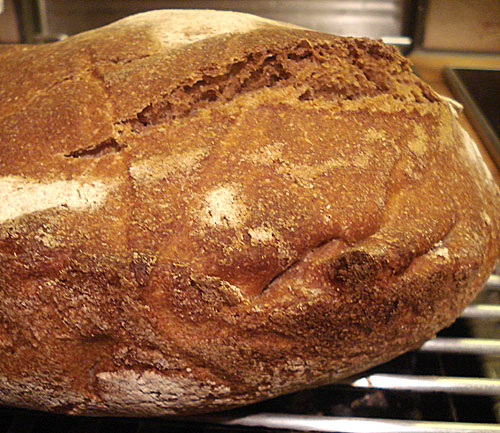 I've adapted the No Knead Bread method for making this bread as described here, for a bread that originally requires at least 20 minutes of kneading. It turns out a quite light, crispy-crust, delicious loaf.
- 1 3/4 cups of fully mature desem, containing 2 cups (120g) of flour
- 2 1/4 cups of unchlorinated (bottled or filtered) cold water
- 2 to 2 1/2 tsp. salt
- 4 cups (480g) fresh, organic whole wheat flour (the same flour with which you made the desem starter)
In a large bowl, preferably glass or ceramic, cut the desem into little pieces, and mix in with the water and salt. Stir around, squishing the little bits of dough, until the desem completely melts into the water, making a uniform liquid. Since you won't be kneading the bread for a long time as with the original recipe, this step is critical to ensure the desem is distributed throughout the liquid.
Add the flour, 1 cup at a time, stirring after each addition. At the end you should end up with a soggy, saggy, but not totally liquid mass. It should form a rather wet and soggy ball in the bowl.
Cover the bowl with plastic film, leaving a small gap so that air can get in. Leave the bowl at room temperature for about 8 hours (a shorter time than is required for the original recipe), or until the dough has nearly tripled in size. If you have a good mature desem to start with, this will happen reliably. Punch the dough down and leave it to re-rise for another 1-2 hours.
Make ready a clean, non-terry kitchen towel by sprinkling it rather thickly with whole wheat flour.
Take the dough out and sort of knead/round it out - it will be very sticky, but you want a sort of cohesive ball, as detailed in the original No Knead Bread recipe. Put the ball on the floured towel and cover. Let it rise for about 90 minutes.
In the meantime, heat up the oven and your heavy enamelled cast iron pot with the plastic knob removed (lest you melt it off) in a 450°F / 225°C oven for at least 30 minutes before the baking time. (I use a Le Creuset Doufeu, whose lid had no knob to start with.)
Take the heated pot carefully out of the oven, remove the lid and place on a secure heat-proof surface. Take the towel containing the dough by both ends and carefully flop the dough into the pan. Immediately put the lid back on and the pot into the oven.
Bake for 30 minutes, then remove the lid, lower the heat to 350°F / 175°C (this differs from the original recipe) and bake for an additional 30 minutes.
Take the loaf out of the pan and let cool before cutting, if you can resist.
Note: the crust turns out a bit thicker than the white flour No Knead, but is still thin and crisp enough. The lowering the heat and baking for a longer time is necessary to bake this heavier whole grain bread all the way through.
I still haven't figure out how to prevent a large rip from appearing on the upper crust. Though I must say that the ripped part has a really nice, crispy/chewy texture.
Submitted by maki on 2007-02-07 19:08.
If you enjoyed this article, please consider becoming my patron via Patreon. ^_^
 Welcome to Just Hungry, where we serve authentic Japanese recipes and more! I'm








Comments
DaviMack
29 May, 2007 - 05:25
Permalink
Rip in Top Crust
Have you tried slashing the top? This might alleviate some of the pressure from inside, to give you a bit of a planned gap, rather than a random one. I'd guess that you're getting it because you don't have sufficient gluten content in the flour, or that you're not developing the gluten enough because you're not kneading it. However, I'd try slashing, oiling the surface, and kneading just a wee bit to see if you can get either of these methods to work for you.
Also, you might be developing the rip because you're forming the top crust too quickly, due to the heat. You might try placing the casserole dish in the oven to pre-warm without the top lid, so that you're not getting the full radiant heat, and are insulating the top from the blasting heat by having the cold lid on top. This should also provide you with a higher rise, somewhat, due to the delay in formation of the top crust.
I usually end up with a rip in my breads when I've incorporated too much fiber, though, so you might consider as your first remedy the addition of gluten flour, or kneading a bit.
mamastrat
11 February, 2009 - 23:16
Permalink
Re: No Knead Desem Bread
Where do I find the recipe for the desem starter?
tom2000
12 February, 2009 - 05:22
Permalink
Re: No Knead Desem Bread
I have been using a starter I got from a friend that has been fed a diet of skim milk and AP-KAF in equal measures. I had been using a strain that I started using water but this smells so much better, plus it’s an old starter. Is there anything I should know about the care and feeding using skim milk?
Tom
Cooking
maki
12 February, 2009 - 09:34
Permalink
Re: No Knead Desem Bread
I'm really not an expert on sourdough starters, but there is a terrific site that has a very enthusiastic community of 'artisan' type bread bakers, where I'm sure you'll get good advice: http://www.thefreshloaf.com/
Loretta
20 November, 2011 - 10:23
Permalink
Re: No Knead Desem Bread
Well done, Maki! I'd got into no-knead breads a few weeks before I embarked on the desem journey (I make it with white, wholemeal, rye, wine, water, salt & instant yeast) and I'm glad I had plenty of practice before tackling this version. I must say we're delighted with the results. Perhaps it's the different ratio of desem to flour and the wetter crust but we did prefer this to the mature desem recipe in the book in last night's side by side comparison test. This no-knead version is even more 'koubashii' than the kneaded version and every bit as light. We also got a random rip but, then again, I didn't poke any holes in, the rip was small and to the side and I like seeing the desem express itself 'creatively', so I won't be seeking to address this. I'm just not that kind of baker!
Thanks for doing all the leg work with this adaptation. I could easily relegate the kneading to our breadmachine but I wanted a method I could give to another mother of a young child, the bonus is our preference, i.e. You've improved on an already sensational recipe. Thank you again!