
Heidi's hard goat cheese, perhaps
One of my favorite books as a child was Heidi. Heidi, in case you don't know, is the story of a little Swiss girl who goes to live with her grandfather, the reclusive Alm Uncle. It is the most famous children's book ever written in Switzerland. The author Johanna Spyri was actually a resident of Zürich, who thought of the story of the simple Alpine girl while she was convalescing from an illness in the Grisons, which is the eastern part of the country.
Cheese figures quite prominently in the story of Heidi. Since the Alm Uncle keeps goats, it seems logical that he made cheese from the milk of those goats. But in actuality goat cheese is not at all common in Switzerland. The goat cheese that is the most familiar to most of us is the French style - creamy in texture and intense in flavor, but it's very unlikely that the Alm Uncle made that kind of cheese, since he was making cheese mostly for his (and Heidi's) consumption. It would have needed to be a long storing kind. In one passage in the book, he is toasting a hunk of cheese:
The kettle soon began to boil, and meanwhile the old man held a large piece of cheese on a long iron fork over the fire, turning it round and round till it was toasted a nice golden yellow color on each side. Heidi watched all that was going on with eager curiosity. [...]
Then he brought her a large slice of bread and a piece of the golden cheese, and told her to eat. After which he went and sat down on the corner of the table and began his own meal. Heidi lifted the bowl with both hands and drank without pause till it was empty, for the thirst of all her long hot journey had returned upon her. Then she drew a deep breath--in the eagerness of her thirst she had not stopped to breathe--and put down the bowl.
"Was the milk nice?" asked her grandfather.
"I never drank any so good before," answered Heidi.
"Then you must have some more," and the old man filled her bowl again to the brim and set it before the child, who was now hungrily beginning her bread having first spread it with the cheese, which after being toasted was soft as butter; the two together tasted deliciously, and the child looked the picture of content as she sat eating, and at intervals taking further draughts of milk.
The cheese he used has to be firm enough to put on a long fork and toast over an open fire. Was there such a thing as a firm, hard goat's cheese?
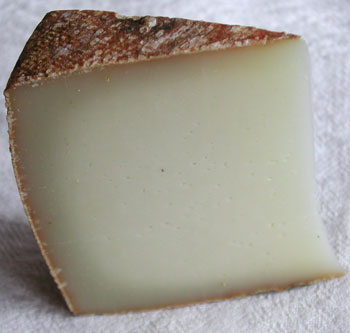
Then on Wednesday, when I made my weekly prowl through the main station market, there it was: a hard goat's cheese. Not from the Grisons, but from the Züri (Zürcher) Oberland, a mountainous rural region to the southeast of the city of Zürich.
With a distinctly blueish-grey, translucent color that is rather like pale moonlight, it's one of the most unusual looking cheeses I've ever encountered.
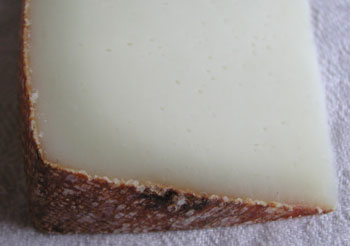
The taste, like its color, is mild, delicate and somewhat elusive. It is totally unlike any other goat cheese I've ever had. It reminded me the most of Manchego, a sheep's milk cheese from Spain. The texture is quite firm, and although it's a whole milk cheese it is crumbly rather than creamy. It's the kind of cheese I could nibble on for a long time without getting tired of it.
I'm not sure if the Alm Uncle's goat cheese was anything like this one, but it has opened my goat-cheese horizons. I only bought a very small piece, but next time I will buy a larger one and see if I can toast it over the fireplace.
Submitted by maki on 2006-02-24 16:24.
If you enjoyed this article, please consider becoming my patron via Patreon. ^_^
 Welcome to Just Hungry, where we serve authentic Japanese recipes and more! I'm






Comments
foodcrazee
25 February, 2006 - 12:32
Permalink
Heidi's hard goat cheese, perhaps
that does looks delish.....what a wonderful way of posting them...
foodcrazee
25 February, 2006 - 12:34
Permalink
Heidi's hard goat cheese, perhaps
wow! thats does looks delish...u have a great way of putting words, its so pleasant and nice to read....thank you
Margaret
25 February, 2006 - 14:50
Permalink
Heidi's hard goat cheese, perhaps
Very interesting. They do sell Ziegengouda here in Germany, which seems to be industrially produced - from Holland? It is milder than Manchego but I like it a lot.
RennyBA
25 February, 2006 - 22:26
Permalink
Heidi's hard goat cheese, perhaps
Interesting article and nice documentary pics. I've eaten it and it tasted Norwegian:-)
Christine S.
30 January, 2009 - 06:06
Permalink
Re: Heidi's hard goat cheese, perhaps
This was wonderful info. I have been looking in WI-USA for hard goat cheese and everyone looks at me like I am crazy. My grandfather used to eat this crumbled/grated on all kinds of food, when I was younger. I remember it also being strong smelling. He use to store it in a canning jar in the fridge. He was French/german and none of his 14 children, my aunts and uncles, knew the exact name and we have all been in search off and on for awhile. This is a great stepping stone in my search. Thank you.
lynda
6 December, 2009 - 07:14
Permalink
Re: Heidi's hard goat cheese, perhaps
Looks very yummy!...Trader Joes had a goat swiss cheese for a while, and it was very yummy. I sure wish I could find it again...Obviously, someone was making it, but I have no idea where I could find such a cheese again.
Rolf
20 December, 2009 - 08:07
Permalink
Re: Heidi's hard goat cheese, perhaps
Lynda, if you read this, I'm almost positive they sourced their goat Swiss from the Carr Valley Cheese Company. If not, then it was a goat Swiss made very similar to Carr Valley's goat Swiss.
cmtigger
22 December, 2009 - 06:44
Permalink
Re: Heidi's hard goat cheese, perhaps
I've been just starting to experiment with goat's cheese, and I've only made soft cheese so far. But in my research and what I've seen at the natural foods co-ops, it looks like you can pretty much make any kind of cheese, hard or soft, fresh or aged out of any kind of animals' milk that you want. (of course it's going to depend on the right equipment, rennet, enzymes, bacteria and so on...)
In general I see a wide variety of cheeses made from cow's milk, goat's milk and sheep's milk at the co-ops.
JE
23 February, 2010 - 03:45
Permalink
Re: Heidi's hard goat cheese, perhaps
Hi, you didn't mention who made this cheese, or what it was called. Can you tell us that info please? Thank you, I really enjoyed this entry!
dreambria
11 May, 2010 - 00:07
Permalink
Re: Heidi's hard goat cheese, perhaps
I stumbled on a great goat-cheese maker in the heart of Wisconsin's Driftless area. He makes both soft and hard cheeses with a traditional artisan approach. Worth checking out... http://www.capricheese.com/about.htm
Jen
1 September, 2011 - 18:02
Permalink
Re: Heidi's hard goat cheese, perhaps
can someone please tell me the official name of this hard goat cheese and where I might find it? I am in San Diego Ca..looks really good. Ive been looking for a goat cheese substitute for Parmesan.
thanks!
Pat
16 February, 2012 - 01:10
Permalink
Re: Heidi's hard goat cheese, perhaps
What's the name of the cheese? I'm in the midst of re-reading Heidi and would love to see if a cheese store here can get some of the one that you write about. Thanks!
Mobilemom
31 January, 2014 - 20:44
Permalink
Re: Heidi's hard goat cheese
Love the article. I was researching Heidi's diet on the internet. I remember thinking how wonderful the Shirley Temple movie and the book made goat's milk, (the milk I tried was horrible) the bread and the cheese seem the most wonderful food in the world. Today I love goat cheese (any cheese in fact)& bread. I'll have to try some goat's milk again. Maybe the goats I sampled from, had too strong of a diet. :)