
How to cook lotus root (renkon)
(From the archives - since all of a sudden, a lot of people are asking about lotus root! Originally published in April 2008.)
Lotus root (renkon in Japanese) is actually the rhizome of the lotus plant. It's a popular vegetable throughout southern and eastern Asia, but it's still not that well known in the west. Lotus root is full of fiber and various vitamins and other nutrients. In Asia it's believed to have various medicinal qualities, but in macro-nutrient terms it's best to think of it as a starchy vegetable, like potato. Visually of course, it's very appealing with all those little holes. Here I'll explain how it's prepared and eaten in Japan.
How to prepare lotus root
First off, this is how a raw lotus root looks like. You can buy them at an Asian (South or Eastern) grocery store. More often than not they will be vacuum packed. A nice fresh one is a light orangey-brown. The older the root the browner and darker it is.
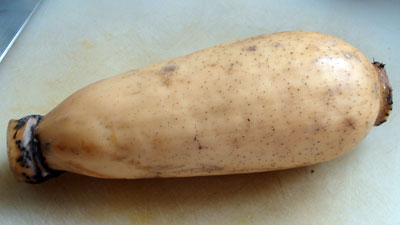
Mature lotus root has a sort of slightly bitter or tannic quality, so should not be eaten raw. (Apparently young lotus roots can be eaten raw, but I've never encountered them unfortunately.) The bitter/tannic substance is most concentrated in the skin, so you should peel it. Inside, it's a light flesh color.
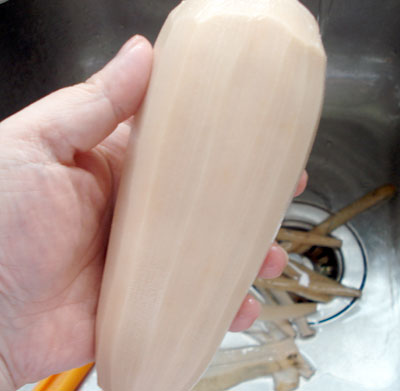
(Another way to deal with a raw lotus root is to steam it whole, but peeling and slicing is easier for beginners.)
Raw lotus root will start to darken almost right away, rather like raw potato. To prevent this, put the peeled lotus root in water with a little vinegar in it. If I slice it up, I put the slices in the vinegar water.
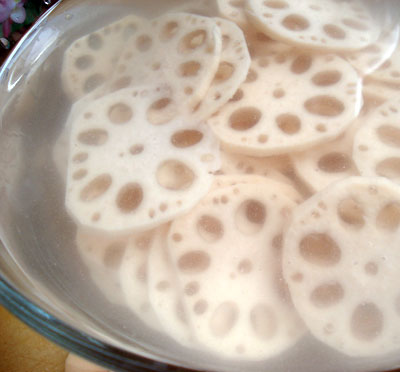
If using the slices for a salad, or for any dish that has no further or very little more cooking, they should be boiled for a couple of minutes in vinegared water. This retains the crunchy texture but gets rid of that tannic-ness.
You can also buy lotus root in cans, which can be used straight away. However, many canned lotus roots have been bleached to make then whiter, so I prefer to use raw lotus root if I can find it. (The natural color of lotus root is a very light flesh-orange.)
Changing textures
Depending on how long it's cooked, the texture of lotus root varies from crunchy to very starchy and a little sticky. I like it either way. Here are two ways of using lotus root in its crunchy stage.
Recipe: Lotus root, cucumber and Serrano ham salad
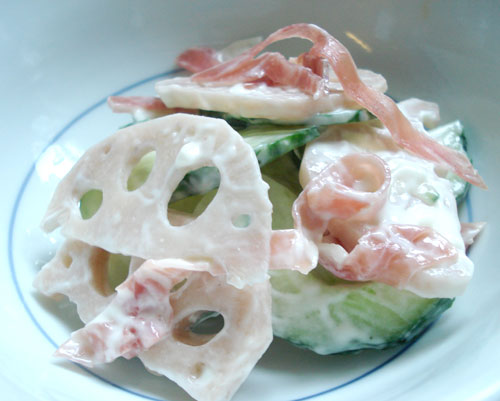
- 1/2 lotus root, sliced very thinly and the slices cut into halves
- 1/2 English or seedless cucumber, de-seeded and sliced thin
- 1-2 slices of Serrano or other dried ham, cut into thin slivers
- 1/2 Tbs. rice vinegar plus additional for cooking
- Dash salt
- 1 tsp. sugar
- 1 Tbs. mayonnaise
Put the sliced lotus root into vinegar water as you slice it, as described above. Bring a pot of water to a boil, and add a little vinegar. Boil the lotus root for a couple of minutes. Drain and cool under running water; drain well.
Mix the vegetables and seasonings except the mayonnaise together well with your hands, scrunching them a bit to let the flavors penetrate. Add the mayonnaise and ham and mix well. Serve immediately, or cool in the refrigerator until dinner time.
Recipe: Stir-fried lotus root with sesame and green onions
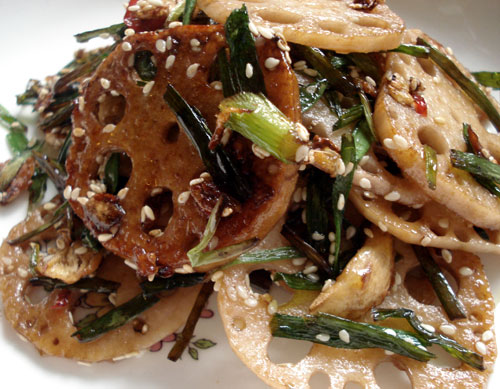
- 1/2 lotus root, sliced very thinly
- 1 piece of fresh ginger about 1 inch / 2 cm or so long, peeled and chopped
- 2 garlic cloved, peeled and chopped
- 1 1/2 cups of roughly chopped green onions
- 2 Tbs. hot red chili pepper, finely chopped
- Oil
- Vinegar for the lotus root water
- 1 Tbs. sesame seeds
- Pepper
- 1 to 1 1/2 Tbs. soy sauce or to taste (more if you intend to eat this the Japanese way, with plain white rice)
- 1 tsp. sesame oil
Put the sliced lotus root into vinegar water as you slice it, as described above. Drain well just before cooking.
Heat up a large frying pan with the oil. Add ginger and garlic, and stir fry until the oil is very fragrant. Add the drained lotus root slices in a single layer. Cook until the lotus root slices start to change color - they turn a bit translucent looking. Turn over and cook a couple more minutes.
Add the chili pepper and green onions, and stir-fry. Add the sesame seeds, pepper, soy sauce and sesame oil. The lotus roots should get a bit caramelized from the soy sauce. Serve hot or cold. This is very nice for bento.
Other ways to eat lotus root
- Lotus root mini-cakes with sweet chili sauce. This uses the starchy, sticky quality of grated cooked lotus root.
- Lotus root slices poached in dashi and vinegar - a very traditional Japanese dish
- Cut up and put into soups or stews - the longer it's cooked, the more starchy it gets
- Deep-fried or baked as chips (these baked ones on jugalbandi look great)
- With a batter as tempura
- Sandwich some meaty filling inside and pan-fry (hasami-age)
Submitted by maki on 2009-02-02 11:53.
If you enjoyed this article, please consider becoming my patron via Patreon. ^_^
 Welcome to Just Hungry, where we serve authentic Japanese recipes and more! I'm







Comments
Amy
14 April, 2008 - 19:35
Permalink
Thanks for this
I always order lotus root dishes in Chinese restaurants but had no idea how to prepare it. Your photos look great!
fossettes
16 April, 2008 - 14:19
Permalink
Thank you
Thank you specially for that complete article. I know have a global view of that veggie and will give it another try. The stir fry looks terrible!
elizabeth
16 April, 2008 - 15:41
Permalink
terrible = really, really
terrible = really, really terribly good in french slang :)
maki
16 April, 2008 - 15:58
Permalink
is it like ‘bad’ meaning
is it like 'bad' meaning 'really great' in English? :P
Pag
25 February, 2011 - 13:53
Permalink
Re: is it like ‘bad’ meaning
I think you'll find that it is US English. In the 1980s, people tried to be more like Americans and tried introducing opposite meanings so that they could be 'cool' but it only keeps going in the youth culture as each generation becomes teenagers and thinks that they have invented it an all of the previous generations are too old to be using such terms.
BTW, I've used dried lotus (from the local Chinese supermarket) and rehydrated it for this.
Nice one.
Kevin
16 April, 2008 - 15:20
Permalink
Renkon!
Finally, a vegetable that's far too underrated. Thanks a lot for featuring this one, Maki. =D
I'm Chinese, so the lotus root features more predominantly in things like soups - one very common one is a combination of pork bones and sliced lotus root, brought to a gentle, rolling boil and left to slowly simmer for a few hours, bringing out both the goodness of the pork and turning the lotus root slices somewhat al dente. Very delish, I must add.
I've been thinking of using renkon in oden, in addition to daikon, konnyaku and the likes, but then you'd probably have to simmer it for quite a long time (even longer than the daikon!) to get it soft and really flavoured.
maki
16 April, 2008 - 15:57
Permalink
i’m not sure why renkon is
i'm not sure why renkon is rarely used in oden...maybe it is the texture. (then again, things like satoimo are not used much in oden either, though jagaimo (potato) is. Maybe people get stuck with particular combinations.)
Tess
16 April, 2008 - 20:00
Permalink
Could it be a seasonal thing?
I haven't seen fresh renkon until this spring. Oden seems like a winter dish. Potatoes store really long, so they are available year round. Lotus root, growing in the mud under water seem as though they'd be difficult to get in the winter, and unless they're processed they don't keep long.
maki
16 April, 2008 - 21:19
Permalink
Actually, i think lotus root
Actually, i think lotus root is considered to be a winter vegetable in Japan anyway (not sure about China etc)...and it does turn up in winter stews (nimono). My guess is it's 1. habit/tradition and 2. texture.
tanja
23 April, 2008 - 05:19
Permalink
Can not add much to above
Can not add much to above but to thank you for your simple recipes! Looks delicious!
I see often the slices filled with minced shrimp and then fried. Tasty and decorative as well.
Maki, sometimes, the root is a little dark inside. You cannot see it from the outside when you buy it. Any ideas, how (if?) to improve it?
Thanx a lot again!
t-in-t
maki
23 April, 2008 - 13:19
Permalink
tanja, I just try to select
tanja, I just try to select the healthiest-looking ones that are lighter in color outside (fleshy-brown-pink), and if there are dark spots I just cut them out. It is a bit difficult to tell from the outside though, that is very true.
Bell
29 April, 2008 - 12:07
Permalink
Gah!! I wish I could find
Gah!! I wish I could find lotus roots in Bern! Maki, you're so lucky in Zürich... I've got cravings for lotus root soup now. And I'm dying to try the lotus roots mini cakes!
Bell
29 April, 2008 - 15:20
Permalink
yay!
I take that back. I spoke too soon about not finding fresh lotus roots in Bern. For months now all I've been able to get are frozen, pickled or dried (ugh!) lotus roots. But TODAY I went to my local Asian grocers and they had new stock in (it was a mess, Styrofoam boxes everywhere, could barely walk) and I spied among the fresh veges still in the boxes, packets of fresh lotus roots! Only 4 though, maybe I was simply never fast enough to get to them before someone else did! happiness ^__^♥ Gonna try them mini cakes woo hoo!
Wakkun
30 April, 2008 - 23:31
Permalink
Tasty!
Hi Maki,
I made this last night, the lotus root stir fry that is. I didn't use green onions but substituted it with chinese chives instead. It was very tasty. Hubby who is not fond of lotus roots at all decided to take a bite. He was pleasantly surprised and said it tasted very good. He says he will eat this again when I make it again. Thanks for sharing another great recipe!
maki
1 May, 2008 - 12:47
Permalink
I’m glad your husband
I'm glad your husband liked it! Thank you always for your feedback Wakkun - they are really helpful :)
hime-chan
1 May, 2008 - 17:26
Permalink
emm... taste good and crunchy
this recipes is really good, i just try it and love it . never know that lotus root can be this good.
simple and easy really satisfied
yukirei
5 May, 2008 - 20:26
Permalink
I LOVE lotus root!!!=D
I am so happy to see this post! I've LOVED lotus root all my life; but only ate it one way growing up- in Chinese soups that my mom and grandma made for as long as I can remember. I make the soup too regularly and dip the lotus root and meat in spicy soy sauce for a extra kick. I'm going to try the stir fry version this week!=)
Sarah
28 December, 2008 - 00:24
Permalink
Love the salad
I've been wanting to make this salad since I saw it here. Mmm Lotus root. I finally had the chance, and I made some additions. I've posted my changes on my blog, along with a link back and a quote from your recipe, I hope you don't mind.
Your site always gives me tasty ideas, it's one of my favorite reads. Thanks for all you share!
Lyvvie
21 January, 2009 - 15:02
Permalink
Re: How to cook lotus root (renkon)
I just bought some from Japan Centre and didn't know what to do with them - your post was #1 on the google search! Thank you!!
eilismaura
26 June, 2009 - 22:00
Permalink
Re: How to cook lotus root (renkon)
I just bought a pack of the boiled lotus root slices
Once I open it how long will it last?
How should I store what is not used right away?
Thanks!
Eilish
maki
27 June, 2009 - 07:29
Permalink
Re: How to cook lotus root (renkon)
You should try to use up the packet once opened as soon as possible. Just store it covered in the refrigerator. But yeah...use it up ASAP when it's opened.
Chia Baker
6 February, 2009 - 05:03
Permalink
The flavor?
I discovered this post actually through the photo which appeared on a search...though now I'm curious to try it after reading what you've said!
But, what does it taste 'like'?
You'd said 'regard as starchy vegetable' is it like a zucchini in flavor or other squash-type thing? Can it be compared to anything slightly less extoic so one who wants to try it may know what they're letting in for?
Thanks for posting this,
maki
6 February, 2009 - 10:29
Permalink
Re: The flavor?
If it is prepped as above to get rid of any bitterness, it has a very neutral flavor. It's more about the texture (crunchy when lightly cooked, or sticky/starchy when grated or cooked a long time) rather than flavor. It takes on the flavors of whatever is cooked with/in/on it.
Heidi / Savory Tv
6 February, 2009 - 18:10
Permalink
Re: How to cook lotus root (renkon)
What a beautiful vegetable! Thank you for the education and recipes, I hope I can find it somewhere!
Katrina Gair
7 February, 2009 - 00:52
Permalink
Re: lotus root
Just a question about lotus root,is it good for weight loss
maki
7 February, 2009 - 09:55
Permalink
Re: lotus root
It's not zero-calorie, since it has a fair amount of starch and some protein too, but it is high in fiber so it could be used in a weight loss plan for that sense of fullness (not to mention keeping you know, the plumbing moving things along!) 100g (about 3 ox) of cooked lotus root has about 66 calories, 16g carbohydrates, 1.5g protein, 3.1g fiber. I treat it as a carb component of meals generally.
dorayaki
8 February, 2009 - 21:02
Permalink
Re: How to cook lotus root (renkon)
I love renkon! I've never seen them here whole, can only buy them packaged sliced in vinegar, or frozen. I must get some soon to try your recipes.
Amy in Yokohama
22 February, 2009 - 12:54
Permalink
Re: How to cook lotus root (renkon)
I've made the baked lotus chip recipe on jugalbandi a couple of times - it's great as long as they're eaten fresh out of the oven. (I went a little heavy on the cayenne one time and made my friends sweat!) Next time will be the stir fry.
I love your site - it helps me figure out what to do with all the random things I can't help buying from Japanese grocery stores!
japanskmat
8 March, 2009 - 12:06
Permalink
Re: How to cook lotus root (renkon)
レンコンに関するサイトを探していて、こちらのブログを見つけ、リンクとして使わせていただきました♪
Weaselle
29 August, 2009 - 05:36
Permalink
Re: How to cook lotus root (renkon)
Thanks for the great article! Living in south-central China, lotus is a specialty of the area, and I'm so happy to get more suggestions on how to cook it.
BTW, here in China lotus is a summer vegetable, not a winter one. But my Japanese-American husband seems to remember his mom including lotus in oden when he was little.
Anyway, another way to fix it is to make a kinpira. A Japanese friend suggested this, so I just used your recipe for kinpira gobo, and wow! came out great.
Jin Lee
22 March, 2010 - 04:05
Permalink
Re: How to cook lotus root (renkon)
lotus root is sooo good. especially when it's stewed or if it's in a vegetarian stir fry^^ i love the little thread looking things that come out when I bite into it... <3
i love your recipes^^
Kate
2 October, 2010 - 07:33
Permalink
Re: How to cook lotus root (renkon)
Just returned from 3 weeks in China where we ate lotus root numerous times, usually stir fried, always absolutely delicious. Don't know where I'll find it in Israel where I live, but I'll look in specialty stores.
Thank you for all the information and recipes.
Annie
30 October, 2010 - 10:24
Permalink
Re: How to cook lotus root (renkon)
I ate the fried lotus root at my host family's and fell immediately in love, you have no idea how thankful I am for you sharing this (and the whole site of course)!
Hans
18 November, 2010 - 12:58
Permalink
Re: How to cook lotus root (renkon)
Thank YOU. It is clear information with your pictures
I live in Asia and it is one of my favorite vegetables and now I know how to cook and fry them. It has been very, very succesful. Thank you
Paige
21 November, 2010 - 17:40
Permalink
Re: How to cook lotus root (renkon)
Oh man, the lotus stir fry is so delicious. How long does it last in the fridge? I'm trying to decide just how big a batch I can get away with making next time!
rose
22 December, 2010 - 20:12
Permalink
Re: How to cook lotus root (renkon)
I am young,but i would love to cook with natural Asian-found food like lotus root or bamboo shoots.The only problem is,I do not know what lotus root tastes like because i have never cooked with it before,or even tried it.If you could leave a brief description on the taste please,that would be very helpful.Thank you for the recipes and happy cooking!
maki
23 December, 2010 - 00:43
Permalink
Re: How to cook lotus root (renkon)
I've described the taste already in this reply.
Saeed Tunio
8 September, 2011 - 14:56
Permalink
Re: How to cook lotus root (renkon)
lotus rhizome(lotus root) is a good vegitable, in Sindh (pakistan) its called as a "BEEHU" very famous serving in wedding meal. its cooked with lot of vegitable like spinach and mutton.
Cherie
11 October, 2011 - 12:44
Permalink
Re: How to cook lotus root (renkon)
Had a whole bunch of renkon from our friend who got it from his dai fan/stalker. Wish someone would stalk me with homegrown veggies(^^)
Made the whole lot with the green onion recipe and no togarashi for the kids. My husband got one taste, I put a little away for the bento tomorrow and the 6 year old kindergartener proceeded to eat the entire bowl while i was preparing dinner. Guess it was pretty good. I've promised to buy more renkon for the rest of the family tomorrow.
mcarl404
9 November, 2011 - 16:54
Permalink
Re: How to cook lotus root (renkon)
My experience with lotus root is as follows:
I bought a lotus root from my local market in Tian Jin, China.
Admittedly, my Chinese is poor, but when I asked the vendor if I had to peel the skin, he said, "No."
So I didn't. I put the lotus slices in a wok full of boiling water, which proceeded to turn an evil shade of purple, causing me no small amount of distress.
For some reason I could not find anyone else who had this experience on google, or maybe just one guy, but that wasn't encouraging, so I went to Baidu, and used my Chinese language skills to find a few other people commenting about this, and some experts who said I was not poisoning myself by eating the evil purple brew that had unexpectedly appeared in my wok.
I also read that the peels contained the most..uh...purple-making stuff, and that you should put the sliced roots in vinegar, as this article suggests.
So the next night, I used a potato peeler to slice away the peel (which, by the way, tasted fine the night before)and put the slices in a vinegar/water solution for about 5 minutes.
But even after this, I got the same purple brew!
What gives? Surely someone has used lotus root as a dye somewhere, but I can't find that either.
anon.
26 January, 2012 - 05:39
Permalink
Re: How to cook lotus root (renkon)
I remember my mother used to stuff sweet rice in the holes and steam the lotus root for mucho hours. Then she would slice it up and sprinkle sugar and serve. That was such a treat! yum!
I would like to try it but cook/steam them in the microwave in a bowl with water and loosely covered. Do you think this will work, Maki?
anon.
23 March, 2012 - 19:58
Permalink
Re: How to cook lotus root (renkon)
Renkon makes for my favorite tempura item, followed by maitake. I like 'em both dipped in a little salt (sometimes maccha or ume flavored), rather than tempura tsuyu.
I like 'em even more than shrimp tempura!
maki
24 March, 2012 - 01:35
Permalink
Re: How to cook lotus root (renkon)
I love renkon tempura. I can take or leave shrimp tempura actually ^_^ I think my favorite tempura is kabocha squash. Or shiso.
Figgy
2 September, 2012 - 01:24
Permalink
Re: How to cook lotus root (renkon)
I made the stir fried lotus root with sesame & green onions tonite and it was delish! I've never had it before but since my husband received it as a gift from a friend of his I had to learn how to serve it. Yours was the first site that popped up and the recipe looked easy enough so I tried it. I'm glad I did!!! This recipe is a keeper! Thank you for posting it along with the instructions on how to handle and prep the root itself.
anon.
30 May, 2013 - 20:47
Permalink
Re: How to cook lotus root (renkon)
The Lotus Root and Green Onion recipe is incredible! I now have to bring it to every pot luck I attend, and it disappears within the first 15 minutes. It is not a snap to make but definitely worth the trouble!
HINT: I put extra chili peppers on the side for those who like it really spicy.
Great recipe, Thanks for the delicious recipe! t is similar to dishes I ate in Mainland China.
Derek
10 December, 2013 - 19:21
Permalink
Re: How to cook lotus root (renkon)
I like to use renkon as a replacement for potatoes in my curry dishes.