
Cooking whole dried soybeans
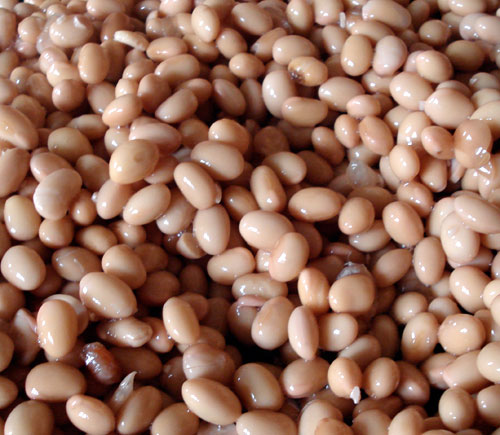
Until fairly recently I had a blind spot when it came to the humble soybean. I regularly consume soy products like soy milk, tofu and okara, not to mention fermented soybean products like natto and tempeh. And green soybeans or edamame are always a great snack.
But for some reason, I didn't really get into eating the whole dried (and cooked) soybean. It's not that they are that much harder to cook than other dried beans either.
In any case, I've rectified that situation and now I cook up a batch of soybeans quite regularly and store them in the freezer. Plain boiled soybeans are amazingly delicious, and just packed with nutrition. The cooking liquid is so rich that it can be used as a very nutritious stock or dashi for making soups and such.
There are a couple of points to watch out for when cooking whole soybeans, which are noted below in copious detail.
Step 1: Wash and pick over
Rinse the dried soybeans, rubbing them together gently to remove any surface powdery residue , and pick out any dark or discolored beans. These will not cook properly. If any of the hulls work themselves loose while you're washing, pick those out too.
Step 2: Soak overnight
Soak the beans in water to cover for several hours or overnight. You may need to soak them a bit longer than other types of beans. Also, the bring to a boil then let sit for an hour method of speeding up bean cooking does't really work well for some reason.
After soaking, you can optionally split the beans by squeezing them gently. (An alternative is to use a food mill to split the dried beans, but I don't have such a device so if I want the beans split I do it after they are saturated with water.)
Step 3: Use a big pot
Just like soy milk foams up like crazy while it's being cooked, soybean cooking liquid will bubble up quite enthusiastically, all over your stovetop if you don't watch out. So the dried soybeans should not come up to more than 1/4th of the height of your cooking pot, and the cooking water should only come up to about 1/3rd of the height maximum. In other words, use a big pot, or cook less. This is particularly true if you're using a pressure cooker - the viscous cooking liquid may even clog up the works, so be careful. (My pressure cooker can handle about 3 cups of dried beans.)
Step 4: Bring to a boil, then skim off the grey stuff
Whether you are using a pressure cooker or a regular pot, you should first bring the soybeans to a boil, then skim off the greyish stuff that will rise to the surface of the water.
Step 5a: Using a pressure cooker
After you've skimmed off the initial grey stuff, put a heat-safe plate that is a smaller than the circumference of the pot on top of the beans. This plate helps to keep the beans from dancing around, and also prevents any loose hulls from rising up and possibly clogging the pressure valves. Once it's reached pressure, lower the heat and cook for 20-25 minutes. Turn off and let cool naturally until de-pressurized.
Step 5b: Using a regular pot
Heat up to a boil, then put a heat-safe plate or an otoshibuta on top of the beans. Cooking time is about 3 hours, but don't worry, you don't have to watch it continuously for that time. Top up with additional water from time to time if it seems to be cooking off, and skim off any grey stuff. A slow cooker would work too. The beans are done if you press one between your finger and thumb and it's soft, not crunchy. (Or just eat one!)
Step 6: Draining and removing the hulls
Once the beans are cooked using either method, stir then let them sit a bit - the loose hulls will rise to the surface. Skim these off. Strain the beans, reserving the liquid to use as a vegan stock. (Don't get too concerned about a few loose hulls left in. Removing those hulls is just a good idea because they tend to end up undigested and loose in your innards, which may cause you to rooty-toot-toot a bit more than you may want to and such.)
Step 7: Optional oven drying
The beans at this stage are pale and rather soft. You can use them as-is, but one thing I like to do to at least half the beans is to slow-dry them in the oven. This makes the beans firmer and meatier, and more suited to use as a meat substitute.
Just spread out the well drained and cooked beans on a baking sheet, and put into your oven at the lowest possible heated setting. On my oven that's 50°C or 122°F. Leave the sheet of beans in there for about 2 hours, turning occasionally. They will shrink to about 20% and turn a light reddish brown. If you taste one it should be just a bit chewy but not hard.
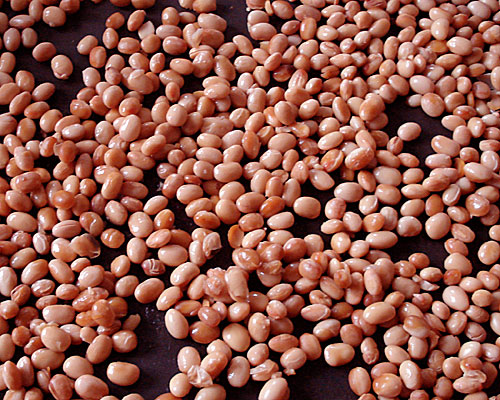
You can use these dried soybeans coarsely ground in a food processor as a ground meat substitute in pasta sauces and such, or to make soy burgers and so on. (You can dry canned soybeans in this way too.)
Storing and freezing
I store un-dried soybeans in freezer bags with a little bit of the cooking liquid. These are used in stewed dishes, soups and such. The dried beans are stored on their own in freezer bags. The cooking liquid can be frozen too.
So there you have it. It may seem complicated, but it really isn't once you've done it once. And the results are worth it especially if you are a vegan/vegetarian. And it's wonderfully cheap too.
Now, of course you can turn these boiled soybeans into fun things like tempeh and natto. That's for another day....
Submitted by maki on 2008-05-01 13:53.
If you enjoyed this article, please consider becoming my patron via Patreon. ^_^
 Welcome to Just Hungry, where we serve authentic Japanese recipes and more! I'm








Comments
Debbie
1 May, 2008 - 22:50
Permalink
It’s nice to see somebody
It's nice to see somebody else eating dried soybeans -- I always thought they were wonderful, but most people just turn up their noses. My favorite way of eating them is, as recommended by The Farm Vegetarian Cookbook (now The New Farm Vegetarian Cookbook), is piled in a tortilla with salsa and a sprinkling of nutritional yeast. Nothing else. Perhaps not so bento friendly, but surprisingly tasty.
jojo not healthy
24 August, 2013 - 08:15
Permalink
Re: It’s nice to see somebody
Hello...help. I am trying to get healthy so off I went & bought bags of Just Organic dried Soy Beans. Wow I thought...I am good!! Now I cant find recipes. Do I still soak overnight & cook them for hours first before I do something with them? They are small & slightly tan/yellow in colour & dont look like the whole bean but a half. Can you help? Thankyou Jo
Hakujin
2 May, 2008 - 02:13
Permalink
The magical fruit...
I was told to blow on a spoonful of the beans, if the hull separates when you do this then they are done.
I, too, make them from dried along with adzuki. I don't put sugar or mash them like most of my neighbors do. Just cooked plain and chilled they are good on a salad. Also good to mash them with some garlic and mayo and use them kind of like regular refried beans.
I'm not the biggest konnyaku fan but if it is cooked with dried soy beans and some seasonings I actually enjoy it.
Mei Ying
2 May, 2008 - 13:07
Permalink
interesting!
wow! your dried soybeans look good! We also dry soybeans like you do, but we dry it until it's crispy and then use them for toppings on clear soup. Sometimes I also eat them as a snack :)
I'm glad that you like tempeh too! But I'm wondering about how you cook it ^^ it's not that tempeh is unfamiliar to me but I want to know how others cook it. We usually marinade them with a mixture of crushed candle nut, ground coriander, a small amount of crushed garlic and salt, and then fry them with a little oil until cooked thoroughly. Another way is to simmer them in sweet soy sauce based liquid until the tempeh is well flavored and ready to eat. Or turn them into chips (it's a famous snack here).
Though there are many ways of cooking tempeh here, i still want to know how you cook it. I'd be really glad if you can post one or two tempeh recipes :)
Thank you very much!
Mei Ying
2 May, 2008 - 13:49
Permalink
and the boiled soybeans look
and the boiled soybeans look great too and I'm sure I'll make it someday :D
anon.
2 May, 2008 - 18:14
Permalink
my mom uses dried soybean
my mom uses dried soybean and then makes awesome lightly sweetened soymilk out of them. sooooo darn tasty!
Nora
3 May, 2008 - 13:08
Permalink
Hello Maki, Thank you for
Hello Maki,
Thank you for your soybean post. I recently discovered Natto is helpful in promoting vascular health. I started taking tablets, but I'd much prefer making it myself. So I will look forward to reading your post on Natto.
Nora
V
20 September, 2008 - 16:29
Permalink
Tempe
Hi Maki,
I'm wondering where you get tempe in Switzerland. I'm Indonesian and tempe is our staple which I can't get here.
Thanks!
maki
21 September, 2008 - 11:58
Permalink
I actually make my own
I actually make my own tempeh... you can get tempeh culture from here (they are based in the Netherlands, so it comes fast to CH). The instructions on that site are very good also! It's a bit of a bother to make but is very economic. Try it out :)
V
21 September, 2008 - 18:35
Permalink
You did? Wow… But yeah,
You did? Wow... But yeah, it doesn't look too difficult. Thanks Maki and thanks on the info re: Miso.
Annie
5 October, 2008 - 08:56
Permalink
The best absorption
Hi,I just cooked a pot of boiled soybeans today, for the very first time. Though I read it somewhere that soybean products provide better nutrition than soybeans because the whole beans contain some enzyme which prevents protein from being absorbed into our body. Is it true?
maki
7 October, 2008 - 05:53
Permalink
The enzyme is present in
The enzyme is present in whole uncooked soybeans, but is broken down by cooking, so no need to worry on that count. (They steam soy beans used as cattle feed for this reason, or so the interwebs tell me.)
Annie
7 October, 2008 - 11:25
Permalink
Thanks!
Ah, that's a good thing to know.Here in China, since people have no habit of taking bean dishes regularly, (not many vegetarians here)the information is limited and people who give advice are meat-eaters.They say it's best to drink soymilk or eat tofu as most of the protein will be taken by our bodies, and use the rest added to streamed bread to increase fiber intake.They sound like a good way, but I think that's too troublesome. I always like to cook beans and put them in the freezer for later use.
Gnoe
17 February, 2009 - 15:51
Permalink
Wow!
Thank you so much! I have a bag of dried soy beans sitting in my pantry for a year now, without knowing what to with it. At the time I couldn't find many recipes on the web. Now I will definitely try to make my own tempeh sometime! Hey, I live in The Netherlands so the starter stuff should be here any minute ;) And I absolutely love Indonesian food, so...
Thankyou thankyou thankyou! ;)
anon.
2 September, 2009 - 03:12
Permalink
Re: Cooking whole dried soybeans
Where do you get the soybeans to make soymilk from (can you get it from Trader Joe's or Whole foods)??? And can you use the green edamame to make soymilk??? I'm planning to start making my own soymilk so that is why i'm asking these questions.
maki
2 September, 2009 - 21:44
Permalink
Re: Cooking whole dried soybeans
Not sure about Trader Joe's but Whole Foods should have whole dried soy beans. If not, try a health food store. No you can't use green edamame, you need the dried kind.
Unspun
13 January, 2010 - 00:11
Permalink
Re: Cooking whole dried soybeans
Thanks! This is the best info for first time soybean users I've found. I'm not a vegitarian just a food fanatic. I just read that a 104 year old strongman was a vegitarian, and at 104 he could still bend a quarter with his bare hands!
anon.
21 January, 2010 - 06:43
Permalink
Re: Cooking whole dried soybeans
Good ideas but I would keep the hulls. They are a great source of fiber. Most Americans and people in the West don't get nearly enough fiber. Most don't come close. This is great fiber for you.
Bijan Omidi
5 March, 2010 - 22:27
Permalink
Re: Cooking whole dried soybeans
Thank you for descriptive recipe. I checked other sites they don't care about my question (DRY. However I'm a brand new user. I'll try it, then let you know the result.Thanks again.
worldtravler
9 April, 2010 - 14:34
Permalink
Re: Cooking whole dried soybeans
I am smiling...I too used to eat these using the Farm Cookbook and still like that recipe the best! Where can I get nutritional yeast flakes in Turkey or Bangladesh? Wonder what it is called in another language.
Alison
12 June, 2011 - 14:17
Permalink
Re: Cooking whole dried soybeans
This is a great post on cooking soybeans! Thank you. Though one thing I noticed: when I rinsed the soybeans before soaking they created a lot of foam, so I rinsed them until they stopped foaming. I rinsed them using a sieve in a bowl, so the bowl would fill with water yet I could lift the sieve out to tip the water out and rinse again with more fresh water. I soaked the beans overnight and rinsed them again before cooking. They didn’t foam while cooking, not in the slightest. This surprised me as anytime I'd cooked them before they foamed - but this was the first time I used organic soybeans. I also used a brand from a high end local organic distributor. Any experience/knowledge with foaming and non-foaming? Organic and non?
aa
22 November, 2011 - 14:37
Permalink
Re: Cooking whole dried soybeans
So I've prepared my soybeans, made my no1 bento staple hijiki ni. Now I have about half a litre of a hearty looking soy stock remaining and I haven't the foggiest what to do with it.
Do you have any suggestions - perhaps I can use it as a base for nabe, miso or tsuyu?
I'm sure responding to justhungry comments is far from a priority for you at the moment, but on the off chance you're enjoying contact from your growing number of followers, I thought I'd ask.
In the meantime I'll bung the stock in the freezer.
Our thoughts are with you!
Nae
28 November, 2011 - 23:04
Permalink
Re: Cooking whole dried soybeans
A base for nabe or soba soup dish would be ideal.
I also use my soy stock to add more body to Western style stews as well as iced cold with Somen on hot days.
It's coming into Summer in Australia, so I'm a little focused on chilled meals.
Sharmi Trivedi
30 November, 2011 - 05:06
Permalink
Re: Cooking whole dried soybeans
HI:
I am looking for dried soybeans. I need about 10 lbs. Please let me know where can I get it.
Thank you.
Sharmi
maki
30 November, 2011 - 19:09
Permalink
Re: Cooking whole dried soybeans
You can usually find dried soybeans at an Asian grocery store, or a health food store.
Diane
8 March, 2012 - 07:35
Permalink
Re: Cooking whole dried soybeans
Does anyone know if you can eat soybeans after just soaking overnight.
Sandra H. Phillips
25 November, 2012 - 23:07
Permalink
Re: Cooking whole dried soybeans
I added mashed cooked Soybeans to my meatloaf and my husband
had no idea! I added onion, grn pepper, egg, catsup, and dry oatmeal..brown sugar/worchestershire/catsup topped it! Really good! Thanks fro your nice post! (I am baking some of them now sprinkled with ranch powder and sprayed with Olive oil spray!This is good as well)
vegan
30 November, 2012 - 22:04
Permalink
Re: Cooking whole dried soybeans
Add a piece of dried kombu seaweed to the pot when cooking any kind of beans -- including soybeans. This prevents most of the foaming, and also makes the beans more digestible. No idea why: read it many years ago, tried it, found that it works, and always cook beans with kombu now.
Riisis
3 January, 2013 - 12:55
Permalink
Re: Cooking whole dried soybeans
Thank you so much for this post! I was experiencing some pressure cooking trauma with a spitting cooker. You explained it all, and if there ever is a next time with pressure cooker and soy beans in my kitchen, it's thanks to you!<3 (Boiling as we speak)
anon.
8 February, 2013 - 18:39
Permalink
Re: Cooking whole dried soybeans
New vegetarian--soaked the beans for about 4 hours. Simmered them for 3 hours---still quite firm. Will cook for another hour with some soy sauce then cool and use in green salad. Wish me luck.
anon.
4 March, 2013 - 00:14
Permalink
Re: Cooking whole dried soybeans
how would it work out using dried soy beans that were roasted to be used in animal feed , they are already roasted , just a little dusty which can be washed off
maki
4 March, 2013 - 11:09
Permalink
Re: Cooking whole dried soybeans
Roasted soy beans are already cooked, so they would not cook up the same as raw dry soy beans. Besides...this is *animal feed*...I'm not sure it's safe for human consumption. In Japan roasted soybeans (meant for humans) is usually ground up to use as kinako, a kind of flour that's sprinkled onto mochi with sugar or sugar syrup, or eaten whole like nuts.
Mui
9 March, 2013 - 23:35
Permalink
Re: Cooking whole dried soybeans
I love fresh soya beans (green color) that they usually serve in Japanese restaurant. Anyone know where to buy frozen soya beans (fresh green ones) in Zurich?
HomieSapiens
22 March, 2013 - 13:34
Permalink
Green dried beans with white eyes
Are they soybeans? Someone gave them to me and told me they were, but honestly they look nothing like any picture of dried soybeans I've seen nor can I find then just by googling. They are bright green dried beans with white/creamy small 'eyes', they really look like dried edamame. Any ideas?
Ciao,
HS
Toby
24 April, 2013 - 00:33
Permalink
Foul smell
Thank you for your post. I wished I'd searched the web before cooking them, because I must have made a mistake.
You talk about some grey stuff that needs to be skimmed off the pot while cooking. Does it smell foul, by any chance?
I ask because I've made myself some soup, using these beans as I would any other kind of beans, but the end result is kind of greasy and foul smelling :-(
I usually soak beans (of any kind) overnight with a piece of kombu seaweed, then rinse them, sauté some onions, chili peppers and other veggies in some olive oil on the bottom of my pressure cooker, then I add the rinsed beans, top up with new water, and pressure cook for 5 to 10 minutes.
I don't throw away the cooking liquid, as it becomes part of the soup, as does the piece of kombu. This usually turns out very well. I can recommend red azuki with tomato sauce and cubed potatoes, along with the sautéed onions and peppers: it's one of the best combinations I've found.
But this time something went wrong: I can barely eat the thing. Could it be that grey stuff you mention?
maki
24 April, 2013 - 03:03
Permalink
Re: Foul smell
The grey stuff is just scum, and doesn't smell like much of anything. When soy beans are cooking they smell like - well, protein, if that makes any sense. They do not smell foul at all to me. Maybe you kept the beans soaking for too long and they started to rot? Or maybe it's the konbu? Or it could be that the beans were not good in the first place... did they smell ok after soaking?
anon.
24 January, 2014 - 23:36
Permalink
Re: Cooking whole dried soybeans
My English is not as good, but I really like reading your comments, and knowledge, I was searching, as my husband was given a crème by the doctor that was based on soya, well the smell was getting to me but I still love him lol, so he went back to his doctor and they prescribed another crème to help him I decided to start buying soya beans, and I could not help to say thank you to you, for getting me on the right track, and I will treat them like dried peas.
Durgan
3 October, 2014 - 03:24
Permalink
Re: Cooking whole dried soybeans
http://www.durgan.org/URL/?QIUDU 22 November 2011 Cooking Soy Beans
A bowl of soy beans are eaten for breakfast, which replaces eggs for me. About a 20 day supply is prepared at one time, and kept in the refrigerator. I ingest slightly less than 100 pounds per year and buy in 55 pound bags of non modified beans.
Method: Wash several times, boil for about 15 minutes, wash again. Place in beans in colander which is insert for pressure cooker. Oil gasket area of pressure cooker to prevent gasket sticking. Boil without rocker for about ten minutes to remove air. Add rocker and cook for about two hours at 15 PSI.Remove when cooked and place in a pot, use any water left in cooker, and add more water for blending.Add some molasses to suit taste, and boil for about ten minutes to mix. Blend and pour into jars and store in the refrigerator. A litre and one half of dried soy beans is sufficient for one person for about 20 days, eating a bowl full daily.
Jo-Lynn Mull
4 October, 2015 - 16:28
Permalink
Roasting Soy Beans for Milk?
I have tried three batches of soy beans for soy milk, varying the soaking time, amount of water, dehulling/not dehulling, and cooking times, and still find the taste of the end product very "raw." My husband suggested we try roasting the beans first. Would this actually produce milk afterwards?