
Goma dofu: Sesame tofu that's not tofu
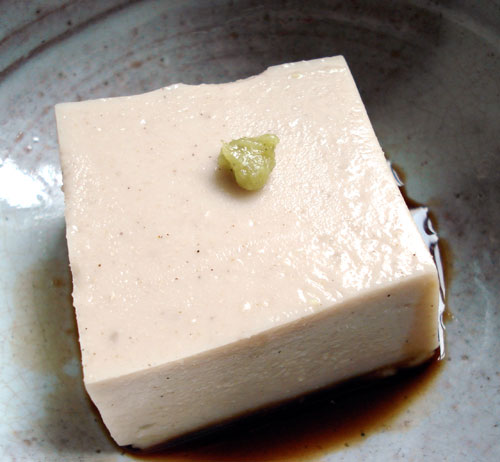
There are some dishes in Japan that look and have a texture like tofu, but are not tofu in the traditional sense; that is, they're not made from coagulated soy milk. One of these not-tofu tofus is _goma dofu_ (ごま豆腐)or sesame tofu. Goma dofu is made from three simple ingredients: ground sesame paste, water, and kuzu or kudzu powder.
Goma dofu, the poster child of shoujin ryouri
Shoujin ryouri (shojin ryori) is the mostly-vegan cuisine that was developed in Buddhist monasteries in Japan, and goma dofu is one of the best known shoujin ryouri dishes. Making it from scratch is hard; kuzu powder is difficult to process from kuzu roots, and the sesame has to be ground for a very, very long time in order for it to become totally smooth. The job of grinding the sesame was assigned to low-level novice monks - the hard work was considered to be good for their character.
But for cooking at home you take two critical shortcuts which make goma dofu a very easy recipe: use readymade kuzu powder, and pre-ground sesame paste. In Japan pre-ground sesame paste is sold as nerigoma, but elsewhere it's tahini is more readily available. Granted, grinding up your own freshly toasted sesame seeds does result in a slightly more fragrant _goma dofu_, but tahini based goma dofu is still very good.
Recipe: Goma dofu - Sesame 'tofu'
An easy to make version of the shoujin ryouri or Zen Buddhist temple cuisine classic, goma dofu is a tofu-like dish made with ground sesame paste and kuzu (kudzu) flour. It's delicious chilled and served with a little wasabi and soy sauce.
Cook time: 20 min :: Total time: 20 min (not including cooling and chilling time)
Yield: 12 to 16 squares
Serving size: 1 square
Ingredients:
- 70g (2.5 oz) tahini or nerigoma ground sesame seed paste, stir well before using
- 50 (1.75oz) kuzu or kudzu powder, available at health food stores and Japanese groceries
- 500ml (2 U.S. cups plus a tablespoon) water, filtered water is preferred, especially if your tap water is heavily chlorinated
Directions:
- Equipment needed: bowl, pan, square container to mold the goma dofu.
- Combine the kuzu powder with a little water to make a smooth paste. Add it with the rest of the water to a small pan and mix well with a whisk or chopsticks.
- Put into a pan over medium heat, and add the tahini or _nerigoma_. Mix continuously, smooshing any lumps of sesame paste and incorporating it as well as possible into the liquid.
- When it heats up it will start to thicken and get a bit lumpy - keep stirring to smooth out the lumps. After a while, it will turn from milky to a bit more translucent in color and have the consistency of a thick pudding.
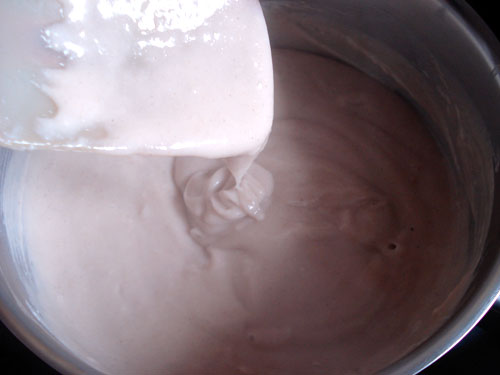
- Wet the inside of the square container you'll use as the mold. Pour in the hot pudding-like mixture and smooth out the top. Bang the container a few times onto a countertop or table to get rid of bubbles.
- Let cool to room temperature, and then put into the refrigerator to cool, about 2 hours.
- Unmold and cut into squares. Serve chilled, with wasabi or grated ginger and soy sauce. (The _goma dofu_ on its own is quite bland, so it does need the sauce.)
- It's really nice as a cold appetizer on a warm day. It can be stored, well covered, in the refrigerator for a couple of days.
If you want to grind your own sesame seeds
Use hulled white sesame seeds, toast lightly in a dry pan, and grind for about an hour or so in a suribachi for about an hour until totally smoooooooth. Character improving, indeed. Strain through a fine sieve before using.
Trivia: the term goma o suru (grind sesame seeds) is a Japanese euphemism for sucking up to (or brownnosing) someone!
Variation with peanut butter
Use smooth unsweetened (and preferably unsalted) peanut butter in place of the sesame paste for a peanut tofu.
A short intro to kuzu powder
If you have a gluten intolerence problem, chances are you have already encountered kuzu or kudzu root powder as a gluten-free thickening agent. It's the starch produced by processing the roots of the kuzu (or kudzu) plant. Here's what it looks like:
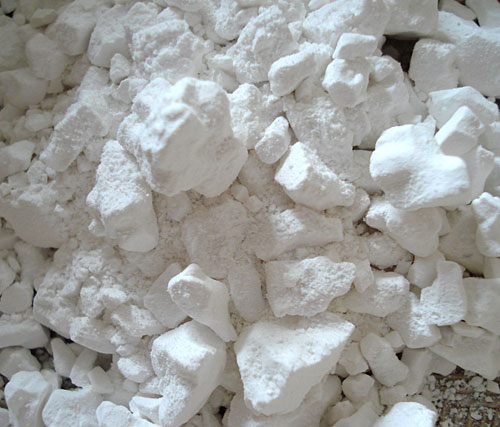
Kuzu is a very good thickener when the dish needs to have a sort of starchy-gelatinous texture and be translucent. It's used in a variety of savory and sweet dishes in Japan. You can buy it at Japanese grocery stores or health food stores. I find that it's usually a bit cheaper at Japanese food stores than at health food stores, but it's still rather expensive since producing it from kuzu roots is a very laborious process.
Read more about kuzu and how it's made on this manufacturer's site.
See also: kuzumochi, "mochi" squares made just from kuzu powder and sugar.
(for search engines)
By Makiko Itoh
Published: May 20, 2008
Type: Japanese, washoku, vegan, shojin ryouri
Submitted by maki on 2008-05-20 18:26.
If you enjoyed this article, please consider becoming my patron via Patreon. ^_^
 Welcome to Just Hungry, where we serve authentic Japanese recipes and more! I'm








Comments
anon.
20 May, 2008 - 19:13
Permalink
been waiting for this!
I've been waiting for this recipe! woohoo! thx :)
Harper
20 May, 2008 - 20:28
Permalink
Can't wait to try this
I've never heard of this but I love tahini and this does sound like a refreshing treat now that it is hot (although we had snow just a few weeks ago, yesterday it was 32 degrees (90 degrees Fahrenheit) so I'm thinking hot-weather food is a necessity). Thanks.
It is still funny to me to think of the kudzu plant being useful since I grew up in the southeastern part of the United States where kudzu vines are out of control.
beanyvondoom
20 February, 2012 - 20:00
Permalink
Re: Can't wait to try this
Why nobody profits off this in the Southern US is beyond me!
CL
21 May, 2008 - 04:34
Permalink
Amazing! This sounds so
Amazing! This sounds so great! Thanks for this post! I miss tofu and all things soy! I recently found out I'm allergic to soy so this might be a great alternative!
AE
21 May, 2008 - 18:36
Permalink
yay!
The first thing I saw in my inbox was this recipe and I had all the ingredients handy, and made it straight away.
It's chilling in the fridge now and I can't wait to eat it!
valentina
22 May, 2008 - 12:42
Permalink
cool! there was a show that
cool! there was a show that did it with walnuts instead of semsame seeds. i think it was with a water:alcohol ratio of 9:1 together with the kuzu and walnuts all blended before it was cooked into a paste and then chilled
Thomas J. Webb
22 May, 2008 - 23:41
Permalink
really??
I've had this stuff at temples and always assumed it to be made from soybeans and goma. Learn something new everyday. One of the strangest things I've ever had was what looked and tasted like a fried egg (but based on the size, rather a quail egg than a chicken egg), but was made out of yuba with a gomadoufu yolk. Weird!
Ginger
23 May, 2008 - 00:22
Permalink
shōjin ryōri ≠ 100% vegan?
Just out of interest, you said shōjin ryōri is "mostly" vegan - I always thought it was 100% vegan? Thanks for the recipe anyway. Got all the ingredients on hand, can't wait to try it!
maki
23 May, 2008 - 06:29
Permalink
I believe honey is allowed,
I believe honey is allowed, which i've been told several times is not vegan :) (and some other things perhaps but I'll hav to double check that) But it is 99% vegan though I'm no expert.
Thomas J. Webb
24 May, 2008 - 05:51
Permalink
Curious
I was always curious why it wasn't deemed 100% vegetarian myself. I actually don't care about honey. In fact, I make my own mead, so I do thoroughly violate the "no honey" rule.
I don't agree with the rationale for deeming honey non-vegan (though it's not up to me, it's up to the vegan society). I'm okay with animal labor because I'm an animal and I work!
marnen
11 June, 2009 - 21:44
Permalink
Re: Curious
[quote=Thomas J. Webb]I don't agree with the rationale for deeming honey non-vegan (though it's not up to me, it's up to the vegan society). I'm okay with animal labor because I'm an animal and I work![/quote]
I had always figured that it wasn't so much a question of animal labor as the fact that the bee's digestive system is involved in turning the nectar into honey, thus making it an animal product on the order of milk. But certainly not everyone would agree, and I've never got the impression that vegans are anything like unanimous on the subject of avoiding honey.
Lyvvie
23 May, 2008 - 19:50
Permalink
This sounds wonderful! I
This sounds wonderful! I want to try it but am having trouble finding kuzu here in the UK. Some sites suggested arrowroot instead - what do you think? Are kuzu and arrowroot similar enough?
maki
24 May, 2008 - 10:45
Permalink
Arrowroot is ok as a
Arrowroot is ok as a substitute when kuzu is called for as a thickening agent for a sauce or something, but not for this recipe when the kuzu accounts for the texture and mouth feel. In the UK you could try one of the Clearspring stockists listed here, or a health food store.
Lyvvie
27 May, 2008 - 18:50
Permalink
I wish I’d read that
I wish I'd read that before I tried it and made a yucky, slimy mess. Thanks for the link - I'll get right on it. Apart from the gelatinous texture, it smelled and tasted rather nice. I mixed it into some breakfast porridge.
anon.
10 June, 2008 - 04:21
Permalink
Sounds like halava/halvah
which is a traditional Jewish dessert. They're basically bricks made from compressed ground-sesame-seed-and-sweetener. Sometimes they're coated with chocolate. Very good, but you can only eat a little wedge at a time.
maki
10 June, 2008 - 15:44
Permalink
this is a lot lighter than
this is a lot lighter than halvah, which is much, much denser (and it's not sweet either)...I like halvah too, but as you say, only in tiny slices!
lisa
9 December, 2008 - 19:01
Permalink
My hero!
I tried this for the first time almost a year ago when I went to Koya-san. Now, I love tofu in every shape and consistency, but when I tried goma dofu I was in heaven! (That and this amazing peanut tofu I was offered at an Okinawan restaurant... drooling just thinking of it!)
This has been bookmarked with an extra big star - can't wait to gather up ingredients to try it at home. :)
clotilde
19 May, 2010 - 13:48
Permalink
Wonderful!
Dear Maki,
Thanks so much for this recipe. I tried it yesterday, all went smoothly, and we really love the results. So rich, so good!
I just want to note, for others who attempt this, that my mixture never turned "a bit more translucent in color." It thickened to the consistency of a thick pudding as you described, but stayed quite milky in color. Don't know if it's my kuzu or if the change was too subtle for me to notice or if I should have stirred longer -- nevertheless, the consistency was perfect when set.
Again, thanks for the simple and fabulous recipe, I'll be making a lot more batches of gomadofu!
Clotilde.
maki
19 May, 2010 - 19:18
Permalink
Re: Wonderful!
Hi Clotilde, I have some step-by-step photos of how the look of kuzu changes as it cooks and cools on the kuzumochi recipe page here. (The kuzu powder I used there is just generic kuzu from my local Reformhaus (health food store))
heidi
7 July, 2010 - 19:28
Permalink
so grateful for a recipe like this!
Last night I tried this recipe; when I unmolded the goma dofu, it sort of collapsed into a beautiful cloud. Delicious, but no tofu-like squares!
Did I perhaps not cook it long enough; or maybe I need to chill it longer than two hours?
Any help appreciated, as this is about to be a huge favorite recipe here! :-)
heidi
30 July, 2010 - 22:55
Permalink
Re: Goma dofu: Sesame tofu that's not tofu
Got it! Stirred for 15 minutes and left in fridge for 4 hours -- perfect! Beautiful subtle flavor, used it along with cold soba servings, also in miso soup it kept its shape and tasted wonderful! :-)
Karen from Deli...
3 November, 2010 - 01:56
Permalink
Re: Goma dofu: Sesame tofu that's not tofu
This looks like an amazing recipe. So unique, I can't wait to try it.
I have used sesame paste so many ways but never like this!
Quick question, any tips for taking food photos in my kitchen while I am cooking which does not have a lot of natural light. My pics of food on my front porch look great but I want some prep and cooking pics too that look good too.
I am new to blogging and photography. your food pics always look so good.
Thanks,
Karen
Claudine
28 April, 2011 - 20:04
Permalink
Re: Goma dofu: Sesame tofu that's not tofu
Hello there,
I'm a long-time follower, first time commenter. I want to thank you for all the beautiful, well-documented and outlined recipes and blogposts over the years. We followed your goma-dofu recipe the other day (fell in love w/ it in Japan) and it came out marvelously.
Thanks so much again!
--Claudine (San Francisco)
nicole b.
7 September, 2011 - 23:57
Permalink
what does it taste like?
hi guys,
just wondering what this stuff tastes like!? anyone think they can describe it. i like tofu in so much as its vegan and full of protein. in a sauce its ok. can i use this to make scrambled tofu, or as protein in noodles?
thanks!
Paula
8 August, 2012 - 14:15
Permalink
Re: Goma dofu: Sesame tofu that's not tofu
Hi,
Do you know if Kudzu Starch can be substituted with potato starch?
If yes, can I use same quantity or should I use more.
Thank you in advance for advising about it.
Jessica
15 August, 2012 - 23:40
Permalink
Re: Goma dofu: Sesame tofu that's not tofu
I took a class that showed how to make this and also found some pre made at a local Japanese store. My question is how do you cook it or do you just eat it raw? I tried it cut into cubes in a pan with some oil and soy sauce. It did taste pretty yummie (very soft), but I'm wondering if there are some good recipes on what to use this in? Thanks and have always loved your blog. As a vegan this is a great recipe for me. =)
Natacha
21 February, 2013 - 13:07
Permalink
Re: Goma dofu: Sesame tofu that's not tofu
Thank you so much for sharing this recipe !!
I just came back from Japan where I ate this (or at least something very similar) in a soba restaurant and I was getting frustrated because I couldn't find any information about this tofu I was served.
I didn't know its name, the waitress just told me "this tofu goes with this sauce". And it was so delicious.
The texture was so different from the tofu I usually eat and the taste was different too (a bit like chestnut but very subtle). And I liked it so much (whereas I don't like eating tofu much) and then and then I finally came upon your recipe and explaination and I can't thank you enough !
Now to find the right ingredients.
Thanks again !
Rafe
16 June, 2013 - 09:33
Permalink
Re: Goma dofu: Sesame tofu that's not tofu
I've made goma dofu by an old recipe, pulverising raw sesame seeds with water in a blender, straining it, and cooking it up with katakuriko (potato starch). It works fantastically, and is very nice warmed with ankake sauce and wasabi.
I'll try your version next!
Ashley
18 April, 2014 - 04:00
Permalink
Re: Goma dofu: Sesame tofu that's not tofu
YES!!! Thank you oh THANK YOU! Gomadoufu was my very favorite food when I lived in Japan. Now that I'm in the US I miss it dearly. I never knew it was so easy. Thank you!!!!!
Bett
28 August, 2015 - 05:16
Permalink
Wow! This recipe is so exciting!