meat

Real beef

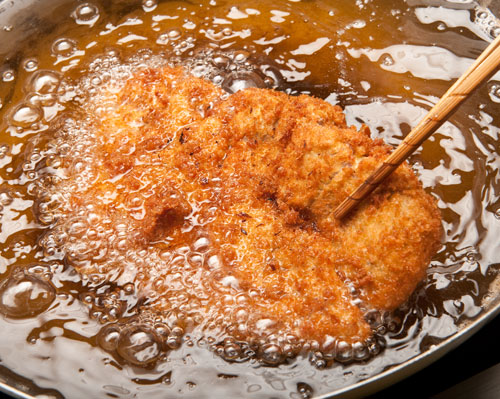
Some real meat this time. continue reading...

filed under

Layered Cabbage Casserole - Kyabetsu no Kasaneni (an everyday favorite)

layeredcabbage2.jpg

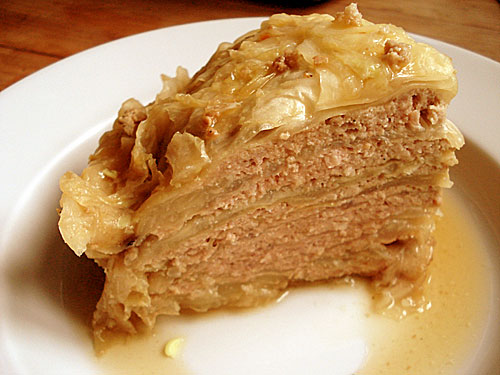
Some dishes dazzle you with their prettiness. Others may look plain, but are just plainly delicious. This simple, filling yet healthy winter dish of cabbage layered with a meat and tofu stuffing and then poached in a flavorful liquid belongs to the latter group. continue reading...

filed under

The role of alcohol, onion and ginger in Japanese meat dishes

Periodically, someone asks a question about subsituting or leaving out sake or mirin from a dish (most recently to the chicken karaage recipe). This reminds me of how certain ways of thinking exist in Japanese and East Asian cooking, that may not necessarily exist in Western cooking. One of those is the perception of the flavor of meat. continue reading...

filed under

Meat and the environment

Today is Green Day, and we’re being bombarded with Green Day Sales, reminders as to how Green this company or the other is, and so on. It’s a big topic nowadays.

I feel that the things that we can do as individuals is getting increasingly muddy. For a while it seemed like biofuels were a solution, but now the huge demand for plant-based fuels may be causing serious food shortages. Food miles and locavorism may not be as clear cut a solution either. Michael Pollan says we should start growing our own vegetables, but that’s not possible for a lot of people, for space or time reasons.

Is there something relatively easy we can do? Sort of. continue reading...

filed under

Menchikatsu

menchikatsu1_500.jpg

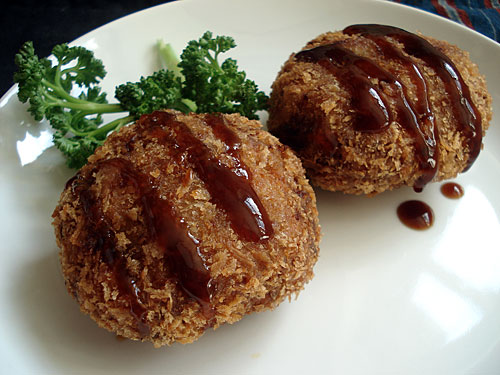
While I make Japanese style hamburgers all the time, I rarely make menchikatsu, its breaded and deep-fried cousin. I guess it’s the breading and deep frying that deters me - it’s a messy process, and I’m not sure it’s worth the effort. So I made these ones for the blog! Fortunately they were consumed very eagerly. continue reading...

filed under

Hambaagu or hambaagaa: Japanese hamburgers

hambaagaa1_500.jpg

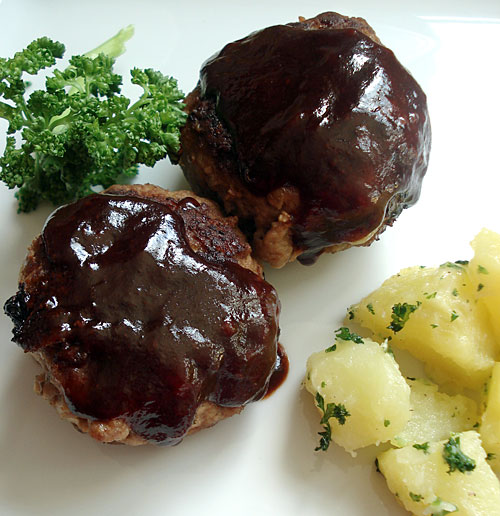
As promised, here is my recipe for making Japanese style hamburgers or hamburger steaks, one of the quintessential yohshoku or Japanese Western-style dishes. They are called hanbaagaa or hanbaagu in Japan, and are very popular for lunch or dinner, and are eaten as a side dish to rice (okazu) in Japanese homes. In fancier restaurants that specialize in yohshoku, they might be eaten with a knife and fork, but at home they’re eaten with chopsticks. Whenever Japanese food magazines have a poll about popular okazu, hamburgers are always in the top three, especially amongst kids.

They don’t have much in common with the American style of hamburger, except for the fact that they both start off with ground meat. A Japanese hamburger has more in common with meatloaf, and a rather similar texture. They are similar to the old TV dinner standby, Salisbury steak, but I think a lot better. continue reading...

filed under

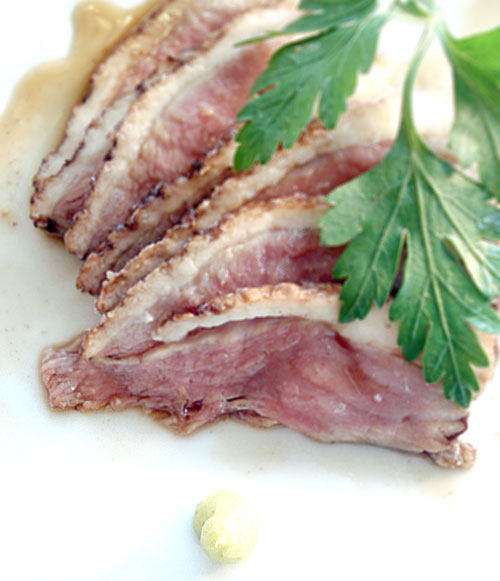
Japanese pan-roasted and marinated duck breast (Kamo ro-su)

kamorosu1.jpg

I had to make this beautifully easy duck breast dish three times over within a span of two weeks. The first two attempts disppeared before I could take a photo. continue reading...

filed under

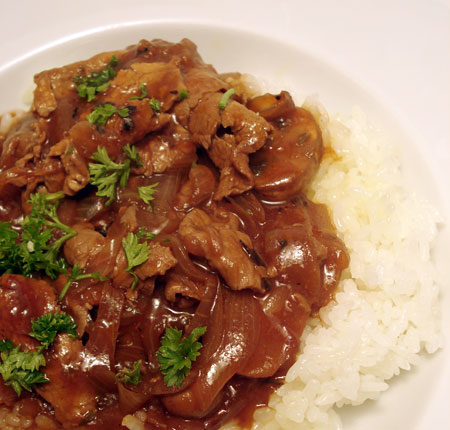
Hayashi raisu (rice): Japanese beef stew

hayashi_raisu2.jpg

Hayashi raisu or hayashi rice is a Japanese version of a rich beef stew. It’s a classic yohshoku (Japanese-adapted Western food) dish. continue reading...

filed under

Buta no kakuni: Japanese Braised Pork Belly

buta_kakuni1.jpg

Today is my mother’s birthday. In her honor, here is one of the few meat dishes that she still allows in her diet: braised pork belly, or buta no kakuni. It’s amazing that she will still eat this, because basically pork belly is bacon without the smoke or salt cure. And in buta no kakuni the bacon, I mean belly, comes in big chunks of layers of meat and unctuous pork fat.

Pork belly recipes exist in other cuisines, especially around northern Europe, but I can’t really stand most of them, even if people in Germany and Britain rave about roasted pork belly with crackling. (The crackling part is ok, but the meat part…I don’t know.) I like fat in moderation as much as anyone, but that amount of gelatinous pork fat is rather hard to bear. That is unless it’s been slowly braised in a salty-sweet liquid for hours and hours, until both the fat and the meat melt in your mouth.

Very similar recipes exist in Chinese (from Peking-style especially) cuisine, and a great Okinawa speciality is rafute. This is a bit like rafute but has a bit more spice and things in it, so it’s closer to the Peking style I think. Either way it’s a great treat once in a great while. It’s definitely a cold weather dish. continue reading...

filed under

There and Back Again: My Perfect Spaghetti Bolognese

bolognese-1.jpg

I love pasta in many guises, but when it comes to ultimate Comfort Pasta, there is nothing that compares to a spaghetti bolognese. By spaghetti bolognese, I mean spaghetti topped with a rich, ground-meat and tomato based sauce. No fancy ragu or such. I don’t think it’s that authentically Italian, but I don’t really care. It’s one of my favorite cool-weather dinners.

Once upon a time, I had what I thought was a perfect recipe for spaghetti bolognese. Then, about a year ago I lost my way. After a year of bewilderingly off-target bolognese, I’ve found my way back.

I blame Heston Blumenthal for messing with my head. (Disclaimer: I am otherwise a big fan of Mr. Blumenthal.) Last year, he tackled spaghetti bolognese on his In Search of Perfection television series (and in the book of course), and came up with a “perfect” version. The perfect Blumenthal version of spaghetti bolognese is, naturally, extremely complicated, but compared to the other “perfect” versions of various popular dishes it seemed to be the most doable. So, we (note the plural: it required a team effort) tackled it, piece by piece. It does help in life to have an almost equally food-obsessive partner for such quests.

It took us 3 full days to accomplish, starting from the pre-ordering of the meaty oxtails at the butcher counter (it’s not a commonly used cut here), finding the perfect spaghetti, ripe tomatoes in December (yes, I know) and the final slow cooking of the sauce. And the result?

It was good, yes, but perfect? Neither of us was sure. But yet it had flashes of something great in there; the meatiness of the gelatinous oxtail, the unctuous richness. So, we embarked on a long journey of trying to tweak that recipe. We tried different meat combinations. (Turkey is a definite no.) We experimented with bacon, chorizo, various sausages, salami. We tried less or more of the vegetables, canned tomatoes alone or fresh alone.

All were interesting, but I still felt off kilter. Then, the other day I made bolognese more or the way I had made it for years until the Blumenthal experiments - and, it was just about perfect.

Mind you, it’s probably because my criteria for a perfect bolognese are different from the great chef’s, as I explain below. And some of the ideas gleaned from the Blumenthal version and the ensuing experiments did creep in, making the sauce even better. In any case, I’m now happy that this is my Perfect Spaghetti Bolognese. I can now move on to perfecting other things. continue reading...

filed under

Related sites

wfp banner img
freerice234_60_Banner2.jpg

Hello!

Just Hungry is a site about Japanese food and home cooking, healthy eating, the expat food life, and more. [log in] or [register]

About this site

maki Just Hungry is a site about food. There are lots of recipes and much more. You may want to take the grand tour, read about Just Hungry, or contact the site owner, Makiko Itoh. To dive in real deep, try the site map.

Sharing!

  • tech-fav-1.gif
This article is from justhungry.com.